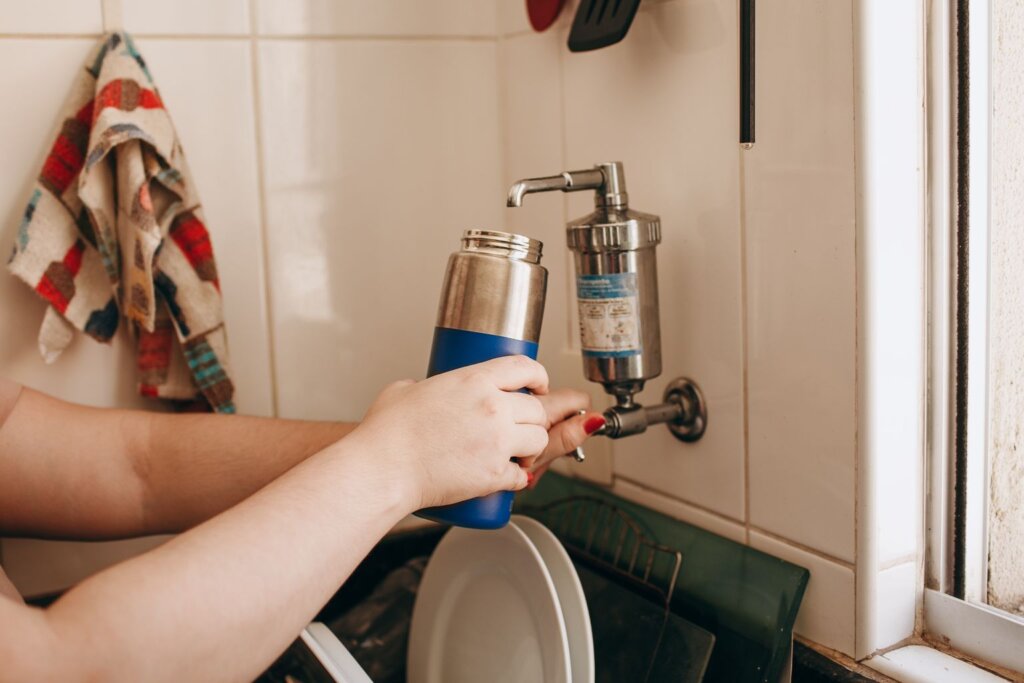
Refrigerator water slow after filter change? The new filter is usually not seated all the way, air is trapped in the system, or the new filter itself is restricting flow. Whirlpool says an improperly installed filter can reduce or stop water flow and cause leaks, and its test is simple: take the filter out and try the dispenser. GE’s version uses the bypass plug. If the water runs faster without the filter, the filter or its fit is the problem. If it is still slow, look at the water pressure and the supply line.
Below are the checks in the order we would do them, with the makers’ own numbers.
Refrigerator water slow after filter change: what causes it?
| Cause | How to tell | Fix |
|---|---|---|
| Filter not locked in | Water runs faster with the filter removed | Refit until it locks |
| Air in the filter and lines | Sputtering, then slowly improving | Flush for 2 to 3 minutes or more |
| Wrong or faulty filter | Flow better with the bypass plug or no filter | Check the part number; try another filter |
| Low house water pressure | Slow even without the filter | Check pressure: 30 to 120 psi for Whirlpool |
| Kinked or blocked supply line | Slow even without the filter, pressure fine | Check the line and shutoff valve |
| Reverse osmosis feeding the fridge | Slow since the RO was added | Ask your RO maker about pressure |
Is the new filter installed correctly?
This is the first thing to check. Whirlpool’s help page on water dispensing slowly says an improperly installed filter can reduce or stop water flow, cut ice production or cause leaks from the housing. Its test: remove the filter from the housing and try to dispense water. If water dispenses, the filter was not installed correctly; reinstall it and make sure it locks in place.
On twist-in filters, turn until it stops, without forcing it past the stop. On Samsung models, the lock symbol on the filter should line up with the indicator mark. On push-in filters, push until it clicks into place.
Is there air in the line?
A new filter is full of air, and that air has to work its way out. GE says to hold the dispenser cradle down for 2 to 3 minutes so the reservoir fills completely, and to hold it again for 2 to 3 minutes to purge trapped air if water dribbles after use. GE’s filter instructions call for 3 minutes, about 1.5 gallons, after a new filter, and Whirlpool’s say 4 gallons. If you only ran a glass or two, keep going.
Is the filter clogged or the wrong one?
GE’s test for a clogged filter: remove it and install the bypass plug, then try the dispenser. If the flow improves, the filter is the problem. GE adds that new construction nearby can send more sediment into the water lines, which can clog a fridge filter faster than its 6 month rating.
A new filter can also be the problem: a filter with the wrong fit for your fridge, or a generic one that restricts flow more than the original. Check that the part number matches your manual. If you have another filter, try it.
Is the water pressure too low?
If the water is slow even with the filter out, the filter is not the cause. Whirlpool says water pressure should be between 30 and 120 psi, and that low pressure can slow the dispenser and cause small or hollow ice cubes or slow ice production. Some newer Whirlpool models list 35 psi as the low end, so check your manual.
Test the house pressure with a gauge on an outdoor faucet or laundry tap. If it is low everywhere, see our guide to low water pressure. Whirlpool also notes that connecting a fridge to a reverse osmosis system can work, but RO systems can reduce water pressure further; see our guide to a reverse osmosis tank not filling if yours feeds the fridge.
What we would buy for this job
- SENCTRL 0 to 200 psi water pressure gauge, 3/4 inch hose thread: screws onto an outdoor faucet or laundry tap to check house pressure against your fridge range, such as the 30 to 120 psi Whirlpool gives. The red max pointer records spikes, by the listing. $13.99 when we checked.
As an Amazon Associate, Complete Water Guide earns from qualifying purchases. Prices change, so check the listing.
Is the supply line blocked or the valve partly closed?
Pull the fridge out and look at the line behind it. A kinked plastic line, a partly closed shutoff valve or a clogged saddle valve all slow the flow. If you closed the shutoff to change the filter, make sure it is fully open again. Our guide to cleaning the water line in a fridge covers flushing it.
How do you speed up a slow fridge water dispenser?
- Reseat the filter until it locks.
- Flush for 2 to 3 minutes, or your maker’s figure, to clear air.
- Test without the filter or with the bypass plug. Faster means a filter problem.
- Check the part number and try another filter if you have one.
- Check house pressure against your fridge’s range.
- Check the supply line and shutoff valve behind the fridge.
If none of these help, the water valve or a frozen line inside the door may be at fault, which is a service call. Our guides on how to change a refrigerator water filter and how often to change it cover the filter side.
Frequently asked questions
Why is my refrigerator water dispenser slow after a filter change?
Usually the new filter is not fully seated, air is trapped in the lines, or the filter restricts flow. Whirlpool’s test is to remove the filter and try the dispenser; if water flows, reinstall the filter properly.
How long should I run water after changing the fridge filter?
GE says 3 minutes, about 1.5 gallons, and Whirlpool says 4 gallons. GE also says holding the dispenser for 2 to 3 minutes fills the reservoir and purges trapped air.
How do I know if my fridge filter is clogged?
GE says to remove the filter and fit the bypass plug, then try the dispenser. If the flow improves, the filter is clogged and needs replacing.
What water pressure does a refrigerator need?
Whirlpool says between 30 and 120 psi. Some newer Whirlpool models list 35 psi as the minimum. Low pressure slows the dispenser and the ice maker.
Can a reverse osmosis system slow my fridge dispenser?
Yes. Whirlpool says connecting a fridge to an RO system can work, but RO can reduce the water pressure further.
Why does my fridge dispenser dribble after I use it?
GE says a few drops are normal because of a delay in the water system. Trapped air can make it worse; hold the dispenser down for 2 to 3 minutes to purge it.
Sources
- Whirlpool product help, Water Dispensing Slowly: improperly installed filter reduces or stops flow; remove the filter and test; RO can reduce pressure; filter every 6 months.
- Whirlpool product help, Ensuring Correct Water Pressure: 30 to 120 psi; low pressure slows dispensing and ice.
- Whirlpool dimension guide W11799034: 35 to 120 psi for some newer models.
- GE Appliances support, Slow Water Flow or Dribble from Dispenser: hold the cradle 2 to 3 minutes, bypass plug test, new construction sediment, dribble is normal.
- GE Appliances support, How to Change the Water Filter: 3 minutes or about 1.5 gallons flush. Whirlpool: 4 gallon flush. Samsung: lock symbol alignment.