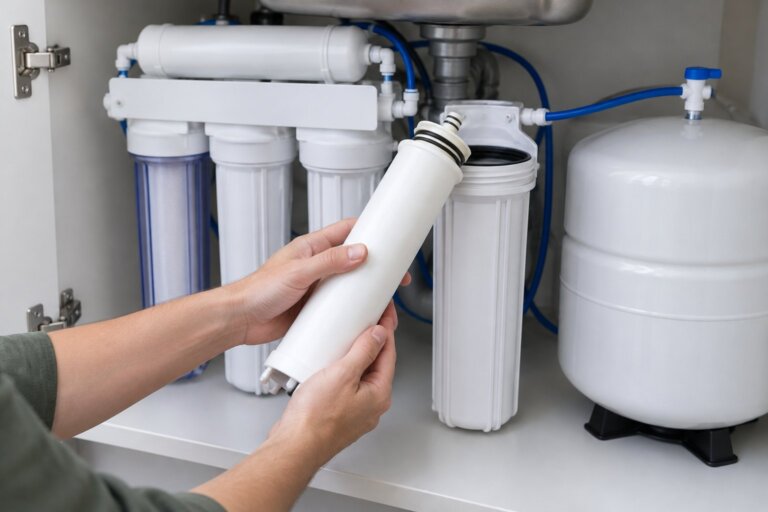
Reverse osmosis tank not filling? Check five things in this order: the tank valve is open, the feed water pressure is at least 40 psi, the pre-filters are not clogged, the tank’s air charge is right when it is empty, and the membrane is not worn out. Whirlpool’s support team says pressure below 40 psi hinders an RO system, and that pre and post filters should be changed within 6 months and the membrane every 2 to 3 years. APEC’s manual adds that low feed pressure alone can stop a tank from filling all the way.
Below we go through each cause with the numbers from the makers’ manuals, and the tests that tell you which one you have.
How long should an RO tank take to fill?
A few hours, not minutes. APEC’s ROES series manual says its tank normally takes 2 to 3 hours to fill, after which the system shuts off automatically. A membrane makes water slowly, which is why the system stores it in a tank. If you drained the tank an hour ago, it may simply not be finished. While it fills, the system also sends reject water to the drain; the EPA says a typical point-of-use RO system sends five gallons or more down the drain for every gallon of treated water.
How full it gets depends on your water pressure. APEC gives these figures for its non-pumped systems:
| Feed water pressure | 4 gallon tank fills to | 14 gallon tank fills to |
|---|---|---|
| 70 psi or more | 3.1 gallons | 9.7 gallons |
| 60 psi | 2.8 gallons | 9.0 gallons |
| 50 psi | 2.5 gallons | 7.8 gallons |
| 40 psi | 1.9 gallons | 6.1 gallons |
So a “4 gallon” tank never holds 4 gallons of water. The name is the tank’s total size, air space included. At 40 psi you get about 1.9 gallons, which can feel like the tank is not filling when it is working as designed.
Why is my reverse osmosis tank not filling?
1. The tank valve is closed
The small ball valve on top of the tank has to be open. APEC’s manual says the valve is on when the handle is parallel with the valve’s outlet. It is easy to knock closed while working under the sink.
2. Feed water pressure is too low
Whirlpool’s RO tank troubleshooting page says incoming water pressure must be at least 40 psi. Below that the tank fills slowly and only partly, as APEC’s table shows. A well system set to a low pressure range, or a partly closed feed valve, can cause it. Check the house pressure with a gauge on an outdoor faucet. If the whole house is weak, see our guide to low water pressure. If pressure is low and cannot be raised, an RO booster pump is the option to ask your maker about.
3. Clogged pre-filters
The sediment and carbon pre-filters clog over time, especially on well water, and starve the membrane. Whirlpool’s test: remove the pre-filter, press the stem in the empty housing and look for a spray of water. Then reinstall it and test the next stage. No spray after a clogged filter means that filter needs replacing.
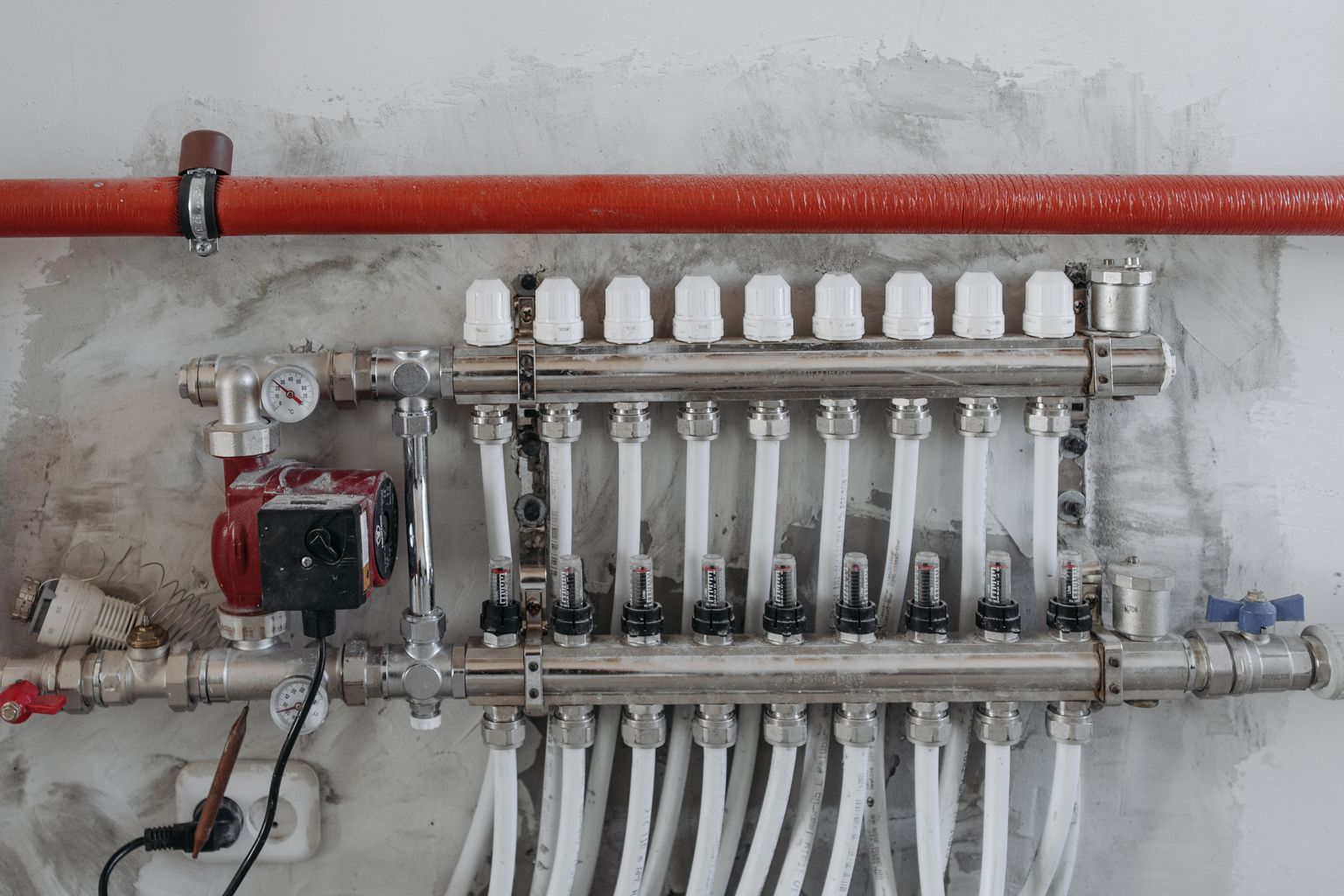
4. The tank’s air charge is wrong
An RO tank has an air bladder that pushes water out. If the air pressure is wrong, the tank holds little water. APEC says its 4 gallon tank comes pre-charged at 5 psi and its 14 gallon tank at 7 psi, measured when the tank is empty. Too much air means the tank fills less; a tank with no air at all delivers almost nothing at the faucet.
To check it, close the feed water, open the RO faucet until the tank stops flowing, then put a low pressure gauge on the air valve on the side or bottom of the tank. Add air with a bicycle pump if it is low, or let some out if it is high, until you reach your maker’s figure. Whirlpool has its own “repressurizing the storage tank” steps for its models.
5. A worn or fouled membrane
Whirlpool’s third test: drain the tank, disconnect the tube from the tank to the system, put its end in a bowl and watch for a few minutes for a steady drip or stream. No steady production means the membrane or the flow restrictor is the problem. Whirlpool recommends replacing the membrane every 2 to 3 years. Our RO membrane replacement guide covers how.
6. The automatic shut-off or check valve
APEC’s diagram shows an automatic shut-off valve and a check valve on its systems. If the shut-off valve sticks closed, no water reaches the tank; if the check valve fails, the system may run to drain without filling the tank. These parts are cheap, but follow your manual or call the maker once the simpler checks pass.
What we would buy for this job
- Low pressure pencil gauge, 1 to 20 psi, 2 pack: a normal tire gauge starts too high to read an RO tank. This one reads 1 to 20 psi, which covers the 5 to 7 psi pre-charge APEC gives for its tanks. $6.89 when we checked.
As an Amazon Associate, Complete Water Guide earns from qualifying purchases. Prices change, so check the listing.
How do you fix an RO tank that is not filling, step by step?
- Check the tank valve is open.
- Check the house water pressure. You want at least 40 psi at the RO, and more fills the tank further.
- Check the filter dates. Replace pre and post filters older than 6 months, as Whirlpool advises, and a membrane older than 2 to 3 years.
- Drain the tank and check its air charge with a low pressure gauge. Adjust to your maker’s figure.
- Let it refill for 2 to 3 hours without using the RO faucet.
- If it still will not fill, run Whirlpool’s flow tests to find which stage stops the water, or contact the maker.
Why does my RO faucet only trickle?
Usually because the tank is empty or nearly empty, or its air charge is low. APEC’s figures show the tank’s delivery pressure falls as it empties: on its 4 gallon tank, 50 psi at 3 gallons, 24 psi at 2 gallons and 10 psi at half a gallon. A tank that barely fills therefore also delivers weakly. A sputtering faucet right after a filter change is often air working out of the lines and clears after a tank or two.
If you also use a softener, check that hard water is not fouling the membrane. Our comparison of water softener vs reverse osmosis covers why dealers often put a softener ahead of RO.
Frequently asked questions
Why won’t my reverse osmosis tank fill up?
The usual causes are a closed tank valve, feed pressure below 40 psi, clogged pre-filters, the wrong air charge in the tank, or a worn membrane. Check them in that order.
What should the pressure be in an empty RO tank?
Follow your maker’s figure. APEC pre-charges its 4 gallon tank to 5 psi and its 14 gallon tank to 7 psi, measured with the tank empty of water.
How long does it take for an RO tank to fill?
APEC says about 2 to 3 hours. Low water pressure or old filters make it slower.
How much water should a 4 gallon RO tank hold?
Less than 4 gallons. APEC’s figures show about 3.1 gallons at 70 psi or more and about 1.9 gallons at 40 psi.
Can low water pressure stop an RO tank from filling?
Yes. Whirlpool says incoming pressure should be at least 40 psi, and APEC’s figures show the tank fills less as feed pressure drops.
How often should RO filters be changed?
Whirlpool recommends pre and post filters every 6 months and the membrane every 2 to 3 years. Your system’s manual and your water quality may change that.
Sources
- APEC Water, ROES series installation and user manual: 2 to 3 hour fill, tank fill by feed pressure, 5 and 7 psi pre-charge, delivery pressure by tank volume, tank valve position, automatic shut-off and check valve.
- US EPA WaterSense, Point-of-Use Reverse Osmosis Systems: five gallons or more of reject water per gallon treated.
- Whirlpool Water Solutions support, Reverse Osmosis Tank Not Filling (updated December 10, 2025): 40 psi minimum, filter and membrane intervals, flow tests, repressurizing the tank.