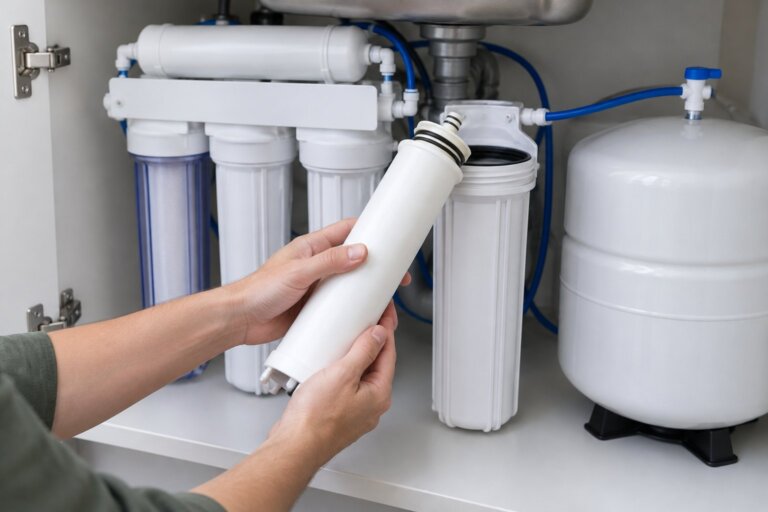
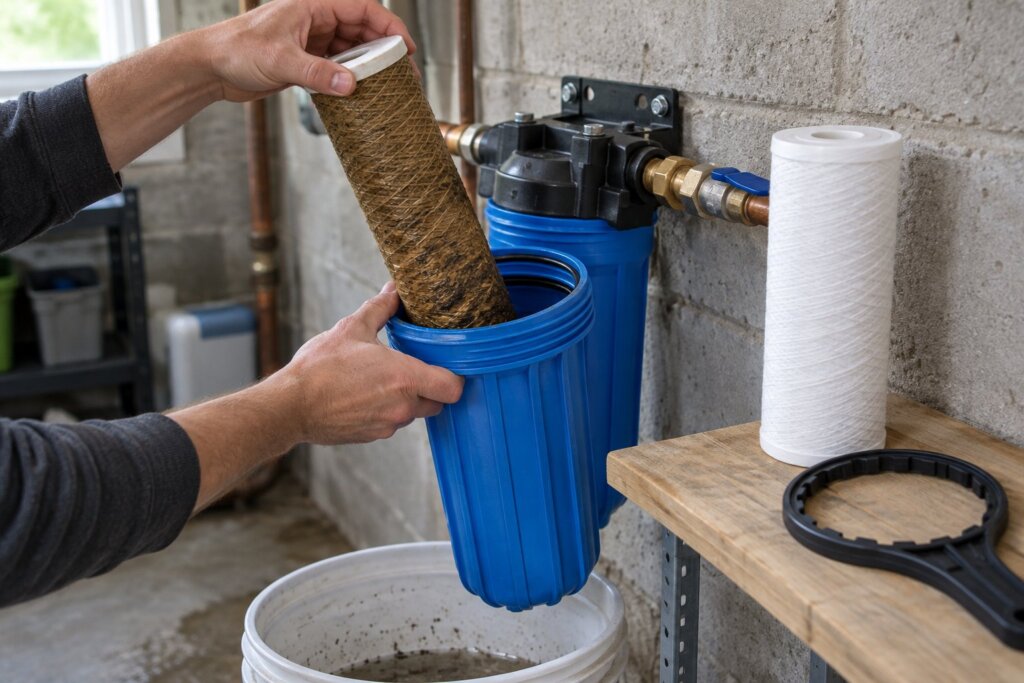
Whole house filter cartridge replacement is due when your water pressure drops, the taste or smell comes back, or the maker’s time limit runs out, which ranges from every 2 months to once a year depending on the cartridge. The swap itself takes a few minutes: shut off the water, release the pressure, unscrew the housing, change the cartridge, grease the O-ring and flush. The two steps people skip are the O-ring and the flush, and those cause most of the leaks and dirty water afterward.
We read the manuals for whole house systems from GE, Culligan, 3M, Aquasana, iSpring, DuPont, Home Master and Express Water, plus Pentek’s housing specifications. Below are each maker’s intervals, the steps they agree on, and where they disagree.
How often should you replace a whole house filter cartridge?
It depends on the cartridge, and the makers list very different numbers:
| System or cartridge | Maker’s interval |
|---|---|
| GE FXUSC sediment | 3 months or 16,000 gallons |
| GE FXWTC carbon | 3 months or 15,000 gallons |
| Culligan R50-BBSA (50 micron) | 6 months or 24,000 gallons |
| Culligan CP5-BBS (5 micron) | 3 months or 12,000 gallons |
| Culligan RFC-BBS | 3 months or 5,000 gallons |
| 3M Aqua-Pure AP902/AP903 | Every 12 months, at rated capacity, or when flow drops |
| Aquasana Rhino pre-filter | Every 2 months (the main tank: 10 years or 1,000,000 gallons) |
| iSpring whole house | Every 6 to 12 months, or 100,000 gallons per 1 ppm of iron |
| Express Water | About 6 months or up to 100,000 gallons |
Treat these as the outer limit. Culligan and DuPont both say, “Changes in taste, odor, and/or flow of the water being filtered indicate that the cartridge should be replaced,” and GE says to change it “when the water flow is noticeably reduced or at least every 3 months.” Well water with sediment or iron uses cartridges up much faster; if yours is turning orange quickly, our guide on yellow and iron-colored well water explains why.
If you have pressure gauges on each side of the housing, they take the guessing out. Express Water says, “Once your pressure has dropped 10-20 PSI from your initial pressure we suggest replacing your filters.” iSpring suggests installing “a shutoff valve and/or a pressure gauge immediately on either side of the filter.” Our list of signs a water filter needs replacing covers the rest.
Whole house filter cartridge replacement, step by step
- Turn off the water to the filter. GE says to “rotate control handle to the BYPASS or OFF position.” On most systems there is a valve before the housing.
- Release the pressure. GE says, “Press the red pressure-release button to release pressure.” No button? iSpring says to “leave open a nearby faucet.”
- Put a bucket under it. DuPont says to “use a pan or bucket to catch any water in the Filter Housing.”
- Unscrew the housing. iSpring says to use “the filter wrench included with your system, or a commercially available ‘strap’ type wrench.”
- Remove the old cartridge and clean the housing. GE says, “Wash the filter canister with mild soap and water. Do not use harsh cleaners or hot water.” Some makers add a bleach rinse; see the next section.
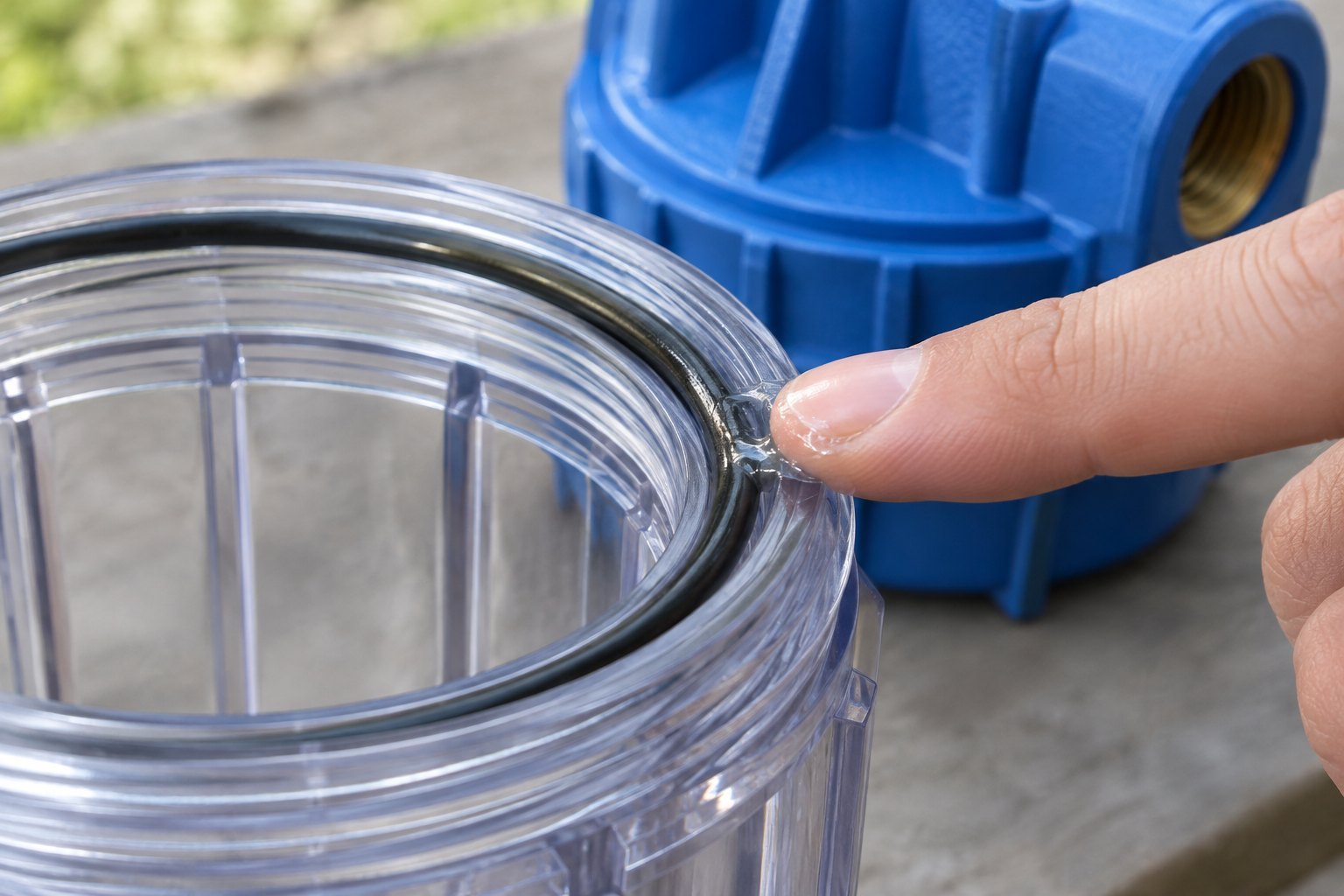
- Check and grease the O-ring. GE says to make sure it is “lightly lubricated with clean food-grade silicone grease” and to replace it if it is damaged. iSpring says, “DO NOT USE PETROLEUM JELLY,” and to make sure “the o-ring is seated level.”
- Insert the new cartridge. GE says to make sure “it is centered and completely seated on the bottom seal.” On Culligan housings, it goes “over standpipe in bottom of housing.”
- Screw the housing back on, gently. Culligan says to “hand-tighten. DO NOT OVER-TIGHTEN.” DuPont allows a wrench for “1/4 turn” after hand-tightening, and Aquasana says you “should only need to use the wrench for ⅛ to ¼ of a turn.”
- Turn the water on slowly and bleed the air. Culligan says to “turn on water supply slowly,” then “depress red pressure-relief button to release trapped air. Check for leaks.”
- Flush. Run water through the system for the time your maker gives in the table below.
One exception: 3M’s AP900 systems use a quick-change head with no wrench. Its manual says to slide the locking latch, lift, and “twist out filter cartridge by turning unit 90° to the left.”
Should you sanitize the housing with bleach?
Several makers say yes, and one says no, so follow your own manual:
- Culligan and DuPont: fill the empty housing about 1/3 full of water, add about 2 tablespoons of bleach, scrub, then “rinse the Filter Housing thoroughly to remove bleach” (DuPont).
- iSpring: scrub “with warm water mixed with about 2 tablespoons of household bleach,” wear rubber gloves, and “rinse all parts very thoroughly!”
- Express Water: a gentler mix, “one gallon of warm water mixed with 1 tablespoon of household bleach,” once a year, with a warning: “Do not add bleach directly to any part of the system.”
- GE: mild soap and water only, and “do not use harsh cleaners.”
Our view: on well water or if the old cartridge smelled musty, we would do the bleach scrub and rinse it out completely. On city water with a clean-looking housing, soap and water is enough.
How long should you flush a new whole house filter?
| Maker | Flush after a cartridge change |
|---|---|
| GE | 30 minutes (GXWH20S) or 15 minutes (GXWH04F) |
| Culligan HD-950 | 10 minutes, wait one hour, then 10 minutes more |
| DuPont | 40 minutes |
| 3M AP902/AP903 | 15 minutes |
| Express Water | Until clear plus 5 minutes, wait 30 minutes, then 10 minutes more |
| Aquasana (replacement filters) | 5 minutes |
Black or cloudy water at first is normal with carbon cartridges. Aquasana says, “The first few gallons will appear black and cloudy due to carbon fines.” Express Water says the cloudiness “may persist for anywhere between 1 day to 1 week,” and that “the air bubbles are harmless.” iSpring says cloudy water “for a day or so” is “tiny air bubbles being purged from the carbon.” We flush from a tub spout or outdoor faucet so the carbon does not go through a faucet aerator.
What we would buy for this job
- Heavy duty Big Blue filter housing wrench: for 4.5 inch Big Blue style housings. Housing sizes vary between makers, so measure yours against the listing first.
- Captain O-Ring NSF H1 food-grade silicone grease: the kind of lubricant GE and Culligan specify for the housing O-ring. Never petroleum jelly.
As an Amazon Associate, Complete Water Guide earns from qualifying purchases. Prices change, so check the listing.
Why is my filter housing leaking after changing the cartridge?
Almost always the O-ring. Culligan says, “It is important that the O-ring be properly seated in the groove above the threads of the housing or a water leak could occur.” Its fix: “Clean and lubricate O-ring with silicone grease. Also, clean the groove… Do not overtighten.” iSpring says, “If a leak is found, first remove the housing and inspect the o-ring to ensure that it is seated properly. Then retighten.”
Home Master is the most emphatic about grease: “Be sure to use liberal amounts of grease on the lower oring… Failure to do so will cause binding, oring damage, leaks, and difficulties reopening the housing.” It also says, “You may need to change them each time you open the housing.”
Housings wear out too. Culligan says, “we strongly recommend that the bottom of all plastic housings be replaced every ten years,” and Home Master says to replace the cap and sump “upon signs of stress or every 5 years.” A cracked or crazed housing under constant pressure is not worth the risk.
What size whole house filter cartridge do you need?
There are two common diameters. Pentek’s Big Blue housings “accept a wide variety of 4-1/2″ diameter cartridges” in 10 or 20 inch lengths, while its standard housings take “2-1/2″ to 2-7/8″ diameter cartridges,” also in 10 or 20 inches. The easiest way to get it right is to read the label on the old cartridge before you throw it away.
Micron rating matters too. Culligan’s sediment cartridges come in 50, 25 and 5 micron ratings, and its manual notes that “the human hair has a diameter of approximately 70 microns.” Lower numbers catch finer particles but clog faster. If you have more than one stage, sediment always comes first: Home Master says, “The SEDIMENT filter treats the water first. The CARBON filter treats the water last.” Our guide to whole house sediment filters explains how to pick a micron rating.
Does certification matter for a replacement cartridge?
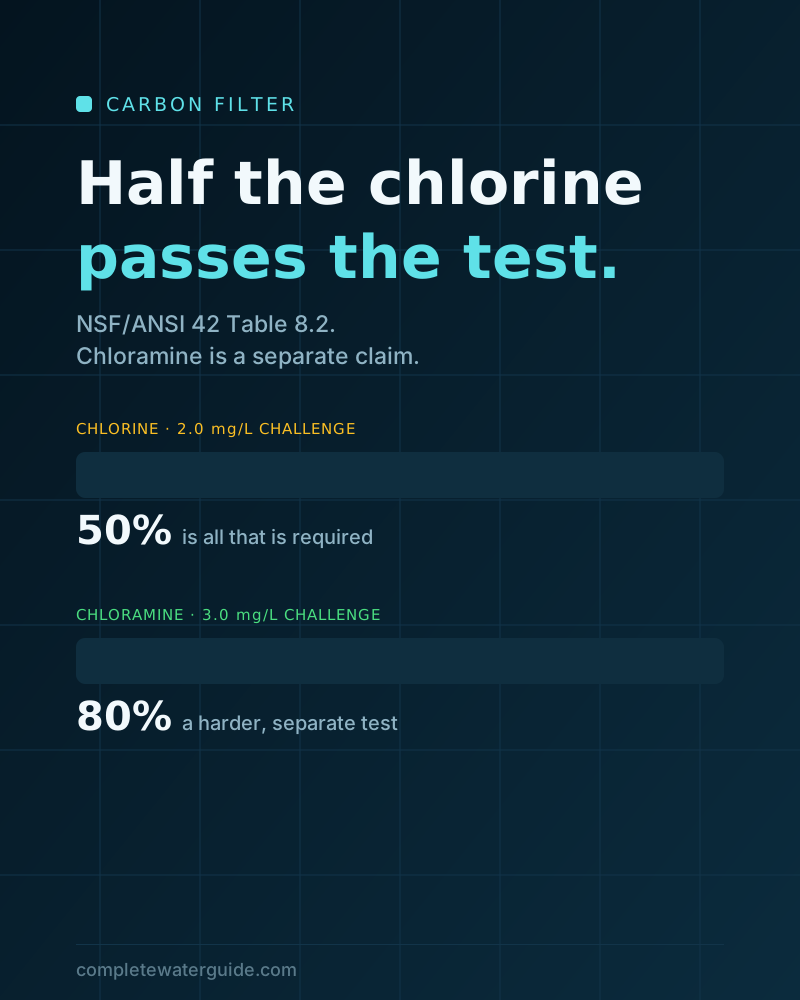
Yes, and read the wording carefully. 3M’s AP902 and Pentek’s Big Blue housings are certified to NSF/ANSI 42 “for material and structural integrity requirements only.” That means the housing will not burst, not that it removes anything. Some cartridges are certified for performance: GE’s FXUSC is certified to NSF/ANSI 42 “for reduction of particulate Class V,” and Culligan lists NSF/ANSI 42 certification for “the reduction of Taste and Odor and Chlorine reduction Class I.” None of the whole house documents we read claimed NSF/ANSI 53, the health-effects standard. Our guide to NSF/ANSI 42, 53, 58 and 401 explains the difference, and our whole house water filter guide covers what certification actually proves.
Frequently asked questions
How often should you change a whole house water filter?
Anywhere from every 2 months to once a year, depending on the cartridge. GE sediment and carbon cartridges are rated for 3 months, Culligan’s range from 3 to 6 months, and 3M’s AP902 cartridges for 12 months. Change it sooner if pressure drops or taste and odor return.
Do you have to turn off the water to change a whole house filter?
Yes. Turn the system to bypass or off, then press the pressure-release button, as GE describes. Without a button, iSpring says to open a nearby faucet to release the pressure.
Can I use Vaseline on a water filter O-ring?
No. iSpring and Aquasana both say not to use petroleum jelly. Use clean food-grade silicone grease, as GE and Culligan specify.
How tight should a whole house filter housing be?
Hand-tight, then at most a small turn with the wrench. DuPont says a 1/4 turn, Aquasana says 1/8 to 1/4 of a turn, and Culligan says not to over-tighten.
Why is my water black after changing the filter?
Carbon fines from a new carbon cartridge. Aquasana says the first few gallons will look black and cloudy. Flush for the time your maker gives; Express Water says cloudiness from air bubbles can last up to a week and is harmless.
What happens if you never change a whole house filter?
Flow drops as it clogs, and filtering stops working. Culligan also warns that a cartridge that disintegrates or develops “a musty or moldy odor” should be switched to a synthetic media cartridge.
Sources
- GE, GXWH04F and GXWH20S whole house filtration system installation instructions.
- Culligan, HD-950 manual and WH-HD200-C manual.
- 3M Aqua-Pure, AP902/AP903 installation manual and specification sheet.
- Aquasana, Rhino EQ-300/600/1000 owner’s manual, EQ-FE20-R replacement manual and How Often to Change Home Water Filters.
- iSpring, whole house water filter user’s manual.
- DuPont, Universal Heavy Duty WFHD13001 manual.
- Home Master, whole house installation and service manual.
- Express Water, whole house filter change instructions and 3-stage installation manual.
- Pentair Pentek, Big Blue and standard filter housing specification sheets.