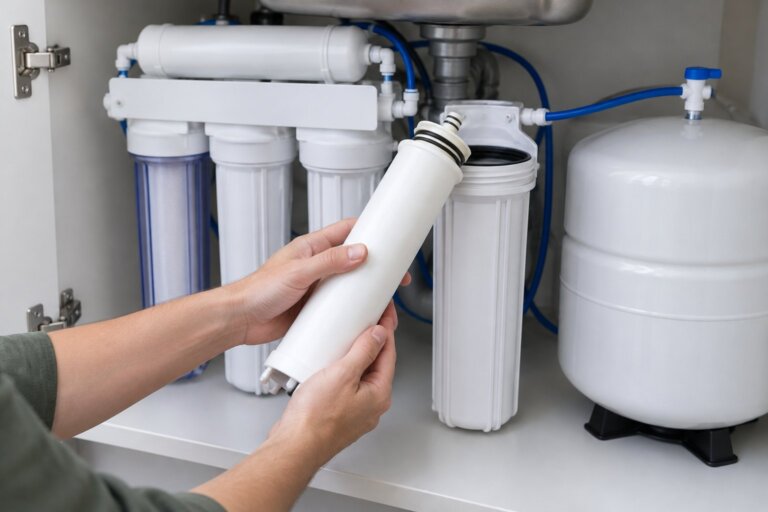
Reverse osmosis constantly draining means the system cannot shut off. The two usual causes are feed water pressure that is too low for the shut-off to work, and a failed automatic shut-off valve or check valve. APEC’s RO manual puts it plainly: when an RO fails to shut off after the tank is full, waste water keeps running down the drain, wearing out the pre-filters and membrane and raising the water bill. A simple test with the tank valve closed tells you whether the shut-off works.
First, make sure it is really a fault. An RO system always sends some water to the drain while it is making water, so some drain sound is normal for a few hours after you use it.
Is it normal for an RO system to drain water?
Yes, while it is filling the tank. Reverse osmosis splits incoming water into filtered water and a reject stream that carries the removed minerals to the drain. The EPA’s WaterSense program says a typical point-of-use RO system sends five gallons or more down the drain for every gallon of treated water, while WaterSense labeled systems send 2.3 gallons or less.
APEC’s ROES series manual says its tank normally fills in 2 to 3 hours, and then the system shuts off automatically. So drain flow for a couple of hours after you draw water is normal. Drain flow all day, every day, is not.
| What you notice | What it means, per APEC |
|---|---|
| Drains for 2 to 3 hours after use, then stops | Normal |
| Drains for hours, about 6 to 7, but eventually stops | “Slow shut-off,” most often low water pressure |
| Drains all day and never stops | Pressure far too low, or a failed shut-off or check valve |
| Drains whenever the ice maker or a second tap is filling | Normal if the RO feeds more than one outlet |
Why is my reverse osmosis constantly draining?
1. Water pressure is too low
The automatic shut-off valve needs pressure to work. It closes when the pressure in the full tank reaches a set share of the incoming pressure; one replacement valve’s listing gives about 65% of supply pressure. If supply pressure is low, the tank may never get high enough to trip it.
APEC lists insufficient input pressure as the most common cause of slow shut-off, says below 40 psi there is not enough pressure to shut off promptly, and says that below 30 psi there is not enough to shut off at all, in which case it recommends a booster-pumped model. Check your house pressure with a gauge, and make sure the RO feed valve is fully open. If the whole house is weak, see our guide to low water pressure.
2. Clogged pre-filters
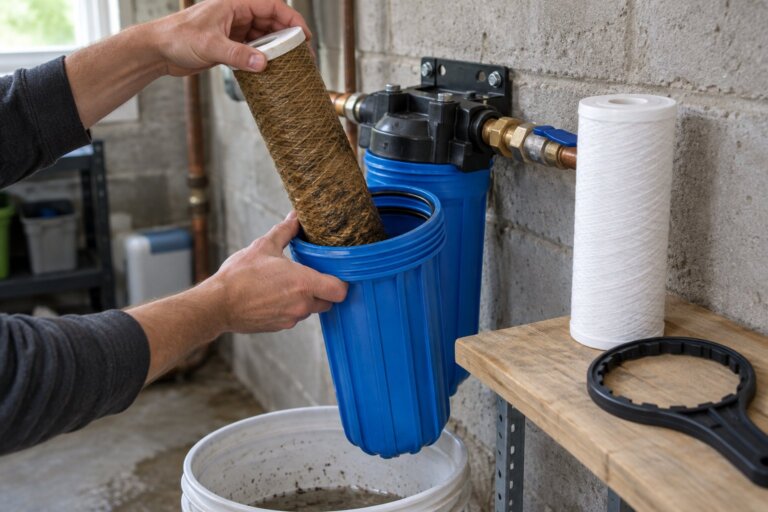
Dirty sediment and carbon pre-filters cut the pressure reaching the membrane and the shut-off valve. APEC says that if its first-stage filter turns brown or another color within 1 to 3 months, the incoming water carries heavy sediment and that filter needs changing more often. Old filters can turn a normal system into a slow shut-off system.
3. A failed automatic shut-off valve or check valve
APEC says these two valves control the RO’s shut-off, and if either is worn, clogged or defective, the system cannot shut off and waste water keeps running. The automatic shut-off valve stops feed water when the tank is full; the check valve stops tank water flowing backward and holding the shut-off open.
4. The tank does not build pressure
If the tank’s air charge is wrong or the tank valve is half closed, the tank may never reach the pressure that trips the shut-off. Our guide to a reverse osmosis tank not filling covers the air charge check.
5. Something keeps drawing water
APEC notes that if the RO feeds more than one outlet, such as an ice maker, a bathroom tap or an aquarium, the waste water runs as long as the RO is making water for any of them. A slow leak at the RO faucet or ice maker line does the same.
How do you test the RO shut-off?
This is APEC’s first test, and it takes about 5 minutes:
- Draw 2 or 3 glasses of water from the RO faucet, so the system starts making water.
- Close the tank valve on top of the tank. This makes the system act as if the tank is full.
- Close any other lines the RO feeds, such as an ice maker.
- Wait 3 to 5 minutes.
- Listen at the drain, or pull out the drain line and look.
If the waste water stops, APEC says the shut-off valve and check valve both work, and the problem is pressure, filters or the tank. If it keeps running, one of the two valves is faulty. APEC’s second test in its manual isolates which one. Open the tank valve again when you are done.
What we would buy for this job
- APEC automatic shut-off valve, 1/4 inch quick connect: only if the shut-off test fails. The listing names the APEC RO-45, RO-90, ROES-50 and other models; for other brands, buy the part made for your system. $10.99 when we checked.
- Low pressure pencil gauge, 1 to 20 psi: to check the tank air charge, since a tank that never builds pressure cannot trip the shut-off. $6.89 for two when we checked.
As an Amazon Associate, Complete Water Guide earns from qualifying purchases. Prices change, so check the listing.
How do you fix an RO system that will not stop draining?
- Check house water pressure. APEC wants at least 40 psi for a prompt shut-off; below 30 psi it recommends a booster-pumped system.
- Open the feed valve fully and check that the tank valve is fully open.
- Replace old pre-filters.
- Check the tank’s air charge when the tank is empty.
- Run the shut-off test. If it fails, replace the automatic shut-off valve or check valve with the part made for your system.
- Look for leaks at the RO faucet and any ice maker line.
How much water does a constantly draining RO waste?
A lot, because it never stops. At the EPA’s typical figure of five gallons or more of reject water per gallon made, a system that runs non-stop sends water to the drain all day whether you use the RO or not. That shows up on the water bill, and for well owners it puts extra running time on the pump. APEC adds that it also wears out the pre-filters and membrane. If you are replacing the system anyway, a WaterSense labeled model sends 2.3 gallons or less to the drain per gallon. Our guide to the best reverse osmosis systems compares models.
Frequently asked questions
Why is my RO system constantly draining?
Usually because it cannot shut off. Low feed water pressure and a failed automatic shut-off valve or check valve are the main causes. APEC also lists clogged pre-filters and an RO that feeds several outlets.
How long should an RO system drain after use?
Only while it refills the tank. APEC says its tanks normally fill in 2 to 3 hours, then the system shuts off automatically.
How do I know if my RO shut-off valve is bad?
Draw a few glasses of water, close the tank valve, and wait 3 to 5 minutes. If waste water still runs to the drain, APEC says the automatic shut-off valve or the check valve is faulty.
Can low water pressure make an RO system run all the time?
Yes. APEC says below 40 psi there is not enough pressure to shut off promptly, and below 30 psi not enough to shut off at all.
Is it normal to hear water running from my RO drain?
Yes, while the RO is making water. It should stop once the tank is full. Constant sound all day means the system is not shutting off.
Does a constantly draining RO system waste a lot of water?
Yes. The EPA says a typical system sends five gallons or more to the drain per gallon of treated water, and one that never shuts off keeps doing it all day.
Sources
- APEC Water, ROES series installation and user manual: 2 to 3 hour fill and automatic shut-off, slow shut-off from low pressure, no shut-off below 30 psi, first-stage filter changing color in 1 to 3 months, multiple outlets, automatic shut-off and check valve test.
- US EPA WaterSense, Point-of-Use Reverse Osmosis Systems: typical five gallons or more of reject water per gallon; labeled models 2.3 or less.
- DIGITEN automatic shut-off valve listing on Amazon: shuts off at about 65% of supply pressure.