Water filter vs water purifier comes down to germs. A water purifier, in the US meaning of the word, has to remove or kill all three kinds of disease-causing microbes: bacteria, viruses and protozoan cysts. A water filter does not. Many filters are very good at chemicals, taste and some microbes, but not viruses. The EPA’s guide standard for microbiological water purifiers sets that bar, and the CDC’s travel guidance gives the numbers manufacturers claim against it: at least 99.9999% of bacteria, 99.99% of viruses and 99.9% of cysts.
For safe city tap water, you usually need a filter for taste or specific chemicals, not a purifier. For untreated water from a stream, a well with germs, or travel in places where tap water is unsafe, you need a purifier.
Water filter vs water purifier: what is the difference?
| Water filter | Water purifier | |
|---|---|---|
| Bacteria | Some do, many do not | Yes, claims at least 99.9999% |
| Protozoan cysts (Giardia, Cryptosporidium) | Many do | Yes, claims at least 99.9% |
| Viruses | Most do not | Yes, claims at least 99.99% |
| Chemicals, chlorine taste, lead | Depends on certification | Depends on the design; not required |
| Standard to look for | NSF/ANSI 42, 53, 401, 58 | NSF P231, or the EPA guide standard |
| Typical use | Treated city or well water | Untreated or doubtful water |
The purifier column comes from the EPA’s Guide Standard and Protocol for Testing Microbiological Water Purifiers, which says a microbiological water purifier must remove, kill or inactivate all types of disease-causing microorganisms, including bacteria, viruses and protozoan cysts. The percentages are the claims the CDC Yellow Book describes for purifiers, and it adds that the EPA does not independently test the validity of those claims.
Do water filters remove viruses?
Most do not. Viruses are far smaller than bacteria and cysts. The CDC’s hiking and travel water page says most portable water filters remove parasites but not viruses or bacteria, and that reverse osmosis filters remove parasites, bacteria and viruses. The CDC Yellow Book adds that microfilters with pore sizes of 0.1 to 0.4 micrometers usually remove bacteria and cysts but may not adequately remove viruses.
That is why “filter” and “purifier” are not interchangeable on a hiking or travel product. Our guide on whether water filters remove viruses and bacteria goes deeper.

Is a water purifier better than a water filter?
Only for germs. A purifier is not automatically better at chemicals. Many filters certified to NSF/ANSI 53 reduce lead or other health-related chemicals, and NSF/ANSI 401 covers some emerging contaminants; a purifier certified only for microbes may do none of that. Pick by the problem:
- City water that is safe but tastes of chlorine: a carbon filter certified to NSF/ANSI 42.
- Lead from old pipes: a filter certified to NSF/ANSI 53 for lead.
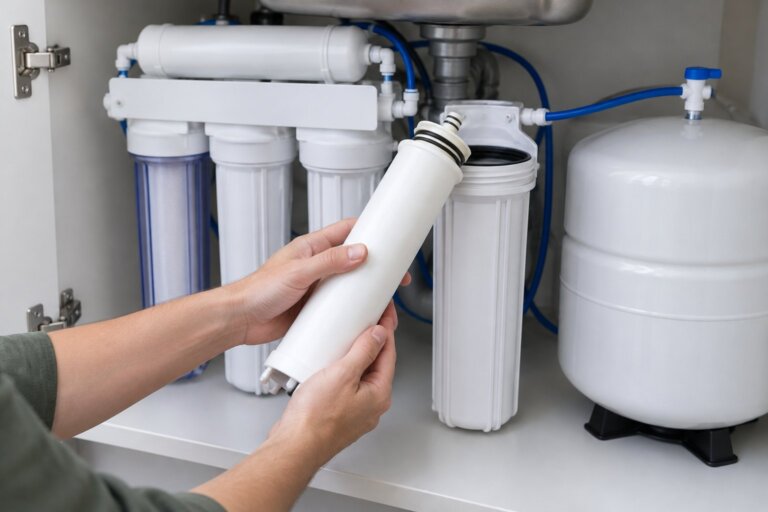
- Many dissolved contaminants: reverse osmosis certified to NSF/ANSI 58.
- Stream, lake or doubtful water while hiking or traveling: a purifier, NSF P231 or claiming the EPA guide standard.
- A private well with bacteria: disinfect the well and test it; then consider UV certified to NSF/ANSI 55 Class A for ongoing protection.
NSF’s list of water treatment standards explains each one, including P231 for microbiological purifiers based on the EPA guide standard, and NSF/ANSI 55 Class A for ultraviolet systems that inactivate bacteria, viruses and cysts. Our guide to NSF/ANSI water filter standards covers them in plain terms.
What we would buy for this job
- GRAYL GeoPress 24 oz water purifier bottle: for hiking and travel, where you need a purifier rather than a filter. The listing claims removal of viruses, bacteria and protozoa and a 65 gallon cartridge; check its current third-party test claims before you rely on it. $99.95 when we checked.
As an Amazon Associate, Complete Water Guide earns from qualifying purchases. Prices change, so check the listing.
Is “purified water” the same as water from a purifier?
No, and the two meanings get mixed up. On a bottled water label, “purified water” is an FDA category for water treated by distillation, deionization, reverse osmosis or similar processes. It describes how the water was made, not a germ-removal standard for a device. Our guide to what purified water is covers the label meaning.
In some markets, especially India, “water purifier” is the everyday name for any home RO or UV unit. If you are comparing those, our guide to RO vs UV vs UF purifiers explains what each technology does.
Do you need a purifier for home tap water?
Usually not, if you are on a public water system that meets federal standards. Treated city water is already disinfected, so a home filter’s job is taste, odor or a specific contaminant you have tested for. Private wells are different: the owner is responsible for testing and treatment. If a well tests positive for bacteria, disinfect it first; our guide on well water testing cost covers what to test for.
When a boil water notice is in effect, follow it even if you have a home filter. A filter that is not a certified purifier is not a substitute for boiling.
Frequently asked questions
What is the main difference between a water filter and a water purifier?
A purifier must remove or kill bacteria, viruses and protozoan cysts, the bar set by the EPA’s guide standard for microbiological purifiers. A filter does not have to remove viruses, and most do not.
Is a water purifier better than a filter?
Only against germs. For chemicals such as lead, a filter certified to NSF/ANSI 53 may do more than a purifier certified only for microbes. Choose by the problem in your water.
Do water filters remove bacteria and viruses?
Some filters remove bacteria and cysts, but most do not remove viruses. The CDC says most portable filters remove parasites but not viruses or bacteria, while reverse osmosis removes all three.
What does a water purifier remove?
By the claims the CDC Yellow Book describes, at least 99.9999% of bacteria, 99.99% of viruses and 99.9% of cysts. The EPA does not independently test those claims, so look for third-party certification such as NSF P231.
Do I need a water purifier at home?
Usually not on treated city water. You may need one for untreated sources, a private well with germ problems, or during travel where tap water is unsafe.
Can I use a water filter during a boil water notice?
Not as a substitute for boiling, unless it is a certified purifier. Follow the notice.
Sources
- US EPA, Guide Standard and Protocol for Testing Microbiological Water Purifiers: a purifier must remove, kill or inactivate bacteria, viruses and protozoan cysts.
- CDC Yellow Book, Water Disinfection for Travelers: purifier claims of at least 99.9999% of bacteria, 99.99% of viruses and 99.9% of cysts; the EPA does not independently test the claims; 0.1 to 0.4 micrometer microfilters may not remove viruses.
- CDC, Water treatment for hiking, camping and traveling: most portable filters remove parasites but not viruses or bacteria; reverse osmosis removes all three.
- NSF, Standards for water treatment systems: P231 for microbiological purifiers; NSF/ANSI 55 Class A UV; NSF/ANSI 42, 53, 58 and 401.