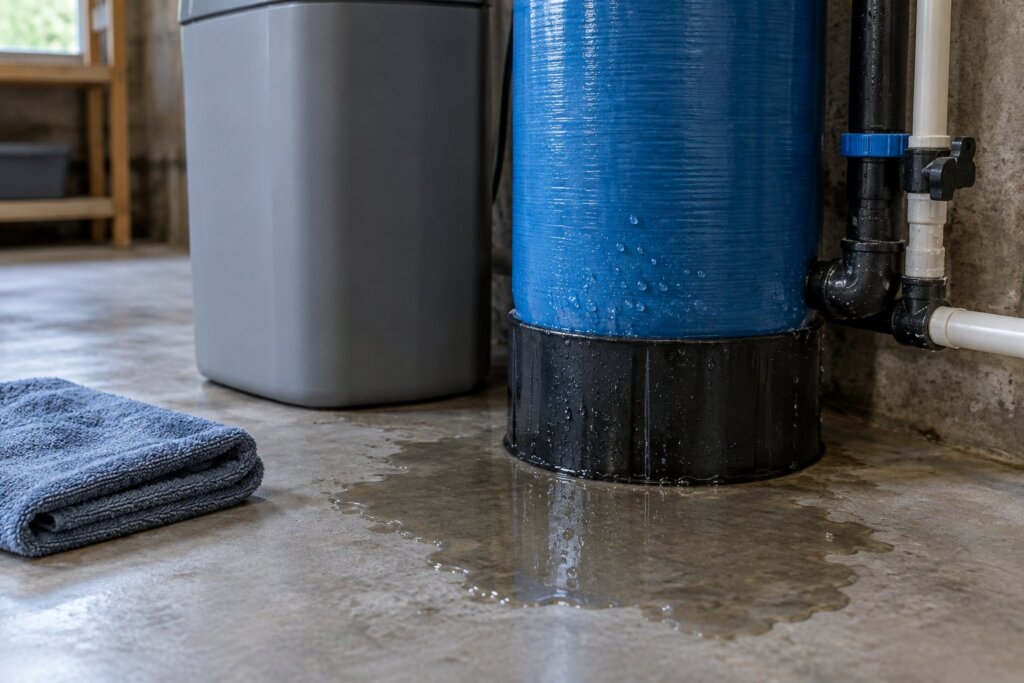
A water softener leaking almost always leaks from one of five places: the inlet and outlet connections, the bypass valve, the control valve on top, the brine tank and its overflow hose, or a cracked tank. Where the water is coming from tells you the fix. Before you look, put the softener in bypass so your house still has water while the softener is isolated.
We read the owner’s and service manuals for Whirlpool, GE, Morton, Rheem, Culligan, WaterBoss, Fleck and Clack. Below is how to stop the water, how to find the leak, and the fix each manual gives for each spot.
First, stop the water: put the softener in bypass
Every softener has a bypass for exactly this. Whirlpool says, “Bypass valves allow you to turn off water to the softener for maintenance if needed, but still have water in house pipes.” How you use it depends on the model:
- Whirlpool, Morton and similar push-pull bypass: “Push in for ‘Bypass'” and “Pull out for ‘Service’ (Soft water).”
- Three-valve bypass (GE’s example): “Close the inlet and outlet valves and open the bypass valve.”
- Clack: turn the handles so they “point to the center of the bypass.”
- Culligan: “turn the blue knob clockwise… DO NOT OVERTIGHTEN!”
Then release the pressure before you take anything apart. Fleck says, “The system must be depressurized before removing any connections for servicing,” and Clack warns, “Pressure hazard; depressurize valve before servicing.” On GE models with a blend knob, GE adds that the knob “must be turned all the way clockwise” before servicing “to close the diversion path and prevent water leaking from the softener valve inlet of the bypass.”
Water softener leaking: where is it coming from?
Dry everything with a towel, put the softener back in service for a minute, and watch where the water appears first. Then match it to this table:
| Where it leaks | Likely cause | Fix the manual gives |
|---|---|---|
| Inlet or outlet connection clips | Damaged or badly seated clip | Depressurize, remove carefully; “Do not reinstall damaged clips” (Whirlpool, Morton) |
| Threaded fittings | Damaged or misaligned O-ring | “Tightening the nut will not stop the leak. Remove the nut, remove the fitting, and check for damage or misalignment of the o-ring” (Clack) |
| Where the valve meets the resin tank | Worn O-rings | “Replace o-rings between resin tank and valve” (Rheem) |
| Inside the valve, water running to drain all the time | Internal valve leak | “Replace seals and rotor” (Rheem); “Replace seals and spacers and/or piston” (Fleck) |
| Distributor tube | Cracked tube or O-ring | “Make sure distributor tube is not cracked. Check o-ring and tube pilot” (Fleck) |
| Brine (salt) tank, outside | Crack in the tank | “Replace salt storage tank assembly” (Rheem) |
| Brine tank overflowing | Drain line, brine valve or float problem | See the next section |
One warning sign is not a leak at all: resin beads in your faucets or toilet tank. Rheem lists “resin in household plumbing” with the cause “crack in distributor or riser tube” and the fix “replace resin tank assembly.”
Also give it a day. Whirlpool says, “Leaks may not be immediately apparent. Recheck for leaks 24 hours after first recharge cycle is complete.”
Why is my water softener brine tank overflowing?
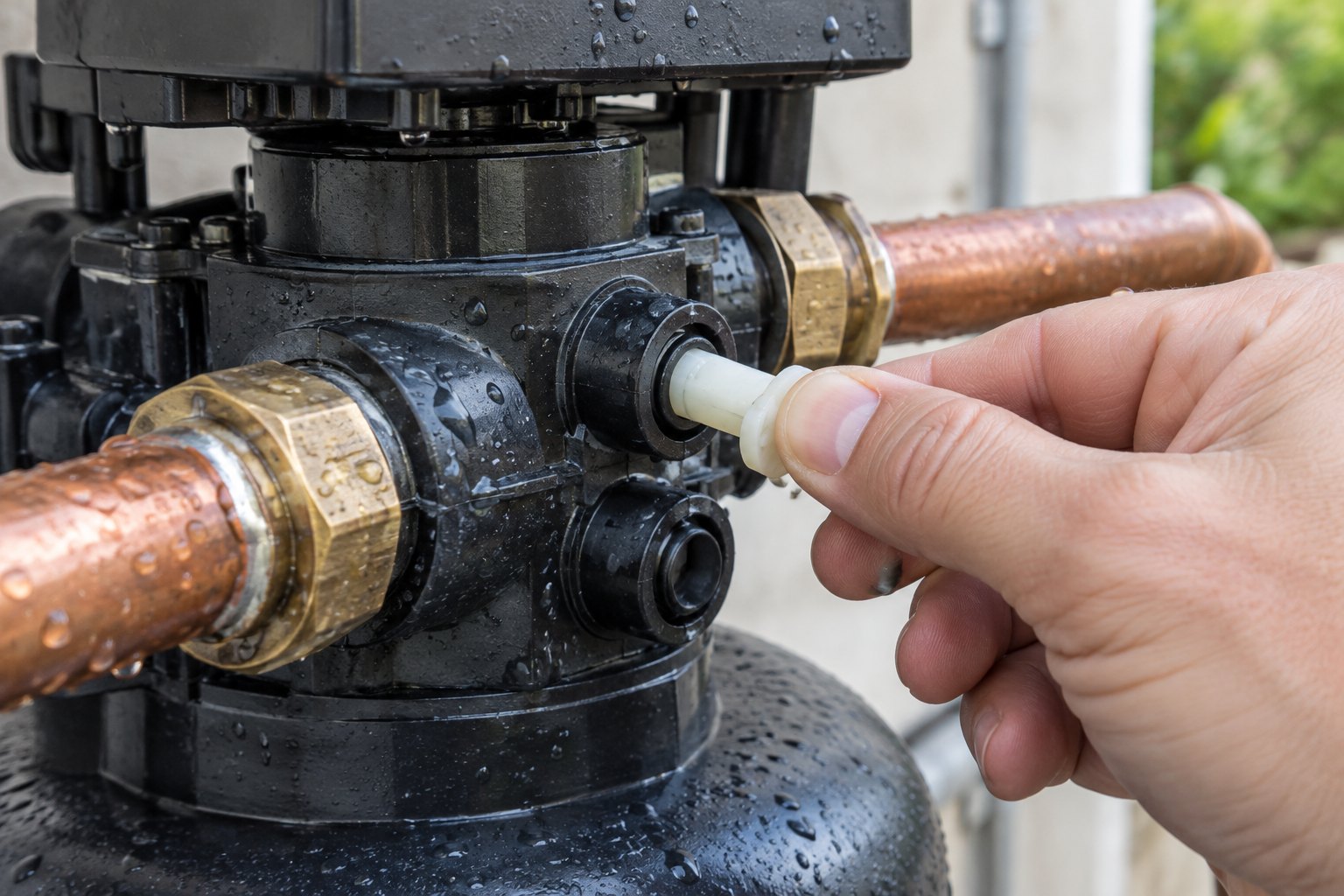
Too much water in the salt tank, or water spilling from its overflow, comes from a few causes the manuals list:
- A restricted drain line. WaterBoss says, “Restricted, frozen or pinched drain line” and the fix “remove restriction, thaw or straighten drain line.” GE lists a valve drain hose that is “pinched, plugged” or run too high.
- A plugged drain line flow control. Fleck’s fix: “Clean flow control.”
- Debris in the brine valve. Fleck: “Replace brine valve seat and clean valve.”
- A sticking brine refill valve. WaterBoss: “Remove brine valve. Lubricate piston with silicone grease and reassemble.”
- A dirty or broken brine float. Rheem: “Clean or replace Brine Valve Float Assembly.”
- A dirty nozzle and venturi. GE lists this for a high water level in the brine tank too.
The overflow hose is your backup if any of these fail, so check it is set up right. Whirlpool and Rheem say to route it to a floor drain “no higher than the drain fitting on the salt storage tank (This is a gravity drain).” WaterBoss says the drain must be “at least 3″ lower than the bottom of the overflow fitting” and that “it is a gravity line and cannot be run overhead.” Never join the two drain lines. Rheem lists “valve drain line and Salt Storage Tank overflow drain connected together by a tee” as a fault, with the fix “Disconnect tee and run separate drain lines.” Clack recommends “a safety brine valve be used.”
Our guide to water softener salt level shows how much water is normal in the brine tank.
Why is my water softener leaking at the bypass valve?
Usually the O-rings, which dry out or get pinched. GE and Morton say to “put a light coating of silicone grease (provided) on the single bypass valve o-rings.” Use only silicone. Clack is emphatic: “USE ONLY SILICONE-BASED LUBRICANTS ON ALL CLACK COMPONENTS. HYDROCARBONS WILL DAMAGE COMPONENTS THAT CONTAIN O-RINGS AND/OR PLASTIC. THIS CAN CAUSE LEAKS OR BREAKAGE.” It names “VASELINE®/PETROLEUM JELLY, WD-40®” as off limits.
Two installation details also cause leaks at the connections. Clack says, “Do not use pipe dope or other sealant on threads. Use teflon tape on threaded inlet, outlet and drain fittings.” Whirlpool warns, “Do not solder with plumbing attached to installation adaptors and single bypass valve. Soldering heat will damage the adaptors and valve.”
What we would buy for this job
- Geevon water leak detector alarms, 2 pack: set one beside the softener and one by the brine tank. A 100 dB alarm beats finding the puddle a week later.
- Captain O-Ring NSF H1 food-grade silicone grease: silicone only on softener O-rings, as Clack, GE and Morton specify. Never petroleum jelly.
- CARBO 0 to 200 psi water pressure test gauge: check you are under the 125 psi maximum; the red pointer catches overnight spikes above 80 psi daytime readings.
As an Amazon Associate, Complete Water Guide earns from qualifying purchases. Prices change, so check the listing.
Can high water pressure or freezing make a softener leak?
Both can. On pressure, Whirlpool and GE use the same wording: “Maximum allowable inlet water pressure is 125 psi. If daytime pressure is over 80 psi, nighttime pressure may exceed the maximum. Use a pressure reducing valve if necessary.” Rheem warns that “high pressure may cause inner valve parts failure” and says to add a pressure reducing valve “if daytime pressure is over 100 psi.” Fleck and Clack also cap pressure at 125 psi.
On freezing, Whirlpool says, “Do not locate the water softener where freezing temperatures occur,” and that freezing damage “voids the warranty.” Clack goes further: no room temperatures “under 40° F (4° C),” including for the drain and overflow lines. Morton and Rheem say that in a summer cabin or lake home, “you must drain all water from it to stop possible freeze damage.” Culligan warns, “If your unit should freeze, do not attempt to disassemble it.” Clack says to let a frozen valve warm to room temperature before running water through it.
Our guide to water softener noises covers the pressure range and drain line rules in more detail.
Is a leaking water softener covered by warranty?
The tanks often are, for a long time. Whirlpool’s WHES30, Morton and Rheem give a ten-year warranty that the salt and resin tanks “will not rust, corrode, leak, burst,” and Whirlpool’s WHES48 extends that to the lifetime of the original owner. Clack warrants its control valves for five years. The conditions matter, though: Whirlpool’s warranty applies only if the softener runs “at water pressures not exceeding 125 psi” and is “not subject to abuse, misuse, alteration, neglect, freezing.” It also says, “After the first year, labor necessary to maintain this product is not covered.” Find your model’s warranty before you buy parts.
Should you fix a leaking water softener yourself?
Some leaks yes, some no. Our dividing line: connection clips, the bypass O-rings, the overflow hose and the drain hose are reasonable DIY jobs with the water bypassed and the pressure released. Internal valve seals, a cracked resin or brine tank, and anything after a freeze are jobs for service, partly because of the warranty. Clack says, “Service and maintenance should be performed by qualified personnel only,” and Culligan warns that work by “an untrained service person can cause major damage to equipment or property damage.” In Massachusetts, Whirlpool notes, “a licensed plumber shall be used for this installation.”
If the unit is old and leaking from more than one place, compare the repair with a new one. Our guides on signs a softener needs repair and water softener installation cost help with that decision.
Frequently asked questions
Why is water leaking from the top of my water softener?
Usually worn O-rings or seals in the control valve, or a leak where the valve meets the resin tank. Rheem’s fix for that joint is to replace the O-rings between the tank and valve, and Fleck’s fix for an internal valve leak is new seals, spacers or piston.
Why is my water softener salt tank full of water?
Usually a restricted drain line, a plugged drain line flow control, debris in the brine valve or a stuck float. Fleck, WaterBoss, GE and Rheem all list these. A properly routed overflow hose sends any excess to a floor drain.
Can I use Vaseline on water softener O-rings?
No. Clack says hydrocarbons such as Vaseline and WD-40 damage O-rings and plastic parts and can cause leaks. Use silicone grease, which GE and Morton supply for their bypass O-rings.
Can I still use water if my softener is leaking?
Yes, with the softener in bypass. Whirlpool says the bypass lets you turn off water to the softener but still have water in your house pipes. It will be hard water until the softener is back in service.
What water pressure is too high for a water softener?
Over 125 psi, according to Whirlpool, GE, Fleck and Clack. Whirlpool and GE suggest a pressure reducing valve if daytime pressure is over 80 psi, because nighttime pressure can be higher.
Should the overflow hose and drain hose connect together?
No. Whirlpool, WaterBoss and Rheem all say to run them separately. Rheem lists joining them with a tee as a cause of problems.
Sources
- Whirlpool, WHES20/WHES30 and WHES48 installation and operation manuals.
- GE, GXSH40V/GXSH45V Owner’s Manual.
- Morton, System Saver M20 to M34 manual.
- Rheem, RHS32 installation and operation manual.
- Culligan, High Efficiency softener owner’s guide.
- WaterBoss, 550/700/900 installation and service manual.
- Pentair Fleck, 5600SXT Downflow Service Manual.
- Clack, WS1 and WS1.25 Drawings and Service Manual, and WS1.5/2 service manual.