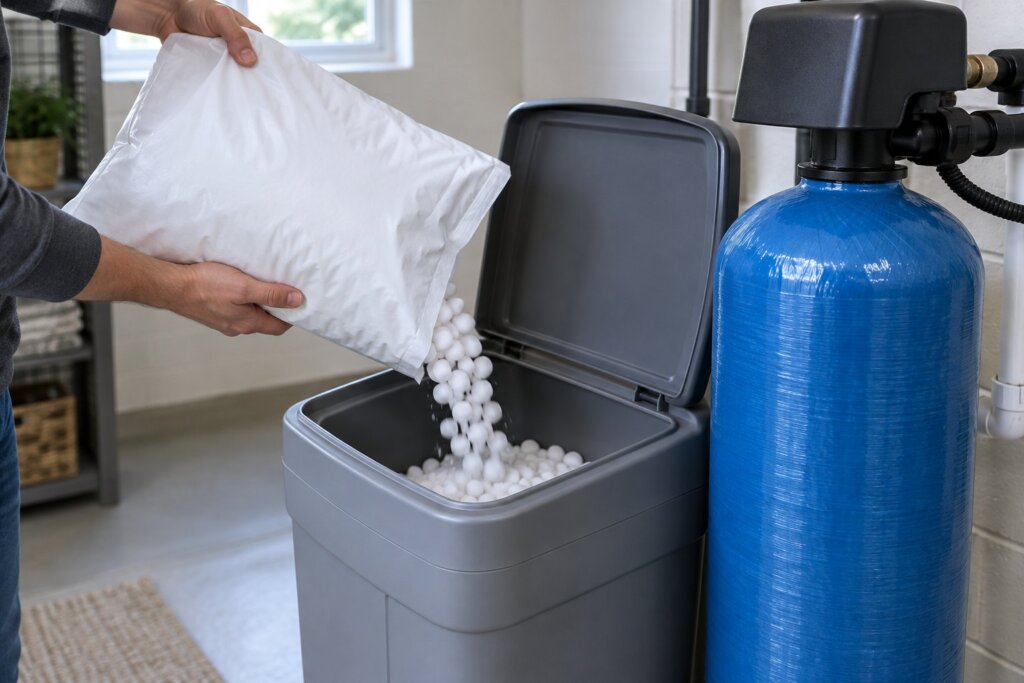
The right water softener salt level is somewhere between one-quarter and half full, with the salt always sitting above the water in the bottom of the tank. Whirlpool, GE and Morton all say, “Always add if less than 1/4 full.” Culligan and EcoWater say to keep it about half full. What every manual agrees on is the water line: once the salt drops below the water, the softener cannot make brine and your water goes hard.
We read the owner’s manuals for Whirlpool, GE, Morton, WaterBoss, Hellenbrand, Fleck and Clack, the maintenance pages from Morton, Culligan and EcoWater, and University of Nebraska and University of Alaska Extension. Below is how full to keep the tank, how often to add salt, and what it means when the salt stops going down.
Water softener salt level: how full should the tank be?
The makers do not agree on one number, so here is what each says:
| Source | Salt level rule |
|---|---|
| Whirlpool, GE, Morton manuals | “Always add if less than 1/4 full.” In humid areas, keep the level lower and refill more often. |
| Culligan | Aim to “keep the tank about half full while ensuring the salt is above the water level.” |
| EcoWater | “Keeping it half-full prevents older salt from sticking to the walls of the tank.” |
| Hellenbrand | About three-fourths full with at least 12 inches of salt; no more than half full in homes that use little water. |
| WaterBoss | “Always keep salt above water level.” |
| Fleck | “Maintain salt level above water level.” |
Our rule, from reading all of them: keep the salt above the water line at all times, top it up to about half full, and never fill higher than your own manual allows. In a damp basement, go lower and refill more often. Whirlpool and GE both say, “In humid areas, it is best to keep the salt storage level lower, and to refill more often to avoid salt ‘bridging’.”
If you use potassium chloride instead of salt, the limit is lower. Whirlpool’s manual says, “do not fill above level 4 on the brinewell scale,” and to keep no more than 60 pounds of potassium chloride in the tank at once.
How often should you add salt to a water softener?
Check first, then settle into a routine. Whirlpool, GE and Morton say, “Until you have established a refilling routine, check the salt every two or three weeks.” Culligan suggests “checking the brine tank at least once a month.”
How much you will use depends on your water and household. Some reference points from the sources:
- Morton: “the average household uses approximately two bags every two months,” and a softener typically regenerates “every 3 to 7 days.”
- Hellenbrand: “with 20 gpg hard water, about a 1/2 lb. of salt per person per day is used. In other words, a family of four uses 60 lbs. of salt a month.”
- Whirlpool WHES48: each regeneration uses from 2.8 pounds to 18.1 pounds of salt, depending on the capacity setting.
Nebraska Extension sums it up: “The amount of salt used for softening depends on the number of people in the household, daily water usage, softener capacity, and water hardness.” If you are going through far more than these numbers, the softener may be set for harder water than you have. Our water softener sizing guide explains the settings.
How much water should be in a water softener brine tank?
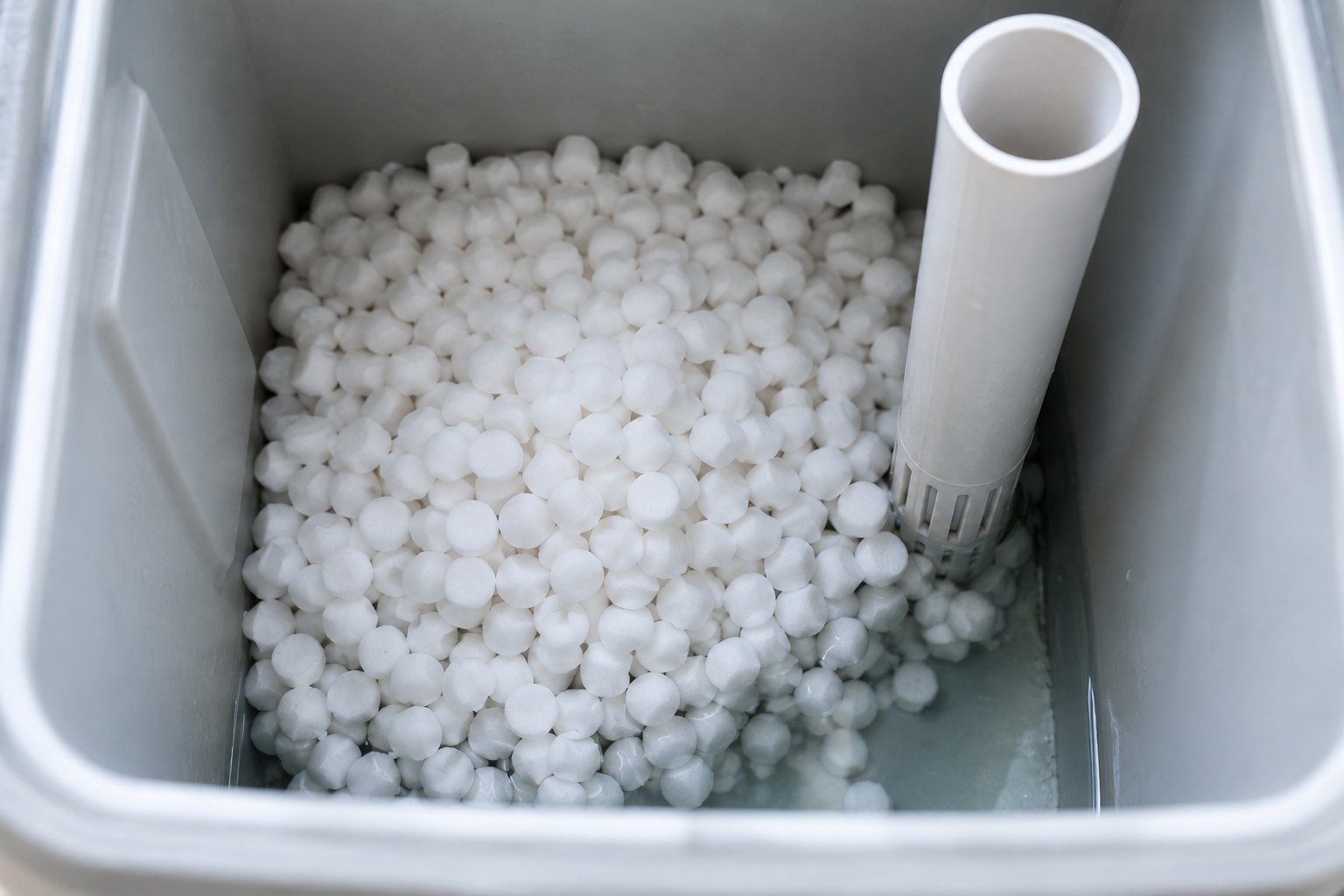
It depends on the design. Most home softeners keep some water in the tank all the time, and a few only add it right before regenerating:
- Morton: “2 to 5 inches of water at the bottom of the salt storage tank is typical.”
- WaterBoss: about 6 to 8 inches with salt in it, and 8 to 10 inches for the larger BigBoss.
- Hellenbrand with prefill: water goes in 2 hours before a scheduled regeneration, so “you will typically not see water in the brine tank unless salt supply is low.”
Too much water is a fault. Fleck’s manual lists the causes of “excessive water in brine tank” as a plugged drain line flow control, a plugged injector system, a timer that is not cycling, or debris in the brine valve or brine line flow control. Whirlpool says to check the water level down the brinewell, and if “the water level does not drop after a recharge, the problem has not been resolved.”
Why is my water softener salt not going down?
Sometimes it is normal, and sometimes the softener has stopped working. GE’s troubleshooting table lists three causes for a softener “not using any salt”:
- It is a demand unit. These only regenerate when you have used enough water, so a quiet week means little salt used.
- A salt bridge. The salt looks full but is not touching the water. See the next section.
- A plugged nozzle and venturi. Whirlpool explains that the venturi “creates the suction to move brine from the brine tank, into the resin tank. If it should become plugged with sand, silt, dirt, etc., the water softener will not work.” It lists a dirty or plugged nozzle and venturi as the most likely reason a softener does not draw brine.
Fleck adds a plugged drain line flow control, a plugged injector or screen, and low line pressure (“Increase line pressure to 20 psi”). Whirlpool notes that with low water pressure, a drain hose that is too long or runs too high “may cause backpressure, stopping brine draw.” WaterBoss lists sediment in the brine tank plugging the brine line. EcoWater says the venturi cleaning “should be done twice a year.” Our guide to water softener noises covers the drain line rules, and signs your softener needs repair covers the rest.
How do you know if you have a salt bridge?
Whirlpool and Morton describe it the same way: “a hard crust or salt ‘bridge’ forms in the brine tank. It is usually caused by high humidity or the wrong kind of salt. When the salt ‘bridges,’ an empty space forms between the water and the salt. Then, salt will not dissolve in the water to make brine.” EcoWater adds temperature changes as a cause. Culligan says it “might make the tank look full, but the reality is that this mass is hiding an empty space underneath,” and EcoWater gives the giveaway sign: “your salt tank appears full but you know your water isn’t soft.”
Whirlpool’s test uses a broom handle. Measure from the floor to the rim of the tank and mark that on the handle, then push the handle straight down into the salt. If you hit something hard before the mark reaches the rim, it is most likely a bridge.
To break it:
- “Gently push into the bridge in several places to break it.” (Whirlpool)
- “Do not use any sharp or pointed objects as you may puncture the brine tank. Do not try to break the salt bridge by pounding on the outside of the salt tank.” (Whirlpool and Morton)
- “To help dissolve the salt bridge pour one gallon of warm water (not hot) into the tank. If the wrong kind of salt made the bridge, take it out. Then fill the tank with nugget or pellet salt only.” (GE)
One plumbing textbook we read suggests tapping the outside of the tank with a rubber mallet. We would follow the softener makers instead, who say not to pound on the tank.
What we would buy for this job
- Morton Clean and Protect water softener salt pellets, 40 lb, 2 pack: high-purity pellets, the type the Whirlpool and GE manuals recommend. Check your own manual before switching salt types, and do not mix types.
- Varify water hardness test strips: test the water after the softener. If it reads hard while the tank looks full, suspect a bridge or a plugged venturi.
As an Amazon Associate, Complete Water Guide earns from qualifying purchases. Prices change, so check the listing.
What is salt mushing, and how do you fix it?
EcoWater explains that mushing “happens when dissolved salt recrystallizes and forms a sludge on the bottom of the brine tank.” If you push on what you think is a bridge and it does not break up, mushing is probably the cause. EcoWater’s fix is blunt: “Draining the softener of its water, digging out all the old salt and replacing it with fresh salt is the only way to fix this problem.”
The sources disagree on which salt is to blame. EcoWater says high-quality pellets “greatly reduce the potential for any problems,” and names salt mushing in particular, while Culligan says mushing “is more likely to occur with pellet salt.” GE says rock, block and granulated salts “may contain dirt and sediments that might mush or cake.” Our take: clean, high-purity pellets from a known brand, and an annual tank cleaning, avoid most of it whichever side is right.
How often should you clean the brine tank?
About once a year. Hellenbrand says to “inspect the brine tank at least once a year for buildup of insoluble materials,” and that “it is recommended to periodically clean the brine tank no matter what kind of salt you are using.” University of Alaska Extension says to “clean out the brine tank annually.”
Hellenbrand’s method: “Scoop out as much old salt as possible,” then “using clean water and a brush or rag, wipe and rinse inside of brine tank,” and “manually add 6 inches of water.” Do not put the old salt back “unless it is clean and not mushy.” Alaska Extension adds a sanitizing rinse of “one cup of 5 percent chlorine bleach to a gallon of water.” Rinse that out well, and never mix bleach with any other cleaner.
What kind of salt should you use?
- Recommended: Whirlpool lists “nugget, pellet or coarse solar salts with less than 1% impurities.” GE wants salt “at least 99.5% pure.”
- Not recommended: Whirlpool rules out “rock salt, high in impurities, block, granulated, table, ice melting, ice cream making salts.” Fleck says, “Do not use granulated or rock salt.” WaterBoss says rock salt “contains impurities that can plug up the injector assembly.”
- Do not mix types. WaterBoss: “DO NOT MIX DIFFERENT TYPES OF SALT.”
- Block salt only in units built for it, according to Nebraska Extension.
- Potassium chloride works in place of salt, according to Morton, but Nebraska Extension says softeners “require more potassium chloride” because it holds onto the resin more strongly.
Our guide to water softener salt pellets vs crystals compares the options in more detail.
Frequently asked questions
Should the salt in my water softener be above the water?
Yes. WaterBoss says to always keep salt above the water level, and Fleck’s fix for a softener that is not softening includes keeping the salt level above the water. Salt below the water line cannot keep making brine.
Can you put too much salt in a water softener?
Yes. Overfilling, especially in humid areas or homes that use little water, makes salt bridges more likely. Hellenbrand says not to fill above half full in low-use homes, and Whirlpool and GE say to keep the level lower in humid areas.
How long does a 40 pound bag of softener salt last?
About a month for an average home, going by Morton’s figure of roughly two bags every two months. Hellenbrand says a family of four with 20 gpg hard water uses about 60 pounds a month.
What happens if a water softener runs out of salt?
It stops softening. Without brine, Whirlpool says, “the resin bed is not recharged and hard water will result.” After refilling, Clack says to wait at least two hours before running a regeneration.
Why is there so much water in my brine tank?
Usually a clog. Fleck lists a plugged drain line flow control, a plugged injector, a timer that is not cycling, or debris in the brine valve or brine line. Morton says 2 to 5 inches of water is typical.
Can I mix different types of water softener salt?
No. WaterBoss’s manual says not to mix different types of salt. Pick one high-purity pellet or solar salt and stick with it.
Sources
- Whirlpool, WHES48 water softener manual.
- GE, GXSH40V/GXSH45V Owner’s Manual.
- Morton, M20 to M34 and MC30 softener manual, Water Softeners FAQ and Maintaining Your Morton Water Softener.
- Culligan, Why It’s Important to Add Salt to Your Water Softener on Time.
- EcoWater, Water Softener Maintenance Made Easy.
- Hellenbrand, E3 Consumer’s Manual.
- WaterBoss, cityBoss and BigBoss Installation and Service Manual.
- Pentair Fleck, 5600SXT Downflow Service Manual; Clack, WS1 control valve manual.
- Rheem Water Treatment, salt type recommendations.
- University of Nebraska-Lincoln Extension, publication G1491 on water softening.
- University of Alaska Fairbanks Extension, Water Softeners Annual Maintenance, HCM-02020.