
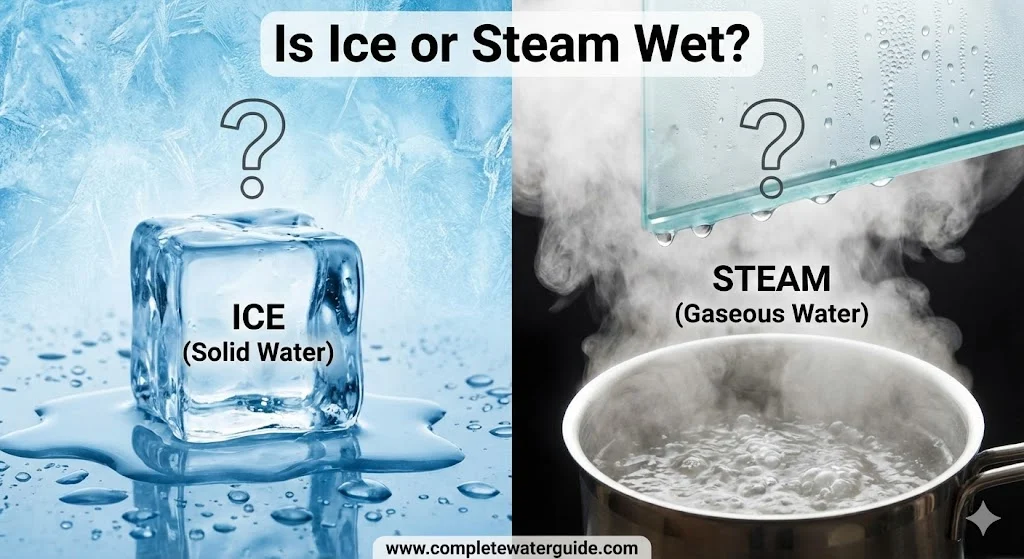

We know water is wet, but what about its other forms? When you touch an ice cube, your finger gets damp. When you walk through a steam room, you feel moisture. But scientifically, are ice and steam actually “wet” themselves, or is something else happening? Here’s an answer-first guide to the states of matter, condensation, and why “dry ice” lives up to its name.

Why Ice Feels Wet (But Isn’t)
To understand this, we have to look at the definition of “wetness.” As explained in our guide What Does Wet Mean in Science?, wetness is the interaction of a liquid adhering to a solid surface.
The Melting Effect:
Ice is frozen water molecules locked in a rigid lattice. Inside a freezer (below 32°F / 0°C), ice is completely dry. If you touched it with a glove chilled to the same temperature, it would feel like a dry rock. The “wetness” you feel is actually liquid water forming the instant the warmer air (or your finger) hits the ice surface.
The Steam Misconception
Most people point to the white cloud above a kettle and call it steam. In physics, that cloud is technically aerosolized liquid water (mist). Real steam is the invisible gas right at the spout.
- Dry Steam: This is pure water vapor gas. If you were inside a pipe of superheated dry steam, you wouldn’t get “wet”—you would be burned by the heat energy, but the gas itself is not a liquid.
- Wet Steam: This occurs when the gas begins to cool and turn back into liquid droplets. This is what makes your skin damp in a sauna.
Comparison: Which State is Actually Wet?
| Substance | State of Matter | Is It Wet? | Why It Feels Wet |
|---|---|---|---|
| Ice (in freezer) | Solid | No | It is a dry crystal until melted. |
| Melting Ice | Solid + Liquid coating | Yes (The surface) | Liquid water coats the solid core. |
| Dry Steam | Gas (Invisible) | No | Gas molecules do not adhere like liquid. |
| Visible Steam (Mist) | Liquid Aerosol | Yes | Tiny liquid droplets hit your skin. |
| Liquid Water | Liquid | Yes | It is the definition of wetness. |
This relates back to the core question: Is Water Wet?—wetness requires a liquid phase.
The “Dry Ice” Proof
The best way to prove that solids aren’t wet is to look at Dry Ice (frozen carbon dioxide). Unlike water ice, dry ice does not melt into a liquid; it sublimates directly into gas.
Because there is no intermediate liquid phase, you can touch dry ice (with gloves!) and it will never feel “wet.” It proves that being a frozen solid doesn’t make something wet—the melting does.
FAQs
Is ice wet when it is underwater?
Yes. If an ice cube is submerged in liquid water, the ice cube is “wet” because it is a solid object surrounded by and adhering to a liquid.
Why does steam burn you faster than boiling water?
This is due to the Latent Heat of Vaporization. Steam holds more energy than boiling water. When it hits your skin, it undergoes a phase change back to liquid, releasing a massive amount of extra heat energy instantly.
Is fog wet?
Yes. Fog is essentially a cloud at ground level—it is made of tiny liquid water droplets suspended in air. Walking through fog makes you wet because those droplets adhere to your clothes.
References
- USGS — The Water Cycle & States of Matter
- NASA — States of Matter
- Encyclopaedia Britannica — Phase Changes
What Readers Say (Verified)
Verified
The dry ice comparison perfectly explains why ice isn’t inherently wet. Great analogy.
Verified
Never realized the steam cloud isn’t actual steam. Fascinating read!
Verified
A bit technical with the latent heat part, but the table made it easy to understand.
Verified
Always wondered about this! Now I can win arguments at the pub. Cheers.
