Quick answer
These are not competing products. Reverse osmosis removes dissolved contaminants. An alkaline stage adjusts pH and adds minerals back at the end, after treatment has already happened. RO is worth it when a water test shows high TDS or contaminants that a membrane can reduce. If your water is already low in TDS and clean, a heavy RO system mostly wastes water. The alkaline stage is a taste preference, not a purification step. Test your water first, then buy.
This guide is written for readers in India, where municipal, borewell and tanker supply often reach the same household.
Most water purifier decisions in Indian homes are made in the wrong order. A salesperson arrives with a twelve-stage machine, lists the stages, mentions an alkaline booster, and quotes a price. Nobody has asked the one question that determines the entire answer: what is actually in the water coming into this house?
Without that, stage counts are just numbers. Here is how the two technologies differ, what each one genuinely does, and how to work out which your home needs.
Step one: find out what is in your water
Different sources behave differently, and most Indian households draw from more than one over the course of a year.
- Municipal supply is usually treated at source, but quality can degrade through old distribution pipes, intermittent supply and storage tanks.
- Borewell water often carries higher dissolved solids and hardness, and in some regions elevated fluoride, nitrate, iron or arsenic depending on local geology.
- Tanker water varies with the supplier and the source, and is the hardest to make assumptions about.
A laboratory test tells you the things a salesperson cannot: total dissolved solids, hardness, pH, and whether specific contaminants or microbiological indicators are present. It is a modest one-time cost against a purchase you will live with for years. If you are trying to work backwards from a symptom instead, our water problems troubleshooting guide maps common signs to likely causes.
The relevant benchmark in India is IS 10500, the Bureau of Indian Standards specification for drinking water. It sets an acceptable limit of 500 mg per litre for total dissolved solids, with up to 2000 mg per litre permissible only where no alternate source is available. For pH it sets a range of 6.5 to 8.5.
What reverse osmosis actually does
Reverse osmosis pushes water under pressure through a semi-permeable membrane whose pores are small enough to block most dissolved salts and many contaminants. It is the most effective domestic technology for reducing total dissolved solids, and it is capable of reducing heavy metals, fluoride, nitrate and a range of other dissolved substances.
That capability comes with three trade-offs that sellers rarely lead with.
- Reject water. RO produces a concentrated waste stream alongside the purified output. Older domestic units can send more water to the drain than they deliver to the tap. Newer designs are considerably more efficient, and some allow the reject stream to be diverted for washing or cleaning, but the waste does not disappear.
- Maintenance is not optional. Membranes foul and pre-filters clog. A neglected RO unit does not stop working in an obvious way, it quietly performs worse while still appearing to run normally.
- It removes useful minerals too. The membrane does not distinguish between calcium and magnesium and the things you want gone. This is why remineralisation cartridges exist.
The regulatory backdrop, accurately
Water wastage and demineralisation from RO systems have been the subject of a long-running legal case in India. The National Green Tribunal directed the Central Pollution Control Board to restrict RO purifiers in areas where TDS is below 500 mg per litre. The Water Quality India Association, representing manufacturers, appealed. In March 2022 the Supreme Court stayed the relevant direction and issued notices to the concerned ministries. As of publication, that stay remains and no final ruling has been publicly reported. Nothing here is a ban currently in force, and nothing here should be read as legal advice.
What the alkaline stage actually does
An alkaline stage sits at the end of the process, after purification. It raises the pH of water that has already been treated, usually by passing it over mineral media or, in an ionizer, by running it through an electrolysis chamber.
This is the point that changes most people’s thinking once they see it clearly: raising pH does nothing to make water safer. Water can be alkaline and still carry bacteria, and it can be alkaline and still carry dissolved contaminants. pH and contamination are two separate properties of the same glass of water.
So an alkaline water purifier for home use is not the part that protects you. It is the part that changes taste and mineral content after the protective work is already done.
On the health claims attached to alkaline water, the honest position is that the evidence is thin. Mayo Clinic’s view is that for most healthy people plain water is fine and the larger claims are not well supported. People with kidney disease should speak to their doctor before drinking alkaline water regularly. That is the limit of what can responsibly be said. We go through the research in detail in our guide to alkaline water vs regular water.
Why a TDS meter cannot answer this question
The handheld TDS meter is the most misunderstood object in this entire category.
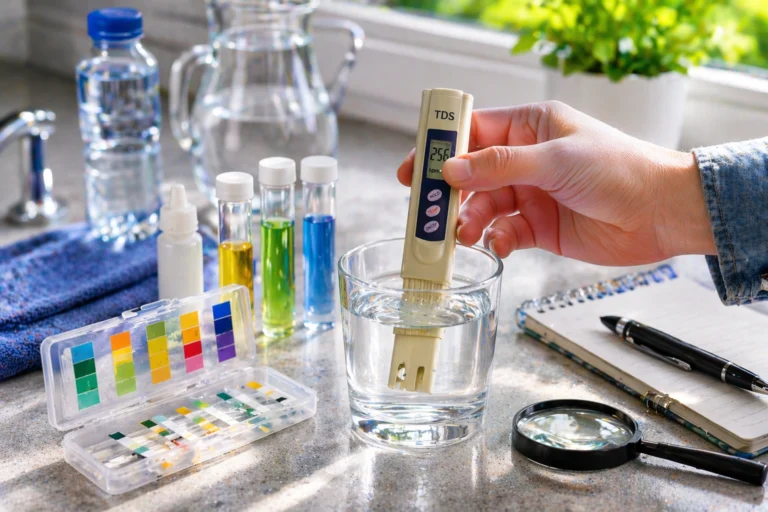
It works by measuring how well water conducts electricity, and converting that into an estimate of dissolved solids. That is genuinely useful for one thing: telling you roughly how mineralised your water is, and whether an RO membrane is still doing its job.
What it cannot do is identify anything. It cannot distinguish beneficial calcium from harmful nitrate. It cannot detect bacteria. It cannot see pesticides, most organic chemicals, or PFAS, because those are present at concentrations far too low to register on a conductivity reading.
A low TDS number therefore does not mean the water is safe, and a high one does not automatically mean it is dangerous. The World Health Organization has not set a health-based guideline value for TDS on its own, treating it largely as a matter of palatability. The US EPA lists TDS at 500 mg per litre as a secondary, aesthetic standard rather than a health limit. IS 10500 uses the same 500 mg per litre figure as an acceptable limit.
The number on the meter is a clue. It is not a verdict.
RO vs alkaline, side by side
| Reverse osmosis | Alkaline stage or ionizer | |
|---|---|---|
| Primary job | Removes dissolved contaminants | Raises pH, adds minerals back |
| Reduces TDS | Yes, substantially | No, it can raise it |
| Reduces heavy metals, fluoride, nitrate | Yes, depending on the unit | No |
| Handles bacteria | Membrane blocks most, but UV is usually paired | No |
| Wastes water | Yes, varies by efficiency | Minimal |
| Removes useful minerals | Yes, hence remineralisation | Adds them back |
| Ongoing maintenance | Pre-filters and membrane replacement | Cartridge or plate maintenance |
| Needed when | Test shows high TDS or specific contaminants | You prefer the taste or want minerals restored |
| Proven health benefit beyond safe water | Safety, yes. Health extras, no. | Not established |
So which one does your home need?
Framing it as RO purifier vs alkaline ionizer sets up a fight that does not exist. Plenty of units contain both, because they do different jobs at different points in the process. RO cleans. Alkaline adjusts. The real decision is whether you need the cleaning stage at all, and at what strength.
A workable sequence:
- Get the source water tested at a laboratory. If your building draws from more than one source, test the one you use most.
- Read the report against IS 10500. Look at TDS, hardness, pH, and any specific contaminants flagged.
- If TDS is high, or the report shows contaminants a membrane can reduce, RO makes sense. Ask about the recovery rate, which tells you how much water reaches the tap versus the drain.
- If TDS is already low and the water is otherwise clean, a heavy RO system is likely to strip minerals and waste water for little benefit. UV plus sediment and carbon filtration may be sufficient.
- Treat the alkaline stage as optional. Add it if you want the taste or the minerals, not because you believe it purifies.
- Retest after six to twelve months. Source water changes, and so does filter performance.
Some modern systems combine several technologies in one unit, including sediment and carbon filtration, reverse osmosis, UV, mineral balancing and alkaline ionisation. There is nothing wrong with that. Just make sure the combination is matched to your test report rather than to the number of stages printed on the box.
What actually deserves your attention
- Certification. Ask what the unit is certified against and by whom, and get it in writing.
- Recovery rate. How much water is delivered versus sent to the drain.
- Service reality. Filter cost, replacement interval, and whether service is available where you live.
- Your test report. It is the only document in this process that is about your water rather than someone’s product.
Stage counts, indicator lights and mineral-sounding brand names are marketing. So when people ask which water purifier is best, the accurate answer is the one that fixes the specific problem in their own water. There is no single winner, because there is no single water.
Frequently asked questions
Is an alkaline purifier better than RO?
They do different things. RO removes contaminants, an alkaline stage adjusts pH afterwards. An alkaline stage on its own does not purify water.
Do I need RO if my TDS is low?
Often not. If TDS is well below the IS 10500 acceptable limit of 500 mg per litre and the water is otherwise clean, RO adds water wastage and mineral loss without a clear benefit. Confirm with a test rather than a meter reading alone.
Can alkaline water kill bacteria?
No. Raising pH is not disinfection. Microbiological safety comes from UV, boiling, chlorination or an appropriate membrane, not from an alkaline stage.
Is a TDS meter enough to check my water?
No. It measures conductivity, so it cannot identify specific contaminants or detect bacteria. Use it to monitor membrane performance, not to judge safety.
Are RO purifiers banned in India where TDS is below 500?
No ban is currently in force. The National Green Tribunal issued a direction to that effect, the Supreme Court stayed it in March 2022, and no final ruling has been publicly reported since.
Sources
- Bureau of Indian Standards — IS 10500 Drinking Water Specification
- World Health Organization — Total Dissolved Solids in Drinking-water
- US EPA — Secondary Drinking Water Standards
- Mayo Clinic — expert answer on alkaline water
- ThePrint — Supreme Court stay on the NGT order concerning RO purifiers (March 2022)
Sponsor disclosure
This article was published in partnership with Dvine H2O, an Indian water-technology company working on filtration, reverse osmosis, alkaline ionisation and hydrogen-water systems for households. Complete Water Guide independently researched, wrote and fact-checked the content. The sponsor did not review or influence the technical conclusions. Links to the sponsor carry the rel="sponsored" attribute.