If your water softener water tastes salty, something is wrong: a working softener adds a little sodium, but GE’s support team says softened water “should not have a distinct salty taste.” A clear salty taste usually means brine was left in the system after regeneration, most often because of a kinked or blocked drain line, low water pressure, a plugged injector or a rinse that is set too short. Most of these are fixes you can check yourself in an hour.
We read the troubleshooting tables in the GE, Fleck, WaterBoss, Morton and Rheem softener manuals, GE’s support article on salty water, and University of Nebraska, Penn State and Ohio State Extension on sodium. Here is what causes the taste, how to fix it, and how much sodium a softener really adds.
Why does my water softener water taste salty?
During regeneration, the softener pulls salty brine through the resin and then rinses it to the drain. If the brine is not fully rinsed out, or leaks into the line you drink from, you taste it. These are the causes the manuals list:
| Cause | Manual | Fix the manual gives |
|---|---|---|
| Kinked, plugged or restricted drain hose | GE, WaterBoss | “Check for kinks in drain line” (GE); “Remove restriction” (WaterBoss) |
| Low water pressure | GE, WaterBoss, Rheem | “Maintain minimum pressure of 20 psi” (WaterBoss); 50 psi if the drain runs higher than 8 feet (GE) |
| Plugged injector, or dirty nozzle and venturi | Fleck, WaterBoss, GE | “Clean injector and screen” (Fleck); “Replace injector screen, nozzle, and throat” (WaterBoss) |
| Backwash or fast rinse set too short | Morton, Rheem | Increase the backwash and fast rinse times “in 1 minute increments” (Rheem) |
| Debris in the brine valve or brine line flow control | Fleck | “Replace brine valve seat and clean valve”; “Clean brine line flow control” |
| Too much water in the brine tank | WaterBoss, Fleck | “Verify correct water level relative to salt setting” (WaterBoss); clean the drain line flow control (Fleck) |
| Timer not cycling | Fleck | “Replace timer.” |
| Brine valve dripping back into the tank, or pressure drops from the supply | WaterBoss | Clean the brine valve housing and replace the piston; add a check valve on the inlet line |
Morton puts the rinse cause plainly: “Setting backwash and/or fast rinse times too low may result in salty tasting water after regeneration.” Rheem says, “If you experience salty tasting water after recharge, you may need to increase the backwash and fast rinse times,” and allows adding “up to 15 minutes.”
Water softener water tastes salty: what to check first
Here is the order we would work in, cheapest and most likely first:
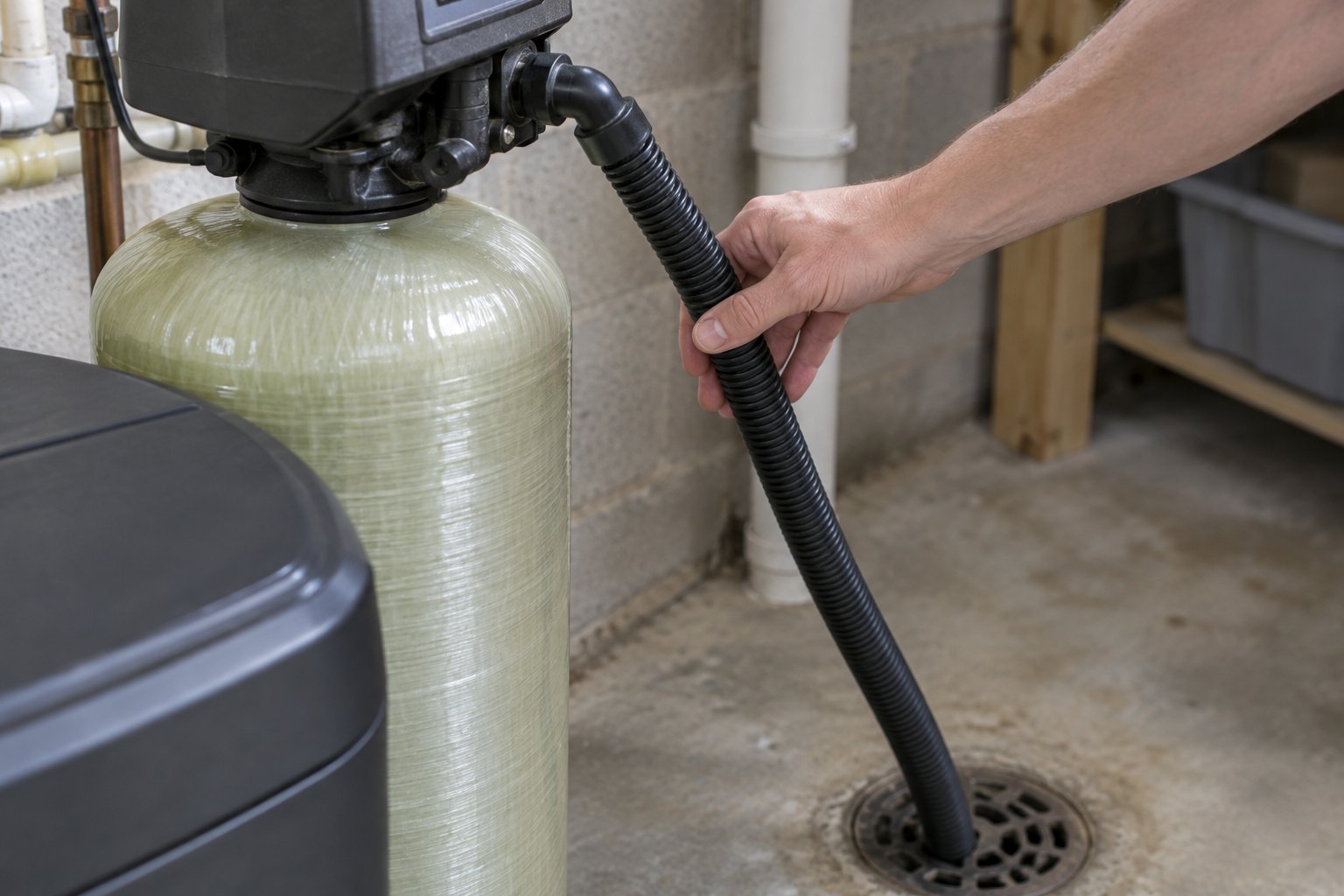
- Look at the drain hose. GE’s support article says, “It is possible that you have a kink in the drain hose that is not allowing the softener to regenerate properly.” Walk the whole length of the hose. GE’s manual adds that a drain hose that is pinched, plugged, run too high or otherwise restricted can stop the brine from being drawn and rinsed properly.
- Check your water pressure. GE says a drain that rises 8 feet or less needs at least 20 psi, and one that rises higher needs at least 50 psi. Rheem notes that “low pressure may disrupt brine draw during recharge.” A gauge on an outdoor spigot tells you in a minute.
- Look at the water level in the brine tank. Too much water there is its own fault and often comes with the salty taste. Our guide to water softener salt level covers what normal looks like.
- Run a full regeneration, then flush. GE’s manual says that at the end of the recharge cycle, which takes about two hours, you should “run water from faucets to purge the salty water.” GE’s support team says, “If it continues to have a distinct salty taste after a complete regeneration cycle, we recommend service.”
- Lengthen the rinse, if your model allows it. Rheem says to increase backwash and fast rinse times in 1 minute steps.
- Clean the injector or venturi. This is the part that pulls brine from the tank. Fleck, WaterBoss and GE all list a plugged injector or venturi as a cause.
Why does my water taste salty right after the softener regenerates?
Because brine is still in the pipes. Regeneration takes time: University of Nebraska Extension says “sixty to 120 minutes generally are required for the brine to pass through the unit and flush the tank before soft water is available again.” If someone runs water during that window, or the rinse is too short, salty water can reach a tap.
Two habits help. Rheem says to “avoid using hot water while the softener is regenerating, as the water heater will fill with hard water,” which is one reason most units regenerate at night. If the taste only shows up first thing in the morning and fades after a minute of running the cold tap, the rinse is probably borderline, and lengthening it is the fix. Our guide to water softener noises explains the regeneration stages and timing.
Is it safe to drink water from a water softener?
For most people, yes, as long as it does not taste distinctly salty. Here is how much sodium softening adds:
- Nebraska Extension: “sodium is added to water at a rate of about 8 mg/L for each grain per gallon (gpg) of hardness,” so “water that was 10 gpg of hardness will have about 80 mg/L of sodium.”
- Penn State Extension: “7.5 milligrams per quart for each gpg of hardness removed,” which works out to the same thing.
To put that in context, the FDA’s Daily Value for sodium is “less than 2,300 milligrams (mg) per day,” and “Americans eat on average about 3,400 mg of sodium per day.” Our arithmetic: if your water was 10 gpg and you drink 2 liters a day of softened water, that is about 160 mg of sodium, roughly 7% of the daily limit. Harder water means more: 20 gpg doubles it.
The exception is anyone on a low-sodium diet. Penn State calls this “the major disadvantage to water softening,” and Nebraska says people on restricted sodium diets “should account for increased intake through softened water and consult their physician.” Ohio State Extension says, “If you are concerned about your water softener contributing to the sodium in your drinking water, talk with your doctor.”
What we would buy for this job
- CARBO 0 to 200 psi water pressure test gauge, 3/4 inch hose thread: screws onto an outdoor spigot so you can check you are above the 20 psi minimum the manuals give. The red max pointer catches overnight spikes.
As an Amazon Associate, Complete Water Guide earns from qualifying purchases. Prices change, so check the listing.
How do you get softened water that does not taste salty for drinking?
Three options from the extension services:
- Bypass the kitchen tap. Nebraska says drinking and cooking with softened water “is often avoided by having a cold water line to the kitchen tap that bypasses the water softener.” This is a common fix and the one we would choose.
- Add reverse osmosis at the sink. Ohio State lists reverse osmosis and distillation as ways to remove sodium from drinking water. Our guide to the best reverse osmosis systems covers the options.
- Switch to potassium chloride. Nebraska says “potassium chloride may be used for softener regeneration instead of sodium chloride,” but warns it “can be more costly and more difficult to obtain,” “adheres more strongly to the resin,” and may “require more potassium chloride.” It suggests talking to a water treatment professional first.
Is my softener using too much salt?
If the water tastes salty and you are also going through salt fast, check the settings. Fleck’s manual lists “unit uses too much salt” with the causes “improper salt setting” and “excess water in brine tank,” and the fix “check salt usage and salt setting.” GE lists “hardness setting too low” for a softener that is not softening. Nebraska says that if a unit “appears to use more salt than expected or water is not softened, have a service provider check the unit settings.” Our guides on softener sizing and settings and signs a softener needs repair go further.
Frequently asked questions
Is it normal for softened water to taste salty?
No. A softener adds some sodium, but GE’s support team says softened water should not have a distinct salty taste. A clear salty taste points to brine left in the system, usually from a drain line, pressure, injector or rinse problem.
How do I get rid of salty taste after regeneration?
Run cold water from the faucets after the recharge finishes, as GE’s manual says. If the taste keeps coming back, check the drain hose for kinks, confirm your water pressure is at least 20 psi, and lengthen the backwash and fast rinse times if your model allows it.
Can low water pressure make softened water salty?
Yes. WaterBoss lists low water pressure as a cause of salty water and says to maintain at least 20 psi. GE says a drain line that rises more than 8 feet needs at least 50 psi.
How much sodium does a water softener add?
About 8 mg per liter for each grain per gallon of hardness removed, according to Nebraska Extension. Water that was 10 gpg hard ends up with about 80 mg/L of sodium.
Should I drink softened water on a low-sodium diet?
Ask your doctor first. Nebraska and Ohio State Extension both say people on sodium-restricted diets should account for it, and the common fix is a kitchen cold-water line that bypasses the softener.
When should I call for service?
When the water still tastes distinctly salty after a complete regeneration cycle and you have ruled out the drain hose and water pressure. That is GE’s own advice.
Sources
- GE Appliances, Water Softener: Softened Water Tastes Salty, and GXSHC40N and GXSH40V/45V owner’s manuals.
- Pentair Fleck, 5600 and 5600SXT service manuals.
- WaterBoss, Models 700, 900 and 950 owner’s manual.
- Morton, M20 to M34 and MC30 installation and operation manual.
- Rheem, RHS32 water softener manual.
- University of Nebraska-Lincoln Extension, Drinking Water Treatment: Water Softening (Ion Exchange), G1491.
- Penn State Extension, Water Softening.
- Ohio State University, Ohio Watershed Network, Sodium.
- U.S. FDA, Sodium in Your Diet.