
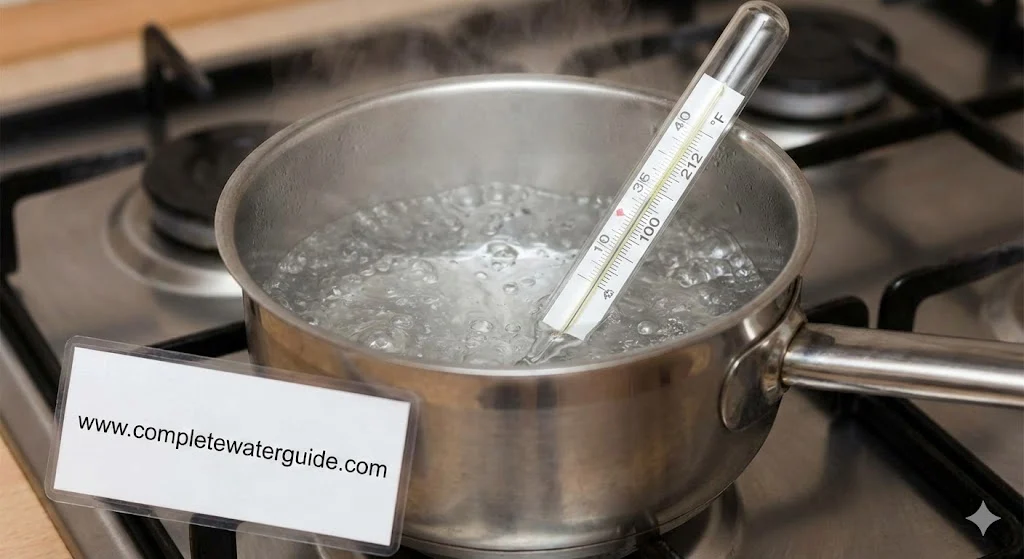

What Temperature Does Water Boil? The Complete Guide to Boiling Point
Updated on , Everyday science explained
Most people learn in school that water boils at 100°C, but this is only true under specific conditions. In daily life, boiling temperature can change due to pressure, altitude, and impurities. Understanding boiling helps in cooking, science experiments, and temperature-dependent tasks like sterilization.
What Is the Boiling Point?
The boiling point is the temperature at which a liquid changes into vapor. This happens when water’s vapor pressure equals the surrounding atmospheric pressure. According to the USGS Water Science School, boiling occurs when molecules gain enough energy to escape into the air.
Why Water Boils at 100°C at Sea Level
- Air pressure is 1 atm: Standard atmospheric pressure supports boiling at 100°C.
- Molecular energy: Water molecules break hydrogen bonds at this temperature.
- Vapor pressure = air pressure: Once equal, boiling begins.
This is why science experiments and recipes assume 100°C — it’s the universal standard at sea level.
How Altitude Affects Boiling Temperature
At higher altitudes, air pressure drops. With less pressure pushing down on the water, it requires less heat to boil. This means water boils sooner — at a lower temperature.
- 1,000 meters: Water boils at ~96°C
- 2,000 meters: Water boils at ~93°C
- 3,000 meters: Water boils at ~90°C
This is why cooking in the mountains takes longer — water never reaches 100°C.
How Pressure Changes Boiling Point
Pressure and boiling point are directly related. The higher the pressure, the higher the boiling point. The lower the pressure, the lower the boiling point.
- Pressure Cooker: Increases pressure → water boils at 110–121°C → food cooks faster.
- Vacuum Chamber: Low pressure → water can boil at room temperature.
Does Salt Change the Boiling Point?
Yes — this is called boiling point elevation. Adding salt increases the boiling temperature, but not significantly for normal cooking.
- 1 teaspoon salt in 1 liter → boiling increases by only 0.5–1°C
- Large amounts of salt needed for noticeable change
Everyday Examples
- Boiling water in Shimla happens at a lower temperature than in Mumbai.
- Pressure cookers raise boiling point and reduce cooking time.
- Pasta water takes slightly longer to boil if heavily salted.
- Water can boil at room temperature inside a vacuum pump.
At-a-Glance: Boiling Point Variations
| Condition | Boiling Temperature | Example |
|---|---|---|
| Sea Level | 100°C (212°F) | Normal cooking |
| High Altitude | 90–95°C | Mountain regions |
| Pressure Cooker | 110–121°C | Fast cooking |
| Salted Water | 100–101°C | Cooking pasta |
What Scientists Say
According to NOAA, USGS, and various chemistry textbooks, the boiling point is not fixed — it depends on pressure and impurities. Under controlled conditions (1 atm), water reliably boils at 100°C. Under different pressures, this temperature shifts, sometimes dramatically.
FAQs
What temperature does water boil?
- At sea level: 100°C (212°F). Under other conditions, it varies.
Does water boil faster at high altitudes?
- It boils sooner (at a lower temperature), but cooking takes longer.
Does adding salt make water boil faster?
- No. Salt increases boiling temperature, so it actually takes slightly longer to boil.
Want to explore more about water and its behaviors? You might also like our articles on whether water itself is wet,how long you can go without water,whether sparkling water affects teeth, and recommended daily water intake.
