How often should a water softener regenerate? For most homes, every 3 to 14 days: Morton says its softeners typically regenerate every 3 to 7 days, and Culligan says anywhere from every few days to every couple of weeks. The right number for your house comes from three things: how hard your water is, how much water you use, and how much capacity the softener has at its salt setting.
Below is a chart that works it out for one to five people at common hardness levels, what the “day override” setting does, how long a regeneration takes, and what to check if yours regenerates too often.
What decides how often a softener regenerates?
A modern softener counts the gallons that pass through it and regenerates when it has removed close to its capacity in grains of hardness. Culligan calls this demand regeneration: it is “based on how many gallons can be treated before the system regenerates.”
The math is simple. Daily grains = gallons used a day x hardness in grains per gallon. Morton’s own example is a family using 400 gallons a day at 10 grains per gallon, which needs 4,000 grains of capacity a day. Divide the softener’s capacity by that number and you get the days between regenerations.
There is one more limit. Most metered softeners also have a day override, a maximum number of days between regenerations even if the capacity is not used up. We cover it below.
How often should a water softener regenerate, by household?
Here are the days between regenerations for a softener with 30,000 grains of usable capacity. We used EPA WaterSense’s figure that each American uses about 82 gallons a day at home, and assumed all of it goes through the softener.
| People | Gallons a day | 10 gpg | 15 gpg | 20 gpg |
|---|---|---|---|---|
| 1 | 82 | 36.6 days* | 24.4 days* | 18.3 days* |
| 2 | 164 | 18.3 days* | 12.2 days | 9.1 days |
| 3 | 246 | 12.2 days | 8.1 days | 6.1 days |
| 4 | 328 | 9.1 days | 6.1 days | 4.6 days |
| 5 | 410 | 7.3 days | 4.9 days | 3.7 days |
*Longer than a typical day override, so the softener regenerates on the override day instead, usually 12 or 14 days. A softener set to a lower salt dose has less capacity per regeneration, so all of these numbers shrink. Our guide to the high efficiency water softener rating shows how much capacity changes with the salt setting.
What the chart shows: a family of four with hard water lands in Morton’s 3 to 7 day range. One or two people with moderate hardness rarely use up the capacity, so their softener is mostly regenerating on the day override.
What is the day override on a water softener?
It is the most days the softener will go without regenerating, even when it has capacity left. The A.O. Smith metered softener manual says the setting “represents the maximum number of days between regenerations,” adjustable from 1 to 28 days or OFF, with 12 days as the factory default. The Hellenbrand manual uses the same 1 to 28 day range with a factory setting of 14 days.
A.O. Smith explains the two choices: with a number set, “a regeneration will be scheduled for that day if the gallon capacity has not been met.” With OFF, “the unit will only initiate a regeneration once the gallon capacity has been met.” For a one or two person home, a long gap or OFF saves salt, but check your manual for what the maker recommends for your water.
How do I know how often my water softener regenerates?
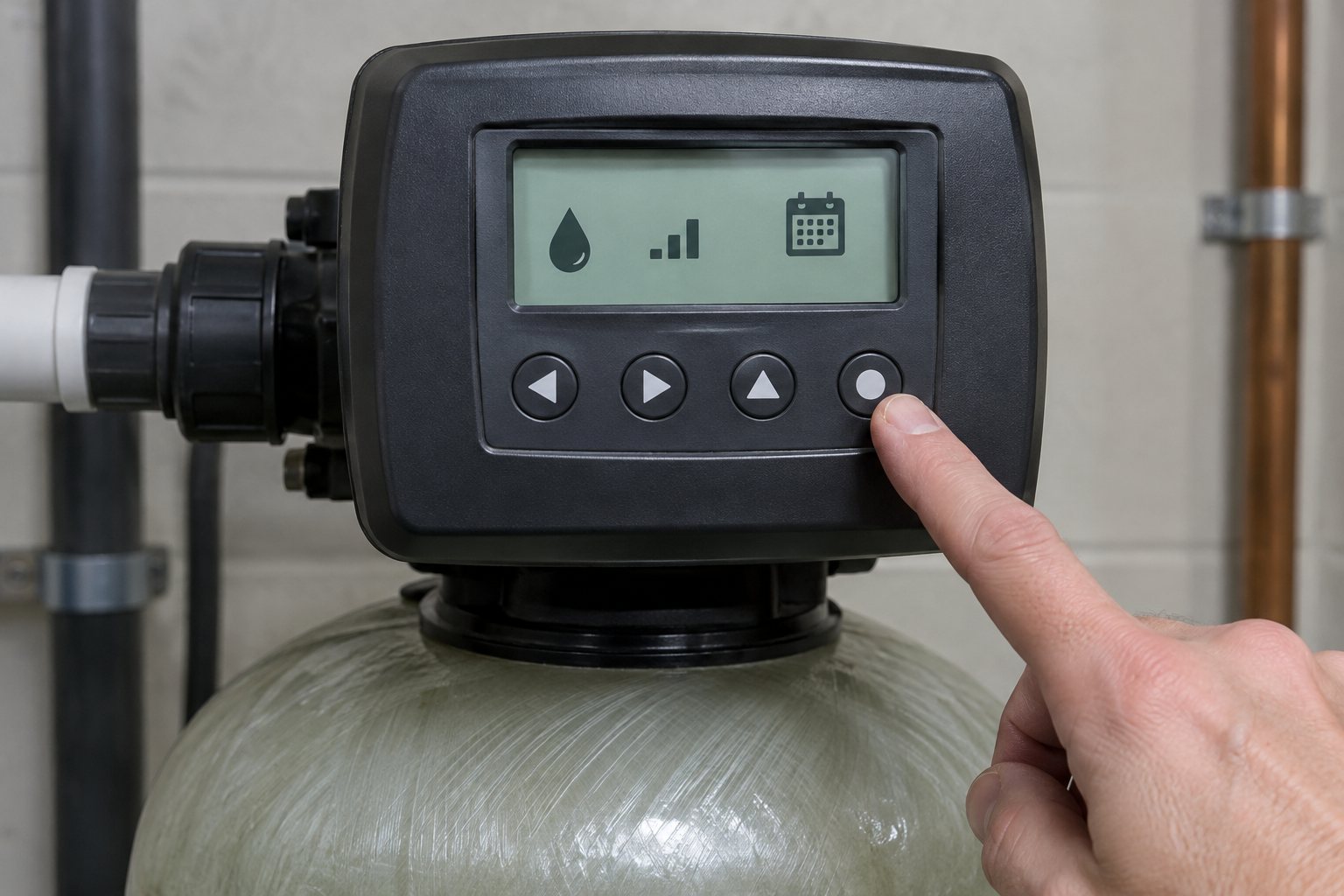
Look at the display. Metered softeners show the gallons left before the next regeneration, and many also show the days left. The A.O. Smith manual lists a “Capacity Remaining” screen with “the amount of gallons of treated water remaining until the system triggers a regeneration,” and a “Days to a Regen” screen.
Check it at the same time on two mornings. If the gallons remaining drop by about what your household uses in a day, the meter is working. If they drop overnight when nobody used water, you have a leak or a running toilet, and the softener is counting it.
How long does a water softener regeneration take?
About 70 minutes to 2 hours. Morton says its softeners take about 2 hours to complete a regeneration, and Culligan cites a single cycle of 70 to 90 minutes. Most are set to run at 2:00 a.m., the factory default in both the A.O. Smith and Hellenbrand manuals, because the house gets hard water while it runs. If you hear water running at night, our guide to a water softener making loud noise covers which sounds are normal.
Can a water softener regenerate too often?
Yes, and it wastes salt and water each time. Culligan’s point is that the right frequency “balances efficiency and performance, ensuring consistent soft water without wasting excess salt or water.” These are the causes we would check, in order:
- Hardness set too high. The A.O. Smith manual says the hardness number “will only impact the frequency of regeneration,” so an inflated setting means extra regenerations with no softer water. Test your water and set the real number.
- Iron added twice, or not at all. If you have soluble iron, A.O. Smith says to increase the hardness setting by 4 grains per gallon for every 1 ppm of iron. Do it once, from a real test.
- A leak or running toilet. Every gallon through the meter counts against capacity, even gallons going down a toilet flapper.
- Day override set too short. A 3 day override on a two person home regenerates far more often than the water needs.
- Salt dose set very low. A low dose is the most salt-efficient setting, but it gives less capacity, so regenerations come more often. That is expected, not a fault.
- Softener too small. If a correctly set softener still regenerates every day or two, it is likely undersized, and our ranking of the best water softeners lists capacities by model. Our water softener sizing guide shows how to check.
What we would buy for this job
- Varify water hardness test strips, 0 to 25 gpg: test the water before you set the hardness. A setting that is too high makes the softener regenerate more often than it needs to.
- Geevon water leak detector alarms, 2 pack: a slow leak or running toilet counts against the softener meter. One alarm by the softener and one by the water heater catch leaks early.
As an Amazon Associate, Complete Water Guide earns from qualifying purchases. Prices change, so check the listing.
How long should a 40 lb bag of salt last in a water softener?
About a month for an average household, by Morton’s figure: it says the average household uses “approximately two bags every two months.” Your number depends on hardness, water use and the salt setting. In our example family of four at 15 grains per gallon, a softener on its low salt dose uses about 352 pounds a year, so a 40 lb bag lasts about 41 days; at its maximum dose, about 677 pounds a year, a bag lasts about 22 days. Our guide to water softener salt level covers how full to keep the tank.
How many gallons should I set my water softener to regenerate?
On most metered softeners you do not set gallons directly. You enter the hardness, and the control works out the gallons from the softener’s capacity: capacity in grains divided by hardness in grains per gallon. A 30,000 grain softener at 15 grains per gallon treats about 2,000 gallons between regenerations.
Frequently asked questions
How often should a water softener regenerate?
Usually every 3 to 14 days. Morton says its softeners typically regenerate every 3 to 7 days, and Culligan says every few days to every couple of weeks, depending on hardness, water use and system size.
Can you regenerate a water softener too much?
Yes. Each extra regeneration uses salt and water without making the water softer. The usual causes are a hardness setting that is too high, a leak, or a day override set too short.
How long does a water softener regeneration take?
About 70 minutes to 2 hours. Morton says about 2 hours, and Culligan cites 70 to 90 minutes. Most softeners are set to regenerate at 2:00 a.m.
How do I know how often my water softener regenerates?
Check the display. Metered softeners show the gallons of capacity remaining and often the days to the next regeneration. Compare the reading on two mornings to see your daily use.
Should a water softener regenerate every night?
Not normally. Nightly regeneration usually means the hardness is set too high, the softener is too small for the household, there is a leak, or the day override is set to one day.
How long should a 40 lb bag of salt last?
About a month for an average household, based on Morton’s figure of two bags every two months. In our example family of four, a bag lasts about 41 days on a low salt setting and about 22 days on the maximum.
Sources
- Morton Water Softeners, Water Softener FAQs: typical regeneration every 3 to 7 days, about 2 hours, 2 a.m. timing, 400 gallon x 10 grain example, two bags every two months.
- Culligan, “How often should a water softener regenerate?”, updated May 7, 2026: every few days to every couple of weeks, demand regeneration, 70 to 90 minute cycle.
- A.O. Smith, Metered Water Softeners Installation Instructions and Owner’s Manual (APR, APRCAB, APRC models): day override 1 to 28 days or OFF, 12 day default, 2:00 a.m. default, iron 1 ppm = 4 gpg, capacity remaining display.
- Hellenbrand, consumer manual 800540: day override 1 to 28 days, 14 day factory setting, 2:00 a.m. factory regeneration time.
- U.S. EPA WaterSense, Statistics and Facts: 82 gallons per person per day at home.