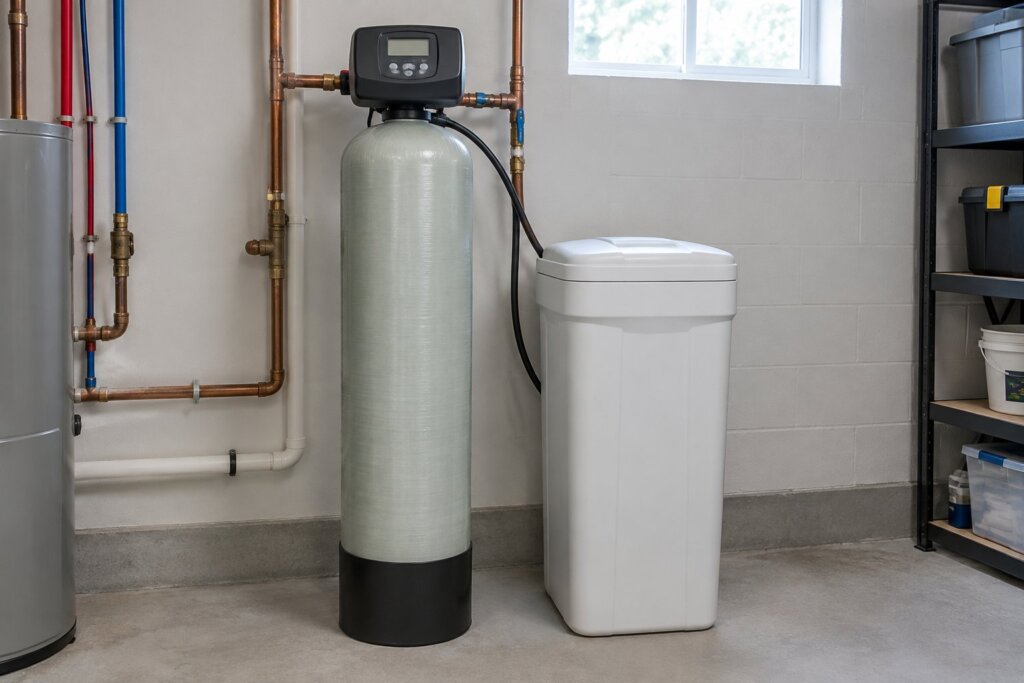
A high efficiency water softener is one that meets the efficiency rating in NSF/ANSI 44: it removes at least 3,350 grains of hardness per pound of salt, uses no more than 5 gallons of water per 1,000 grains removed, and regenerates on demand rather than on a timer. “High efficiency” on a box is a sales phrase. The rating is the part you can check.
The bigger surprise is that the same softener can pass or fail that bar depending on one setting. In the maker charts we checked, a softener set to its lowest salt dose removes about 5,100 grains per pound of salt, and the same unit at its maximum dose drops to about 2,650, below the NSF line. Here is what the rating requires, how much salt and water it saves, and how to set yours.
What makes a water softener high efficiency?
Three things, all from the voluntary efficiency section of NSF/ANSI 44, the standard residential softeners are certified to. The U.S. Department of Energy’s Building America Solution Center, run by Pacific Northwest National Laboratory, lists them for an efficiency rated system:
- Salt efficiency: at least 3,350 grains of hardness removed per pound of salt (477 grams per kilogram).
- Water efficiency: no more than 5.0 gallons of water per 1,000 grains of hardness removed.
- Demand-initiated regeneration: the softener must start a regeneration from a flow meter or a hardness sensor. In the guide’s words, devices that use time clock-initiated regeneration “do not qualify for the efficiency rating.”
NSF’s own certification listings mark these softeners with an [ER] code, defined as achieving “a minimum of 3,350 grains of hardness removed per pound of regenerant salt.”
Is “high efficiency” a regulated term?
No. Any maker can print it. What is defined is the NSF/ANSI 44 efficiency rating, and PNNL’s guide points buyers to the listings kept by NSF, the Water Quality Association’s Gold Seal program and UL to confirm it. If a high efficiency water softener is not on one of those listings, treat the claim as advertising.
Some places set a higher bar. In an EPA WaterSense meeting on a possible softener label, EPA noted it might adopt California’s salt efficiency requirement of 4,000 grains per pound. EPA later withdrew its plan for a WaterSense softener label. Its water softener guidance now tells buyers to choose one certified to NSF/ANSI 44, so there is no EPA badge to look for.
Does the salt setting change a softener’s efficiency?
Yes, a lot, and most buyers never see it. Softeners let you choose how much salt goes into each regeneration. A light dose recharges the resin partway and uses the salt very efficiently. A heavy dose squeezes out the last of the capacity but wastes salt doing it.
These are the capacity charts from four makers’ manuals, the same ones behind our ranking of the best water softeners. We divided the grains each setting removes by the pounds of salt it uses:
| Model | Low salt dose | Medium dose | Maximum dose |
|---|---|---|---|
| Whirlpool WHES48 | 14,300 grains @ 2.8 lb = 5,107 per lb | 37,900 @ 10.5 lb = 3,610 per lb | 48,000 @ 18.1 lb = 2,652 per lb |
| GE GXSH40V | 11,700 @ 2.3 lb = 5,087 per lb | 31,500 @ 8.7 lb = 3,621 per lb | 40,000 @ 15.1 lb = 2,649 per lb |
| Morton M34 | 13,700 @ 2.7 lb = 5,074 per lb | 29,200 @ 8.6 lb = 3,395 per lb | 34,900 @ 14.5 lb = 2,407 per lb |
| Whirlpool WHES30 | 14,700 @ 2.9 lb = 5,069 per lb | 25,400 @ 8.0 lb = 3,175 per lb | 30,100 @ 13.1 lb = 2,298 per lb |
Every one of them clears 3,350 at the low dose, and every one falls below it at the maximum dose. The capacity on the box, 48,000 grains for example, is the maximum-dose number. So a softener bought as “high efficiency” and set to its biggest capacity is not running efficiently.
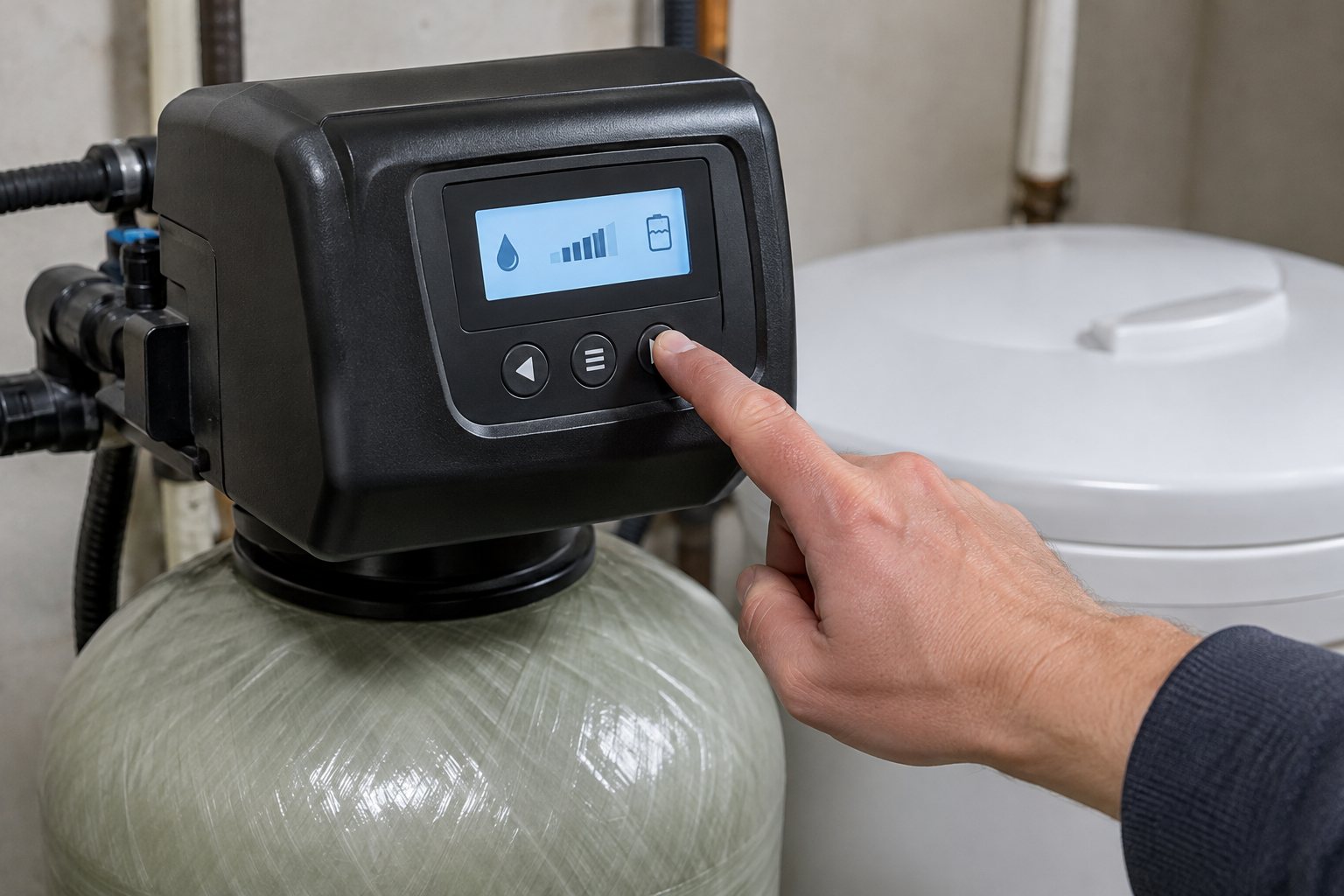
How much salt and water does a high efficiency softener save?
For a family of four with 15 grains per gallon of hardness, roughly 300 to 600 pounds of salt a year depending on the setting, and several thousand gallons of water. We worked it out from EPA WaterSense’s figure that each American uses an average of 82 gallons a day at home.
Four people at 82 gallons is 328 gallons a day. At 15 grains per gallon that is 4,920 grains a day, or about 1.8 million grains a year, assuming all the household water is softened.
| Salt efficiency | Salt a year | 40 lb bags a year |
|---|---|---|
| 5,107 grains per lb (low dose) | about 352 lb | about 9 |
| 3,350 grains per lb (NSF minimum) | about 536 lb | about 13 |
| 2,652 grains per lb (maximum dose) | about 677 lb | about 17 |
Water follows the same pattern. At 2.3 gallons per 1,000 grains, the best rating in our table of manuals, regeneration uses about 4,100 gallons a year. At the 5.0 gallon NSF limit it is about 9,000 gallons. EPA’s WaterSense team estimated that beating the NSF water limit by just 20 percent could save between 1,000 and 6,000 gallons per softener per year.
Your numbers will differ with your hardness, household and how much water bypasses the softener, but the gap between settings holds.
Why do timer softeners use more salt?
Because they regenerate on a schedule whether or not the resin is used up. EPA’s WaterSense presentation calls many existing softeners “inefficient timer-based units that regenerate on a prescribed time interval.” A week with guests and a week away cost the same salt.
A demand-initiated softener counts the water that has passed through, or senses hardness, and regenerates only when the resin is near its limit. That is why NSF will not give the efficiency rating to a timer unit. If your old softener has a clock dial and no flow meter, that alone is a reason to consider replacing it when it fails; our guide to what a water softener costs covers the price side.
Which water softener is the most efficient?
Among the NSF-listed models we checked, the four in the table above all reach about 5,000 to 5,100 grains per pound of salt at their lowest dose. For water, the Morton M34 and Whirlpool WHES30 manuals list 2.3 gallons per 1,000 grains, the lowest of the group. Salt efficiency at the low setting is close enough between them that the right size for your home matters more than the brand; our water softener sizing guide walks through it.
How do you set a softener for the best efficiency?
Get the hardness right, then use the lowest salt setting that still gives you a sensible gap between regenerations. In order:
- Test your hardness. Use a test strip or your utility’s water report, and enter the number in grains per gallon. Setting it too high makes the softener regenerate early and waste salt.
- Check the manual for iron. If you have clear-water iron, your manual may ask you to raise the hardness setting. Use the figure it gives.
- Choose the lower salt setting. It uses salt far more efficiently, as the table shows. The trade-off is less capacity per regeneration, so the softener regenerates more often, and each regeneration uses water.
- Keep the brine tank healthy. A salt bridge or mushy salt makes the softener think it regenerated when it did not. Our guide to water softener salt level covers how full the tank should be.
What we would buy for this job
- Varify water hardness test strips, 0 to 25 gpg: test your hardness before you set the softener. A hardness setting that is too high makes a demand softener regenerate early and waste salt.
- Morton Clean and Protect water softener salt pellets, 40 lb, 2 pack: high-purity pellets, the type the Whirlpool and GE manuals recommend. Do not mix salt types in one tank.
As an Amazon Associate, Complete Water Guide earns from qualifying purchases. Prices change, so check the listing.
Is a high efficiency water softener worth it?
If you are buying a softener anyway, yes, in our view. A demand-initiated, NSF efficiency rated model costs you nothing extra to run efficiently, and in our example the gap between the low and maximum dose is about 325 pounds of salt a year. Just check the listing rather than the label, and set it to a low dose. If your current softener is a working demand unit, changing the salt setting may get you most of the savings without buying anything.
Which salt you use matters less than how much; our comparison of softener salt pellets vs crystals covers that choice.
Frequently asked questions
What is a high efficiency water softener?
One certified to the efficiency rating in NSF/ANSI 44: at least 3,350 grains of hardness removed per pound of salt, no more than 5 gallons of water per 1,000 grains, and regeneration started by a flow meter or hardness sensor, not a timer.
Which water softener system is the most efficient?
Among NSF-listed models we checked, the Whirlpool WHES48, GE GXSH40V, Morton M34 and Whirlpool WHES30 all reach about 5,000 to 5,100 grains per pound of salt at their lowest salt dose. The Morton M34 and WHES30 list the lowest water use, 2.3 gallons per 1,000 grains.
Do high efficiency water softeners use less salt?
Yes, when set to a low salt dose. In our example family of four at 15 grains per gallon, a low dose uses about 352 pounds of salt a year, while the same softener at its maximum dose uses about 677 pounds.
Does a timer water softener qualify as high efficiency?
No. NSF/ANSI 44’s efficiency rating requires demand-initiated regeneration, so softeners that regenerate on a fixed time schedule do not qualify.
Is there a WaterSense label for water softeners?
No. EPA started work on a WaterSense softener specification and later withdrew the plan. Its consumer guidance says to choose a softener certified to NSF/ANSI 44, so look for that standard’s efficiency rating instead.
Why does my efficient softener use so much salt?
Usually because it is set to its maximum salt dose or the hardness setting is too high. At maximum dose the four softeners we checked fall to about 2,300 to 2,650 grains per pound of salt, below the NSF efficiency minimum.
Sources
- Pacific Northwest National Laboratory, Building America Solution Center (U.S. DOE): Water Softeners guide, NSF/ANSI 44 efficiency rated system criteria.
- NSF International certified product listings, Standard 44: [ER] softener efficiency definition.
- U.S. EPA WaterSense, Cation Exchange Water Softener Notification of Intent presentation (2017 upload): NSF 44 voluntary requirements, timer-based units, California 4,000 grains per pound, 1,000 to 6,000 gallon savings estimate.
- U.S. EPA WaterSense, Statistics and Facts: 82 gallons per person per day at home; Cation Exchange Water Softeners page: choose a softener certified to NSF/ANSI 44.
- Association of Metropolitan Water Agencies: EPA withdrew its plan to develop a WaterSense softener specification.
- Owner’s manuals and capacity charts: Whirlpool WHES48 and WHES30, GE GXSH40V, Morton M34 (as compiled on our best water softeners page).