If your water softener keeps regenerating, there are two different problems that look alike. Either it starts a new regeneration far too often, which points to a wrong setting or a hidden leak, or it starts one and never finishes, which points to the control valve. Whirlpool’s support team names a leak or incorrect programming as the reasons its softeners recharge too often, and Pentair’s Fleck 5600SXT manual puts a drain that flows continuously down to a valve that is not positioning correctly, debris in the control or an internal leak.
Below we show how to tell which problem you have, then go through the five causes in the order we would check them.
Is it regenerating too often, or stuck in regeneration?
Listen and look. A regeneration has several steps and runs water to the drain for part of it, so some sound of running water is normal during a cycle. What matters is how often and how long.
| What you notice | What it usually means |
|---|---|
| A full cycle every night, salt going fast, but each cycle ends | Regenerating too often: settings or water use |
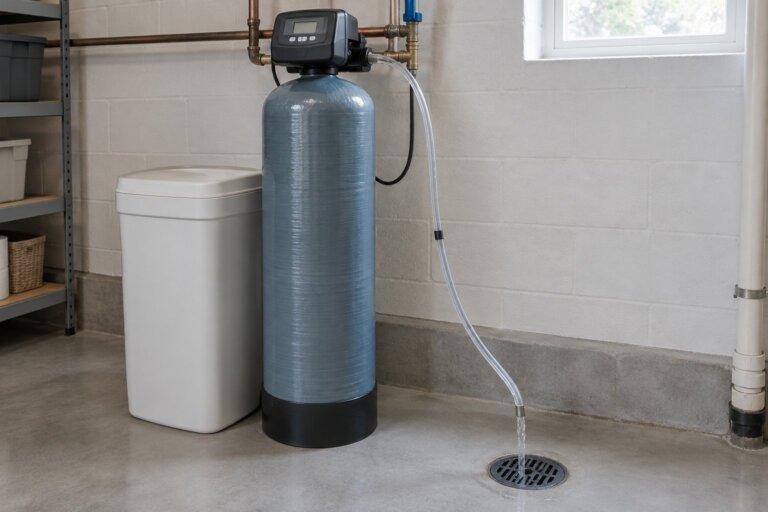
| Water runs to the drain for hours or all day | Stuck in a cycle: valve, motor or control |
| Display shows an error code | Control or valve fault; look up the code |
| Started after a power cut | Lost settings or a cycle that was interrupted |
How often should a water softener regenerate?
Usually every few days to every couple of weeks. Culligan says a softener may regenerate every couple of days to every couple of weeks, depending on hardness, water use and the system, and that it should regenerate as rarely as it can while still giving soft water. Our guide on how often a water softener should regenerate has a chart by household size.
You can check your own number. The Fleck manual explains that a metered softener works out how many gallons it can treat by dividing its capacity in grains by the water hardness, then keeps a reserve back. Here is a worked example with round numbers:
- A softener with 24,000 grains of usable capacity, on water at 15 grains per gallon, treats about 1,600 gallons between regenerations (24,000 ÷ 15).
- The EPA’s WaterSense program says the average American family uses more than 300 gallons of water a day at home.
- At 300 gallons a day, 1,600 gallons lasts a little over five days, before the reserve is taken off.
If your softener regenerates every night on numbers like these, something is wrong. If the water is very hard or the softener is small for the house, frequent regeneration can be correct.
Water softener keeps regenerating: what causes it?
1. The hardness setting is too high
Whirlpool’s first step is to check that the hardness programmed into the unit matches the hardness and iron in your incoming water, because the higher the number, the more often the softener recharges. A setting typed in as parts per million instead of grains per gallon, or a guess from an old test, can make it regenerate far too often. Test your raw water, then follow our guide to the water softener hardness setting.
2. A hidden leak is using water
A metered softener counts every gallon that passes through it. A running toilet, a dripping faucet, a leaking outdoor tap or an irrigation line on softened water all add gallons, so it regenerates sooner. Culligan’s expert gives extra irrigation or an unexpected leak as the first thing to consider when a demand softener regenerates more than expected.
Whirlpool’s test uses the softener’s own meter: turn off every faucet and appliance, open the softener’s water flow screen, and see whether the numbers keep counting. If they count with everything off, water is running somewhere. Whirlpool suggests checking the toilets, hoses, outdoor faucets and sprinklers. Your model may show flow differently, so check your manual.
3. The day override is set too short
Many softeners have a setting that forces a regeneration after a set number of days, whatever the water use. The Fleck manual calls it the day override; Whirlpool calls it maximum days between recharges. Whirlpool warns that if this is accidentally set to 1 or 2 days, the system will recharge more often than needed and use a lot of salt. Check the setting and raise it, or turn it off, following your manual.
4. The settings were lost or changed
After a power cut, a board reset or a service visit, a softener can come back with the wrong time, hardness or capacity. A softener set to regenerate at the wrong time of day can also look like it is running constantly, because it regenerates while people are using water. Check every setting against your manual, or see our steps to reset a water softener.
5. The valve, motor or control is faulty
If the softener starts a cycle and does not finish, the problem is in the control valve. The Fleck 5600SXT troubleshooting table lists these:
- Control cycles continuously: a misadjusted, broken or shorted switch, meaning a faulty switch, timer or power head.
- Drain flows continuously: the valve is not positioning correctly, foreign material is in the control, or there is an internal control leak needing new seals and piston.
- Error 0, cam sense error: the valve drive took longer than 6 minutes to move to the next position.
These are repairs inside the valve. Unless you have the manual and parts for your exact model, call a water treatment technician.
How do you stop a water softener from regenerating?
To stop a cycle that is stuck, put the softener in bypass, so water flows to the house without going through it, and then unplug it. That stops water running to the drain while you work out the cause. Plug it back in and take it out of bypass once you have fixed the problem, then let it finish or start a fresh regeneration.
To stop it regenerating too often, fix the cause: correct the hardness setting, fix the leak, or lengthen the day override. Turning regeneration off for good is not a fix. Without regeneration the resin fills up with hardness and the water turns hard again.
What we would buy for this job
- Varify water hardness test strips, 0 to 25 gpg: test your raw, unsoftened water before you change the hardness setting. A setting higher than your real hardness makes a softener regenerate more often than it needs to.
As an Amazon Associate, Complete Water Guide earns from qualifying purchases. Prices change, so check the listing.
Does regenerating too often cost more?
Yes. Every regeneration uses salt and sends water to the drain. Whirlpool notes that recharging more often than needed leads to higher salt use and a higher water bill. If your salt bags are emptying faster than they used to, it is worth checking the settings and leaks above. Our guide to water softener salt level shows how to keep track of salt use.
Frequently asked questions
Why is my water softener regenerating every night?
Usually a hardness setting that is too high, a hidden leak such as a running toilet, or a day override set to 1 or 2 days. A softener that is too small for very hard water or a large household can also need a nightly cycle.
Why does my water softener keep running water to the drain?
If water runs to the drain for hours, the softener is probably stuck in a cycle. The Fleck 5600SXT manual lists a valve that is not positioning correctly, debris in the control, or an internal leak in the valve.
Can a running toilet make a water softener regenerate more?
Yes. A metered softener counts all the water that passes through it, including leaks. Whirlpool suggests turning off all water and watching the softener’s flow screen; if it keeps counting, look for a leak.
How long does a water softener regeneration take?
It depends on the model and its settings. A cycle that takes much longer than your manual says, or runs water to the drain all day, points to a valve or control problem.
Is it bad if a water softener regenerates too often?
It wastes salt and water. Whirlpool says recharging more often than needed raises salt use and the water bill. The water is still soft, so it is a cost problem rather than a safety one.
Should I unplug my water softener if it keeps regenerating?
Put it in bypass first, then unplug it, so the house still has water and nothing runs to the drain. Find the cause before you plug it back in.
Sources
- Whirlpool Water Solutions support, Softener Recharging Too Often: hardness and iron programming, flow screen leak test, maximum days between recharges set to 1 or 2 days.
- Pentair, Fleck 5600SXT Downflow Service Manual: capacity divided by hardness minus reserve, day override, control cycles continuously, drain flows continuously, error 0 cam sense after 6 minutes.
- Culligan, How often should a water softener regenerate: every couple of days to every couple of weeks; leaks and irrigation raise demand.
- US EPA WaterSense, How We Use Water: more than 300 gallons a day per average American family at home.