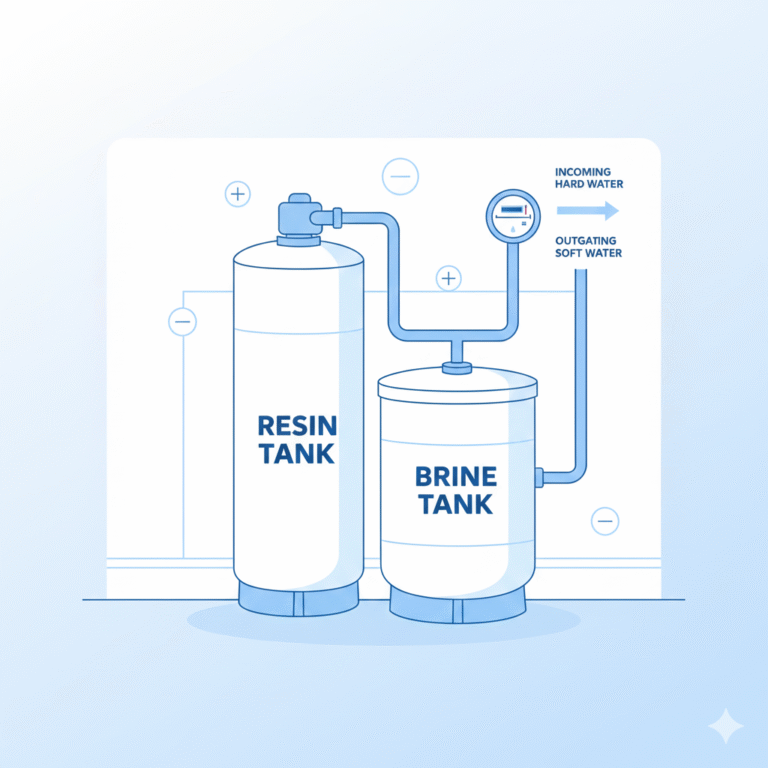
A water softener brine tank full of water almost always means the softener is not drawing brine out of the tank during regeneration. The tank keeps refilling but never empties. Culligan says most “clogged” softeners come down to a salt bridge or salt mush, or a blocked injector, and Pentair’s Fleck 5600SXT service manual lists a plugged drain line flow control, a plugged injector, a timer that is not cycling and debris in the brine valve or brine line flow control. Start with the cheap checks: the salt, the brine line and the drain line.
Below we explain how much water is normal, a quick test to confirm the problem, each cause in the order we would check it, and when to stop and call a technician.
Is there supposed to be water in a brine tank?
Yes, some. The softener needs water in the brine tank to dissolve salt into brine. What is normal depends on the model:
- Culligan says the brine tank fills with water and stops between a quarter and halfway up at most. Because the salt usually sits higher than that, you should not be able to see the water at all.
- Whirlpool’s support page on excess water in the tank says about 0 to 4 inches of water at the very bottom of the tank is normal, and anything above that means something is not working.
So the warning sign is not water itself. It is water you can see above the salt, or a level that keeps rising after each regeneration. Check your own manual for your model’s normal level. Our guide to water softener salt level covers how full the salt should be.
How do you test if the softener is drawing brine?
Start a manual regeneration and watch the water. Culligan says that within a few minutes of starting one, the water level in the brine tank should begin to drop. If it stays where it is, the softener is not pulling brine, and the causes below are where to look.
Mark the water level on the outside of the tank with tape before you start, so a small drop is easy to see. Do not run showers, the dishwasher or the washing machine during the test. Whirlpool gives the same advice for its troubleshooting, because water use elsewhere in the house changes what the softener does.
Why is my water softener brine tank full of water?
These are the causes the makers list, ordered from easiest to check to hardest:
| Cause | What you see | Who fixes it |
|---|---|---|
| Salt bridge or salt mush | Hard crust on top with water or a gap under it, or sludge at the bottom | You |
| Brine line loose, kinked or cracked | Line off its fitting, bent, or air bubbles in it during regeneration | You |
| Drain line blocked, kinked or too high | Little or no water at the drain during regeneration | You, usually |
| Low water pressure | Weak flow in the house; softener cannot finish its cycle | You or a plumber |
| Power cut during regeneration | Problem started after an outage; clock shows the wrong time | You (reset) |
| Plugged injector or injector screen | All the simple checks pass, but no brine is drawn | Careful DIY or a technician |
| Plugged drain line flow control | Drain flow weak even with a clear drain hose | Careful DIY or a technician |
| Debris in the brine valve or brine line flow control | Tank overfills during the refill step | Technician |
| Timer or control board fault | Valve does not move through its cycles | Technician |
1. A salt bridge or salt mush
Culligan calls salt bridging one of the most frequent causes of a clogged tank. A bridge is a hard crust of salt with water or empty space under it; mush is salt that has broken down into sludge at the bottom. Either one stops the water from making brine properly. Culligan’s test is to tap the surface gently with a broom handle; if it feels hollow, there is probably a bridge. Break it up carefully, scoop out any mush, and add fresh salt.

2. The brine line
The brine line is the small tube between the brine tank and the control valve on the resin tank. Culligan notes that if it is not properly attached, the softener cannot draw brine. Check that both ends are pushed fully into their fittings, the tube is not kinked or flattened, and there are no cracks. During the brine draw, steady air bubbles in the line point to an air leak at a fitting.
3. The drain line
The softener has to send water down the drain to pull brine through. Culligan lists drain line damage or blockage as a cause of a rising water level, and Whirlpool’s first check after external leaks is that the drain lines meet its installation requirements. Look for a kinked hose, a hose pinched behind the unit, ice in a hose that runs through a cold garage, or a drain end that sits higher than the maker allows. The Fleck manual also requires an air gap at the drain, at least twice the drain pipe diameter and never less than 1 inch, so the hose end should sit above the drain, not pushed into it. Our water softener drain line guide covers the rules in detail.
4. Low water pressure
The Fleck 5600SXT manual says a minimum of 20 psi of water pressure is needed for the valve to work properly, and lists low line pressure as a reason a softener fails to draw brine. Culligan also notes every softener has pressure requirements. On a well, check the pressure gauge on the pressure tank. If the whole house has weak water, see water softener low water pressure.
5. A power cut in the middle of a regeneration
If the power goes out mid-cycle, the Fleck manual says the valve stays where it is until power comes back, and warns that the system should include safety parts to prevent overflows from a power failure during regeneration. After an outage, check the time on the display. Culligan uses the same quick check for electronic problems: a softener showing the wrong time or day may have lost its program. Reset the clock and start a manual regeneration. Our guide to resetting a water softener walks through it.
6. A plugged injector
The injector, sometimes called the venturi, is a small nozzle in the control valve that creates the suction that pulls brine out of the tank. Sediment and salt residue can clog it and its screen. The Fleck manual’s fix is to clean the injector and the screen. On many models this means turning off the water, putting the softener in bypass, releasing the pressure and opening a small cap on the valve. Culligan says that in most cases this needs expert support, so follow your manual exactly or call a technician.
7. The drain line flow control, brine valve and timer
The Fleck manual’s remaining causes for excess water in the brine tank are a plugged drain line flow control, debris in the brine valve or the brine line flow control, and a timer that is not cycling. These parts sit inside the control valve. Unless you are comfortable taking a valve apart with the manual open, this is the point to call a water treatment technician.
How do you fix a brine tank full of water, step by step?
- Put the softener in bypass so the house still has water while you work.
- Look into the brine tank. Tap the salt with a broom handle. Break up any bridge and remove mush.
- Remove the excess water with a cup and bucket or a wet/dry vacuum, so you can see the bottom of the tank and the brine well.
- Check the brine line at both ends for a loose fit, kinks or cracks.
- Check the drain line for kinks, ice or a blocked end, and confirm the air gap.
- Check the clock on the display and reset it if it is wrong.
- Take the softener out of bypass and start a manual regeneration. Watch the water level over the next several minutes, as Culligan describes.
- If the level still does not drop, clean the injector and screen per your manual, or call a technician.
What we would buy for this job
- Varify water hardness test strips, 0 to 25 gpg: after the fix, test a cold tap to confirm the softener is working again. If the strip still reads hard after a full regeneration, the resin is not being recharged.
As an Amazon Associate, Complete Water Guide earns from qualifying purchases. Prices change, so check the listing.
Is it bad if the brine tank has too much water?
Yes, for two reasons. First, if the softener cannot draw brine, the resin is not being recharged, so hard water comes back. Second, if the water keeps rising, the tank can overflow onto the floor. If your brine tank has an overflow fitting, make sure a hose runs from it to a drain. Fix the cause rather than just scooping out water each week. If your water already feels hard again, our guide to signs your water softener is not working lists what else to check.
When should you call a technician?
Call one when the simple checks pass and the water level still does not drop during a manual regeneration, when the valve does not move through its cycles, or when the display shows an error code. Culligan says problems with the valve or control board typically need a trained technician. If the softener is old and you are facing a valve repair, ask for the cost of a repair next to the cost of a new unit before you decide.
Frequently asked questions
Why is my water softener full of water?
Because it is not drawing brine out during regeneration. The usual causes are a salt bridge or salt mush, a loose or kinked brine line, a blocked drain line, low water pressure, or a plugged injector.
How much water should be in a brine tank?
It depends on the model. Culligan says the water should stop between a quarter and halfway up, below the salt, and Whirlpool says about 0 to 4 inches at the bottom is normal for its softeners. Water you can see above the salt is a warning sign.
Should I drain the water out of my brine tank?
Removing it helps you inspect the tank and break up salt, but it does not fix the problem. Find out why the softener is not drawing brine, or the tank will fill again.
Can a salt bridge cause a brine tank full of water?
Yes. Culligan lists salt bridging as one of the most frequent causes. Water sits under a hard crust of salt and cannot make proper brine. Break up the crust gently with a broom handle.
Can low water pressure stop a softener from drawing brine?
Yes. The Fleck 5600SXT manual needs at least 20 psi for the valve to work properly and lists low line pressure as a cause of a softener failing to draw brine.
How do I clean a water softener injector?
Put the softener in bypass, release the pressure, then open the injector cap on the control valve and clean the injector and its screen, following your model’s manual. If you are not sure how to do it, call a technician.
Sources
- Culligan, Water softener seems to be clogged? Here’s how to fix it (updated August 13, 2026): normal fill level, manual regeneration test, salt bridging, brine line, drain line, injector, electronics.
- Pentair, Fleck 5600SXT Downflow Service Manual: troubleshooting for excessive water in brine tank and failure to draw brine; minimum 20 psi; drain air gap; power failure during regeneration.
- Whirlpool Water Solutions support, Excess Water in Tank: 0 to 4 inches normal, drain line requirements, no water use during troubleshooting.