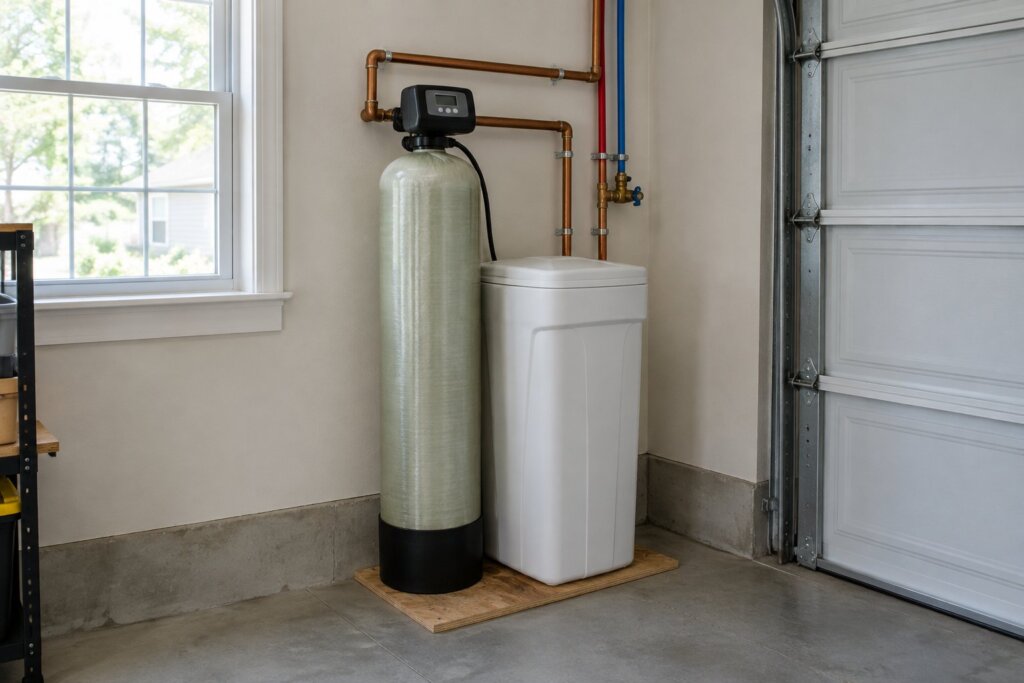
Installing a water softener in garage space is fine as long as the garage never freezes and the unit stays out of direct sun. All three owner’s manuals we read draw the same line: A.O. Smith says the unit and “its connections (including the drain and overflow lines)” must never see temperatures under 33°F, Morton says not to install it where freezing temperatures occur and to avoid direct sunlight, and Hellenbrand’s warranty excludes unprotected outdoor installations. Many garages are where the main water line and water heater are, which makes them a natural spot in mild climates.
Below are the temperature limits from each manual, the setup rules that matter in a garage, what salt does to a concrete floor, and how to drain a softener if a freeze is coming.
Can I put a water softener in my garage?
Yes, in our view, if the garage stays above freezing all winter and does not get very hot. The manuals give these limits:
| Maker | Temperature rule | Other location rules |
|---|---|---|
| A.O. Smith | Water 33 to 100°F; unit and drain and overflow lines never under 33°F | Firm, level surface; transformer for dry locations only |
| Hellenbrand | Operating 40 to 110°F; “cannot be subject to freezing conditions” | Outdoors needs an enclosure with “a floor, roof, walls, ventilation and heat” |
| Morton (M20 to M34) | Water and ambient 40 to 120°F; no freezing, no direct sunlight | Flat, stable surface; outlet in a dry location |
Morton’s FAQ says its softeners can even go outside, “providing it is protected from the elements, such as rain, freezing temperatures, rodents and direct sunlight.” An attached garage often meets that. A detached, unheated garage in a cold climate usually does not.
Freeze damage is not a small risk. A.O. Smith’s warranty excludes “damages due to freezing,” and Morton says “freezing temperatures or hot water damage voids the warranty.”
What about a hot garage?
Heat is the other limit. Morton warns that “excessive sun heat may cause distortion or other damage to non-metallic parts,” and caps ambient temperature at 120°F. Keep the softener out of the path of sun through a garage window or open door, and away from a furnace or water heater flue. Resin maker Purolite adds that higher water temperatures speed up resin breakdown, so the softener belongs on the cold supply; our guide on how long water softener resin lasts explains why.
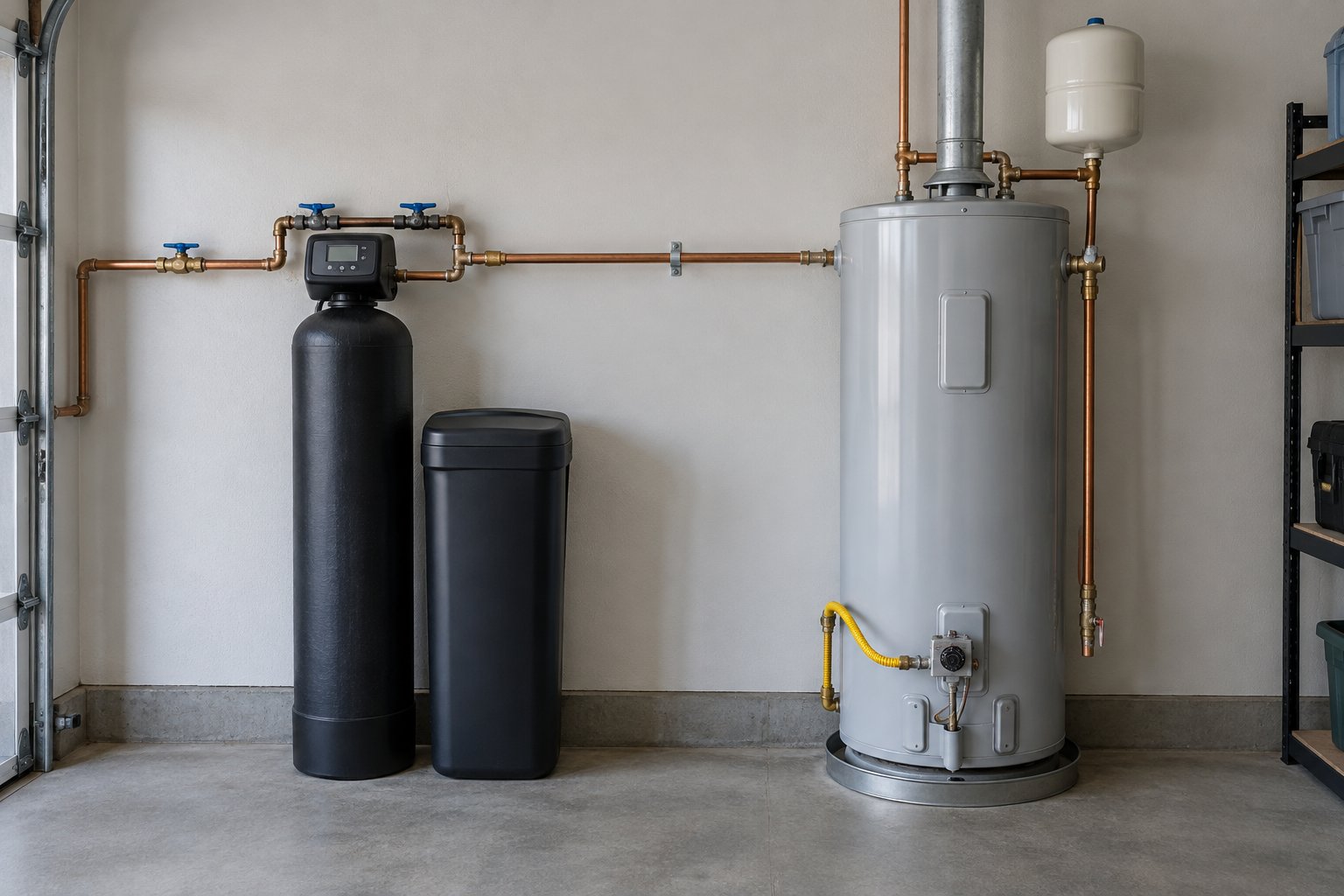
Where is the best place to put a water softener?
Close to where the main water line enters the house, with a drain and an outlet nearby, which is why garages and basements are common choices. Morton’s FAQ says the ideal location is “near the incoming water line, with a standard electrical outlet and drain nearby.” The manuals add a few rules on order and distance:
- Before the water heater. Morton says to always install the softener between the water inlet and the water heater. A.O. Smith does not recommend less than 10 feet of piping between the softener outlet and the water heater inlet, and recommends an expansion tank on the outlet side to protect the unit if hot water backs up. Our guide to water heater expansion tank installation covers that tank.
- After other filters. Morton says any other water conditioning equipment goes between the inlet and the softener.
- Outside faucets stay hard. Morton and Hellenbrand both say outdoor faucets should stay on unsoftened water so you do not waste salt watering the lawn. A garage install near the main line often makes that easy.
- A drain close by. A.O. Smith wants the drain line “as short as possible.” A garage without a floor drain may need a standpipe or laundry sink; our guide to the water softener drain line has the size and air gap rules.
- Easy salt access. A.O. Smith notes the brine tank should be “in an easily accessible location,” since you will carry heavy salt bags to it.
Will water softener salt ruin concrete?
Spilled salt is unlikely to ruin a sound garage floor, but do not let brine sit on it. Softener salt is sodium chloride, the same chemical as rock salt for icy roads. A Michigan Tech review for the South Dakota DOT found that sodium chloride did not cause the expansive cracking and strength loss that magnesium and calcium chloride caused in hardened concrete, but that sodium chloride brines have “the highest rate of ingress into hardened concrete,” which matters for any steel inside the slab.
So our advice is practical: sweep up spilled salt, wipe up drips from refilling, and fix any brine tank leak quickly. Morton suggests leveling an uneven floor with “a piece of plywood and shims” under the softener, and a sheet of plywood or a mat also keeps salt and water off the concrete. If you find water on the floor, our guide to a water softener leaking shows how to find the source.
What we would buy for this job
- MOCREO WiFi thermometer with 2 sensors, app and email alerts: set one sensor by the softener and get an alert before the garage nears freezing. It also sends a power outage alert, which tells you to check the softener clock.
As an Amazon Associate, Complete Water Guide earns from qualifying purchases. Prices change, so check the listing.
How do you protect a water softener in garage cold snaps?
If the garage could drop below freezing, drain the softener before it does. Morton’s steps for a softener that could freeze:
- Close the main shut-off valve near the water meter or pressure tank.
- Open a soft water faucet to release pressure.
- Put the softener in bypass.
- Drain the water out of the softener as the manual describes for your model.
Hellenbrand’s procedure uses compressed air to push water out of the resin tank after running a regeneration, and notes that the saturated brine left in the salt tank “will not freeze solid and cause any damage” as long as salt remains. For a garage that only dips near freezing on the coldest nights, a temperature alarm warns you in time to act. A power cut on a cold night is a double risk; our guide on how to reset a water softener covers resetting the clock afterward.
What are the downsides of having a water softener?
Worth knowing before you pick a spot for one:
- Salt. Morton says the average household uses about two bags every two months, which you have to carry in.
- Water. Each regeneration sends dozens of gallons to the drain; our guide to the water softener backwash has real figures.
- Sodium. Morton says softening adds about as much sodium per liter as a slice of white bread, and suggests potassium chloride or a physician’s advice for people on sodium-restricted diets.
- Space, power and a drain. All three manuals need an outlet and a drain close by, which limits where it can go.
Frequently asked questions
Can I put a water softener in my garage?
Yes, if the garage never freezes and the softener stays out of direct sun. A.O. Smith says the unit and its drain and overflow lines must never go below 33°F, and Morton says to avoid direct sunlight.
What temperature is too cold for a water softener?
A.O. Smith sets 33°F as the minimum for the unit and its lines, and Morton and Hellenbrand set 40°F as the minimum operating temperature. Freeze damage is excluded from their warranties.
Will water softener salt ruin concrete?
Not quickly. Research for the South Dakota DOT found sodium chloride did not cause the cracking that other deicing salts did, but its brine soaks into concrete fastest and can reach steel inside. Sweep up spills, wipe drips and fix leaks.
Where is the best place to put a water softener?
Near where the main water line enters the house, before the water heater, with a drain and an outlet nearby, on a level surface protected from freezing and direct sun.
Can a water softener be installed outside?
Only with protection. Morton allows it if protected from rain, freezing, rodents and direct sunlight, and Hellenbrand’s warranty does not cover unprotected outdoor installs.
How do I winterize a water softener in the garage?
Shut off the main water, open a soft water faucet, put the softener in bypass and drain it as your manual describes. Hellenbrand uses compressed air to push water out of the resin tank.
Sources
- A.O. Smith, Metered Water Softeners Installation Instructions and Owner’s Manual: site requirements, 33°F minimum for unit and lines, 10 feet of pipe before the water heater, expansion tank, accessible brine tank, freezing excluded from warranty.
- Hellenbrand, consumer installation and owner’s manual 800540: 40 to 110°F, no freezing, outdoor enclosure requirement, draining procedure.
- Morton, Water Softener Installation and Operation Manual (M20 to M34): location requirements, 40 to 120°F, direct sunlight, installation order, freeze draining steps; Morton FAQ: outdoor installs, ideal location, plywood leveling, salt use, sodium.
- Purolite: water temperature and resin breakdown.
- Michigan Tech literature review for the South Dakota Department of Transportation (SD2002-01) on deicers and concrete.