A water softener drain line should be as short as possible, at least 1/2 inch inside diameter (3/4 inch or more for higher backwash flows), and it must end above the drain with an air gap of 1-1/2 inches or twice the pipe diameter, whichever is greater. Those are the rules in the A.O. Smith metered softener manual. Get the drain line wrong and the softener can fail to draw brine, overfill the brine tank, or in the worst case pull dirty water back into the system.
Below are the exact limits from two makers’ manuals, where the line can drain to, how much water goes down it each regeneration, and what a bad drain line looks like in practice.
Does a water softener need a drain line?
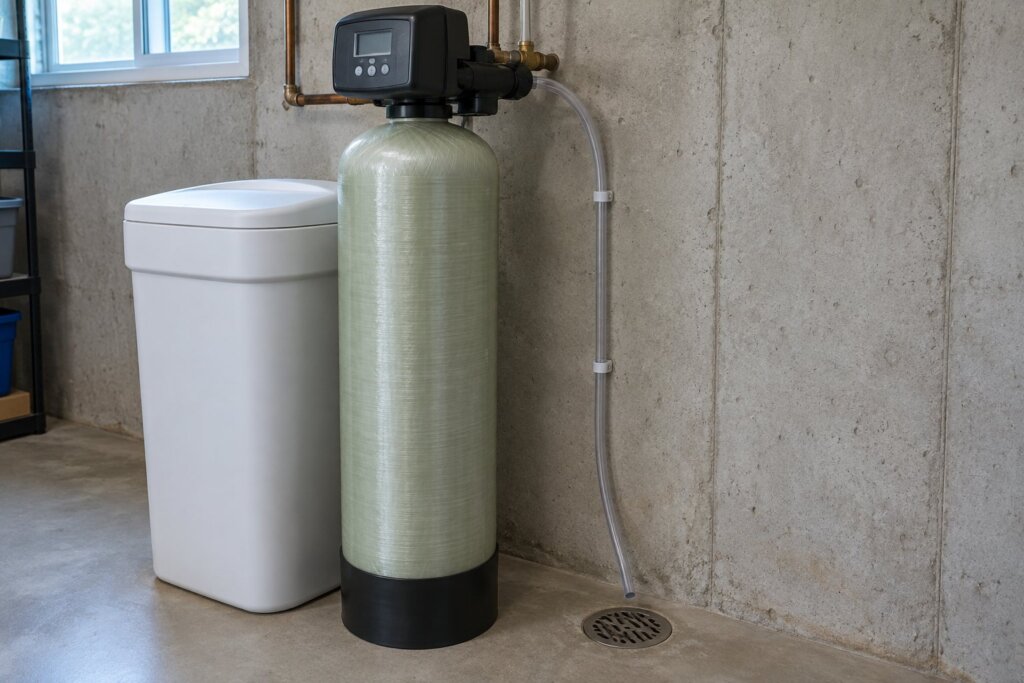
Yes. Every regeneration flushes hardness minerals and leftover brine out of the resin tank, and that water has to go somewhere. The drain line carries it from the control valve to a floor drain, standpipe or laundry tub. The Hellenbrand owner’s manual puts it first in its installation notes: “The softener should be located close to a drain.”
A softener also has a second line, the brine tank overflow. It is a separate safety drain, and we cover it below.
What size should a water softener drain line be?
At least 1/2 inch inside diameter, and larger for high backwash flow or long runs. The two manuals we checked set these limits:
| Rule | A.O. Smith metered softeners | Hellenbrand |
|---|---|---|
| Minimum size | 1/2 inch I.D. tube, or 3/4 inch NPT rigid pipe (recommended) | 3/4 inch minimum |
| When to go bigger | 3/4 inch if backwash is over 7 gpm | 1 inch if backwash is over 7 gpm or the run is over 20 feet |
| Overhead run | Under 10 feet “is normally not a problem” | No more than 8 feet above the floor |
| Length | As short as possible | No more than 20 feet (or use 1 inch) |
| Air gap at the end | 1-1/2 inches or twice the pipe diameter, whichever is greater | Not given in the drain section |
| Freezing | Never below 33°F, drain line included | Not stated |
The backwash rate is in your softener’s spec sheet. If you cannot find it, the safer choice is the larger line, because a drain that is too small restricts flow and causes the problems in the next section.
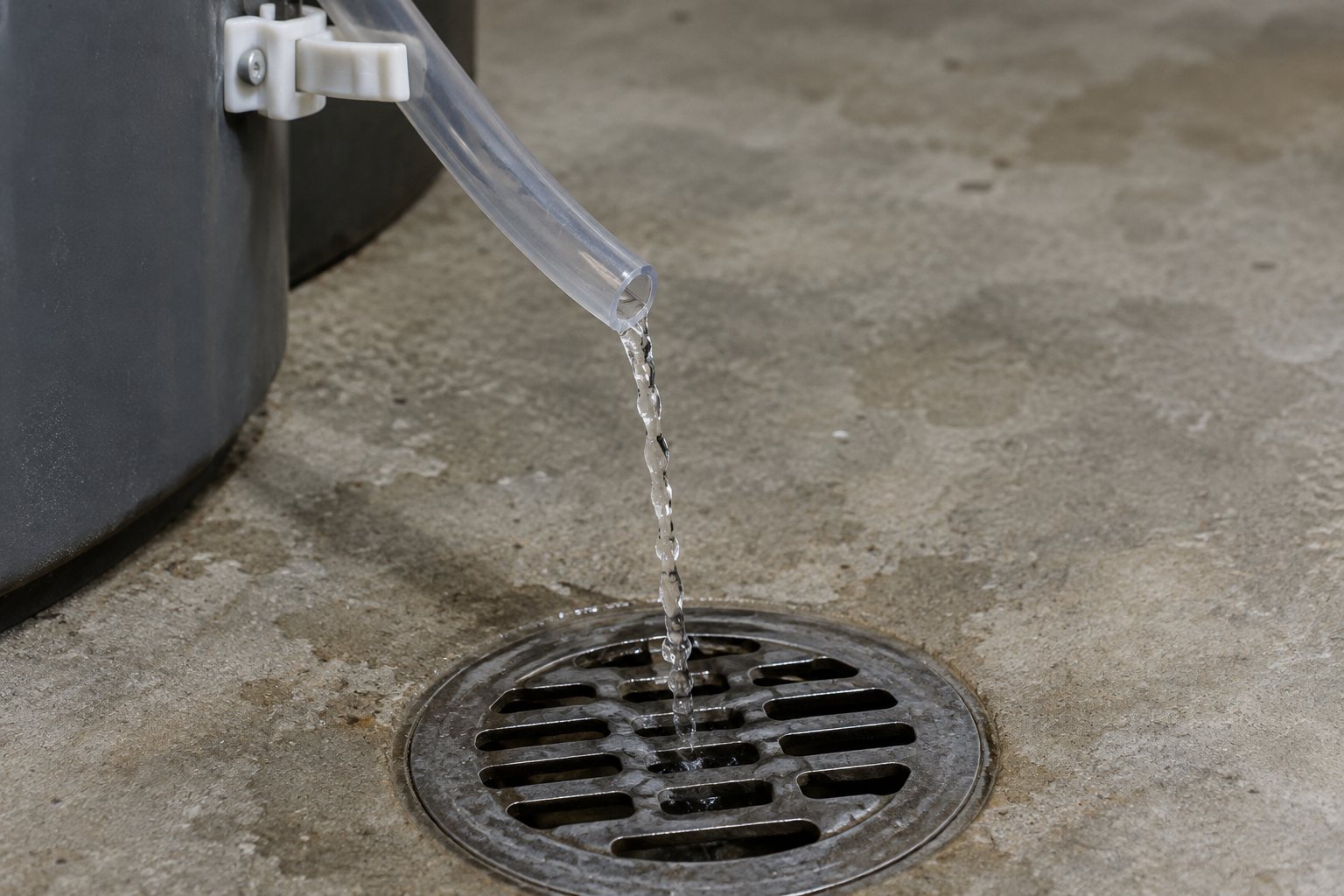
Why does a water softener drain need an air gap?
To stop sewage from being siphoned back into the softener. The A.O. Smith manual is blunt about it: “Never insert a drain line into a drain, sewer line, or trap. Always allow an air gap of 1-1/2″ or twice the pipe diameter, whichever is greater, between the drain line and the wastewater to prevent the possibility of sewage being back-siphoned into the softener.”
An air gap is simply open air between the end of the tube and the drain. For a 1/2 inch line, twice the diameter is 1 inch, so the 1-1/2 inch minimum applies. For a 1 inch line, it is 2 inches. A drain line pushed down into a floor drain or taped into a standpipe has no air gap, even if it seems to work fine.
The manual also says that where the drain line is raised but empties into a drain below the control valve, you should form a 7 inch loop at the discharge end so its bottom is level with the drain connection on the valve, which acts as an anti-siphon trap.
Where should a water softener drain to?
A floor drain, a laundry standpipe or a laundry tub, the three typical installations shown in the A.O. Smith manual, always with the air gap. Pick the closest one, since both manuals want the softener near its drain.
- Floor drain: the simplest. Clip the tube so it cannot move and keep it above the grate.
- Laundry standpipe: fine if it can take the backwash flow along with the washing machine. An air gap fitting that slips onto the standpipe keeps the gap fixed.
- Laundry tub: secure the line to the tub edge so it cannot fall into standing water.
Run the line where it cannot freeze. A.O. Smith says the unit and its connections, “including the drain and overflow lines,” must never be exposed to temperatures under 33°F.
Can a water softener drain into a sewer line?
Only through an air gap and a trap, never connected straight in. Where the drain empties into an overhead sewer line, A.O. Smith says “a sink-type trap must be used with appropriate air gap.” The manual also tells you to run the line “in accordance with plumbing codes,” and to pay special attention to codes for air gaps and anti-siphon devices. Local codes decide the details, so check with your building department if you are unsure.
How much water goes down the drain when a softener regenerates?
Often 70 to 150 gallons per regeneration, depending on the softener. NSF/ANSI 44’s efficiency rating caps water use at 5 gallons per 1,000 grains of hardness removed, and the most water-efficient manuals we checked list 2.3 gallons. For a regeneration that restores 30,000 grains of capacity, that works out to about 69 gallons at 2.3 gallons per 1,000 grains and 150 gallons at the 5 gallon limit.
That volume arrives in bursts during backwash and rinse, so the drain has to keep up with the full backwash flow rate. How often it happens depends on your household; our guide to how often a water softener should regenerate has a chart by household size. If a floor drain backs up during regeneration, the drain itself may be too slow, not the softener. Our guide to the high efficiency water softener rating explains the 5 gallon limit.
What goes wrong with a bad drain line?
The A.O. Smith troubleshooting chart links a restricted, kinked, too-long or too-high drain line to three faults:
- The softener will not draw brine. The chart lists “drain line restriction or debris” causing back pressure, and “drain line too long or too high,” as causes. The fix is to clear the line or shorten its length and height. Hellenbrand gives the same reason for avoiding overhead drains: back pressure on the brine injector.
- Too much water in the brine tank. “Restricted or kinked drain line” is one listed cause, along with a plugged injector and wrong refill settings.
- Brine left in the soft water. A “restricted drain line” can leave residual regenerant going to service, which tastes salty. Our guide to water softener water that tastes salty covers the other causes.
Low water pressure is another listed cause of a softener that will not draw brine. A.O. Smith says incoming pressure must stay at a minimum of 25 psi and recommends 40 to 60 psi for an overhead drain. If you hear gurgling or rushing water during regeneration, our guide to a water softener making loud noise explains which sounds come from the drain.
What we would buy for this job
- Water softener air gap with 1/2 inch barb, for a 1-1/2 inch standpipe (ET117-008): fixes the air gap on a laundry standpipe so the tube cannot slip down into the drain. The listing says it is UPC and IPC listed.
- Eastman 1/2 inch I.D. clear vinyl tubing, 20 ft: the 1/2 inch I.D. size A.O. Smith specifies for its drain tube. Clear tubing lets you see a kink or blockage.
As an Amazon Associate, Complete Water Guide earns from qualifying purchases. Prices change, so check the listing.
How is the brine tank overflow line different?
It is a separate gravity drain from the side of the brine tank, there in case the brine tank’s safety float fails. A.O. Smith’s rules for it: use 1/2 inch I.D. tubing, keep it no higher than 3 inches below the bottom of the overflow fitting, never connect it to the control valve’s drain line, and give it its own air gap. Because it relies on gravity, it “cannot run higher than the initial drain point.” If you see water on the floor near the brine tank, our guide to a water softener leaking walks through finding the source.
Frequently asked questions
Does a water softener need a drain line?
Yes. Each regeneration flushes minerals and used brine out of the resin tank, and the drain line carries that water to a floor drain, standpipe or laundry tub. The softener should be placed close to the drain.
Where should a water softener drain to?
To a floor drain, laundry standpipe or laundry tub, with an air gap at the end of the line. A.O. Smith shows those three as the typical installations.
Why does a water softener drain need an air gap?
To prevent sewage from being back-siphoned into the softener. A.O. Smith calls for an air gap of 1-1/2 inches or twice the pipe diameter, whichever is greater, and says never to insert the drain line into a drain, sewer line or trap.
Can a water softener drain into a sewer line?
Only through a trap with an air gap. For an overhead sewer line, A.O. Smith calls for a sink-type trap with an appropriate air gap, installed to local plumbing code.
How high can a water softener drain line go?
Hellenbrand says overhead drains should not exceed 8 feet above the floor and 20 feet in length. A.O. Smith says an overhead run under 10 feet is normally not a problem with 40 to 60 psi of water pressure.
What size is a water softener drain line?
At least 1/2 inch inside diameter on A.O. Smith metered units, or 3/4 inch on Hellenbrand units. Both makers call for a larger line when backwash flow is over 7 gallons per minute, and Hellenbrand also for runs over 20 feet.
Sources
- A.O. Smith, Metered Water Softeners Installation Instructions and Owner’s Manual (APR, APRCAB, APRC models): drain line size, overhead runs, 7 inch loop, air gap rule, overflow line rules, 33°F limit, troubleshooting chart, 25 psi minimum.
- Hellenbrand, consumer installation and owner’s manual 800540: drain location, 8 foot and 20 foot limits, 3/4 inch minimum, 1 inch for over 7 gpm or 20 feet, back pressure on the brine injector.
- NSF/ANSI 44 efficiency rating as summarized by Pacific Northwest National Laboratory’s Building America Solution Center: 5 gallons per 1,000 grains maximum.