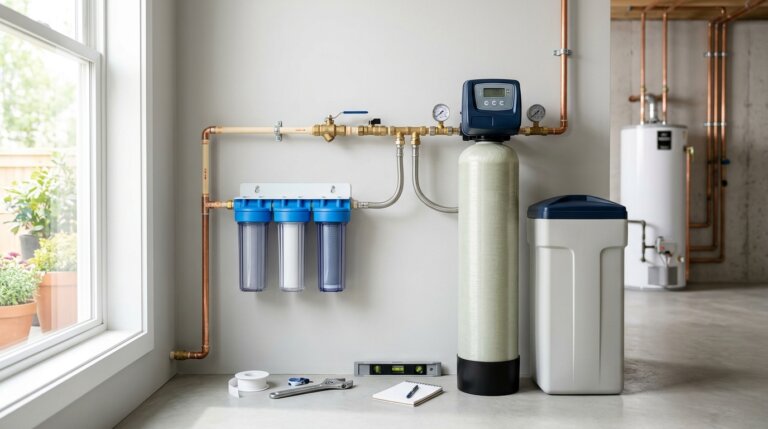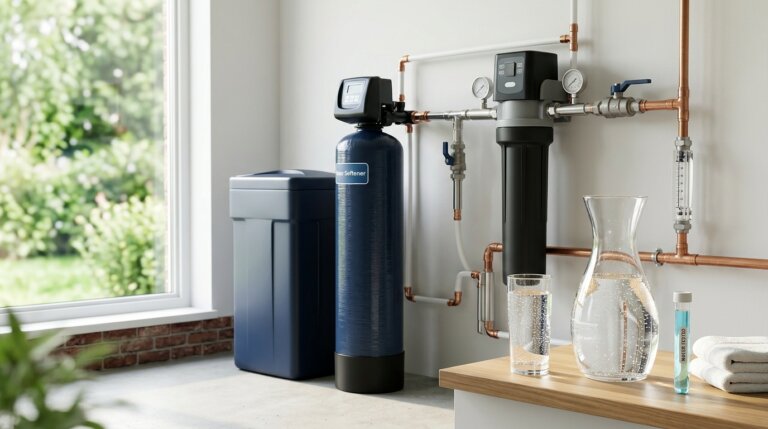
The right water softener hardness setting is your water’s tested hardness in grains per gallon, plus an extra amount for any dissolved iron. The three owner’s manuals we read, from A.O. Smith, Hellenbrand and Morton, all work this way, but they ship with different defaults (20 or 25) and add different amounts for iron: 3, 4 or 5 grains per 1 ppm. A.O. Smith also says the number “will only impact the frequency of regeneration and will not alter or affect the hardness of the water treated by the unit.”
Below is how to find your number, each maker’s rule for iron, what goes wrong when the setting is too low or too high, and how hard 15 or 20 grains really is.
What does the water softener hardness setting do?
It tells a metered softener how soon its resin will run out. The A.O. Smith manual says the unit is preset “so that the gallons between regenerations will be automatically calculated after the hardness is entered.” In simple terms, the valve divides the resin’s capacity by your hardness to get the gallons it can soften before it needs to regenerate.
That is why the setting does not make the water softer or harder. Every gallon that passes through the resin is softened the same way. The number only decides when the softener stops to recharge.
What should I set my water softener hardness to?
Your tested hardness, plus iron if you have it. Here is how the three manuals compare:
| Maker | Factory default | Range | Add for each 1 ppm of iron |
|---|---|---|---|
| A.O. Smith | 20 gpg | 1 to 150 gpg | 4 gpg |
| Hellenbrand | 20 gpg | 1 to 150 gpg | 3 gpg |
| Morton (M20 to M34) | 25 gpg | Not stated | 5 gpg |
Use your own maker’s iron rule, not an average. Morton’s manual gives a worked example: water at 20 gpg hardness with 2 ppm of iron gets a setting of 30, because 2 ppm times 5 adds 10. On an A.O. Smith valve the same water would be set to 28, and on a Hellenbrand to 26.
Do not leave the factory default in place. A default of 20 or 25 is a placeholder. If your water is 10 gpg, a setting of 20 makes the softener regenerate about twice as often as it needs to.
How do you find your water hardness?
Three ways, from quickest to most accurate:
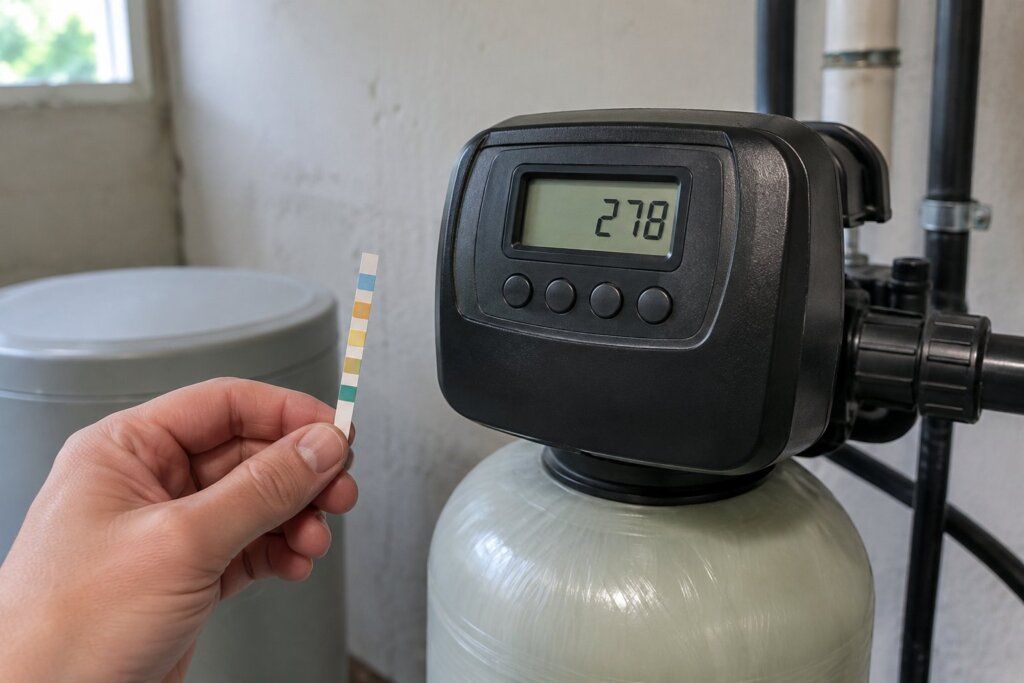
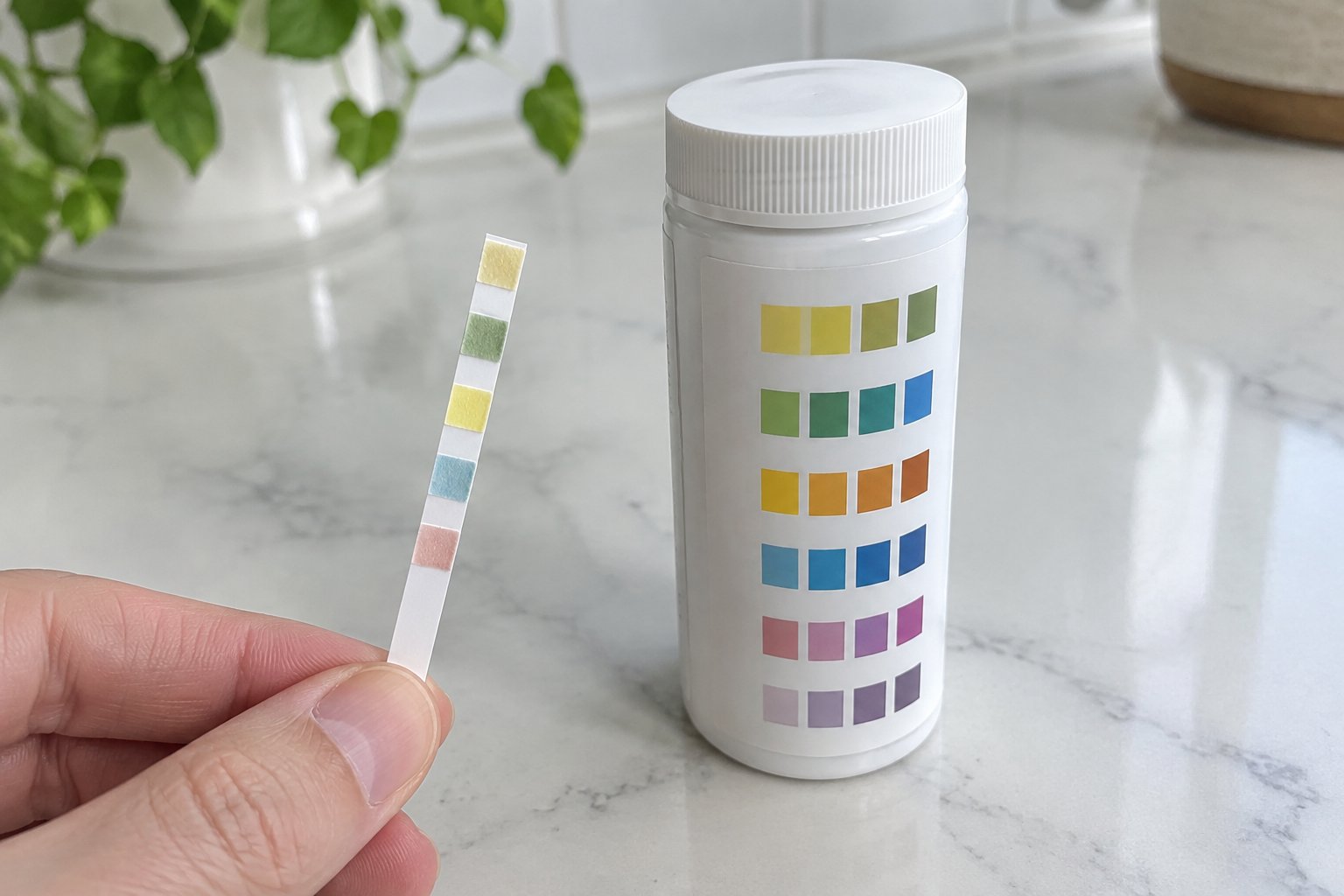
- Test strips. Dip a hardness strip in cold, unsoftened water and compare the color. Our guide on how to read water test strips covers timing and lighting, which change the result.
- Your water utility. City water systems publish an annual water quality report, and many list hardness. If it is in mg/L, divide by 17.1 to get grains per gallon; Morton’s FAQ gives that conversion.
- A lab or dealer test. A.O. Smith says the hardness value “must be set by an authorized dealer following an on-site water analysis.” A lab test also tells you the iron level, which strips may miss. Our comparison of home test kits vs lab tests explains the trade-off.
Test the water before it reaches the softener: use an outdoor spigot, or put the softener in bypass first. A sample of softened water will read near zero and tell you nothing.
What happens if I set my water softener hardness too low?
The softener waits too long between regenerations, and hard water gets through before it recharges. Here is a simplified example. Say a softener has 20,000 grains of usable capacity and your water is 20 gpg. The resin can soften about 1,000 gallons. If you set the hardness to 10, the valve thinks it has 2,000 gallons, so for roughly the last 1,000 gallons before each regeneration you get hard or partly hard water.
Signs are spots on glasses and scale coming back a few days after each regeneration, then clearing up again right after the next one.
What happens if the hardness setting is too high?
The water stays soft, but you waste salt and water. The softener regenerates before the resin is used up, and each regeneration uses the full salt dose and sends dozens of gallons down the drain. Our guide on how often a water softener should regenerate shows what a normal schedule looks like for your household, and our guide to the high efficiency water softener rating covers the salt dose setting, which matters as much as hardness for salt use.
A small cushion is reasonable in our view: if your strip results vary between 14 and 16, set 16. Setting 25 on 15 gpg water just to be safe is not a cushion; it means about two-thirds more regenerations than needed.
Is 20 gpg hard water? Is 15 bad?
Both are very hard. The U.S. Geological Survey’s guidelines classify water by milligrams per liter of calcium carbonate. Converted to grains per gallon at 17.1 mg/L per grain:
| USGS class | mg/L as calcium carbonate | Grains per gallon (our conversion) |
|---|---|---|
| Soft | 0 to 60 | 0 to 3.5 |
| Moderately hard | 61 to 120 | 3.6 to 7.0 |
| Hard | 121 to 180 | 7.1 to 10.5 |
| Very hard | More than 180 | More than 10.5 |
So 15 gpg is about 257 mg/L and 20 gpg about 342 mg/L, both well into the very hard band. Hard water is mainly a scale problem on fixtures and in water heaters, not a safety one. Our guide to hard water vs soft water covers the differences.
What we would buy for this job
- Varify water hardness test strips, 0 to 25 gpg: read in grains per gallon, the same unit your softener uses. Test unsoftened water from an outdoor spigot or with the softener in bypass.
As an Amazon Associate, Complete Water Guide earns from qualifying purchases. Prices change, so check the listing.
How do you change the hardness setting?
On most digital valves you open a settings menu with a button combination, then use the arrows. The three manuals give these steps:
- A.O. Smith: hold NEXT and + together for 3 seconds; the first screen is WATER HARDNESS. Use + or − to set it, then NEXT to move on.
- Hellenbrand: hold NEXT and the arrow button shown in the manual together for 3 seconds; step 2 is HARDNESS.
- Morton M34: press SELECT until “HARDNESS” and a flashing number appear, then use the up and down buttons.
If the softener has already let hard water through, our guide on how to reset a water softener shows how to start a manual regeneration.
Frequently asked questions
What should I set my water softener hardness to?
Your tested hardness in grains per gallon, plus your maker’s iron allowance if you have dissolved iron: 4 gpg per ppm on A.O. Smith, 3 on Hellenbrand and 5 on Morton.
What happens if I set my water softener hardness too low?
The softener waits too long between regenerations, so hard water gets through before it recharges. You will see spots and scale return a few days after each regeneration.
Does a higher hardness setting make water softer?
No. A.O. Smith says the number only changes how often the softener regenerates and does not affect the hardness of the treated water. Setting it too high wastes salt and water.
Is 20 gpg hard water?
Yes, very hard. 20 gpg is about 342 mg/L as calcium carbonate, and USGS classes anything over 180 mg/L as very hard.
Is water hardness 15 bad?
It is very hard by USGS standards, about 257 mg/L. That mostly means scale, so a softener set to 15 plus any iron allowance is worth it.
How much should I add to the hardness setting for iron?
It depends on the maker: A.O. Smith says 4 gpg for each 1 ppm of soluble iron, Hellenbrand 3, and Morton 5. Use the rule in your own manual.
Sources
- A.O. Smith, Metered Water Softeners Installation Instructions and Owner’s Manual: hardness range 1 to 150 gpg, default 20, iron 1 ppm = 4 gpg, hardness only affects regeneration frequency, set after water analysis, settings menu.
- Hellenbrand, consumer installation and owner’s manual 800540: default 20, range 1 to 150, add 3 grains per ppm of iron, settings menu.
- Morton, Water Softener Installation and Operation Manual (M20 to M34): default 25, add 5 per ppm of iron with worked example; Morton FAQ: 1 gpg = 17.1 mg/L.
- U.S. Geological Survey: water hardness classification in mg/L as calcium carbonate.