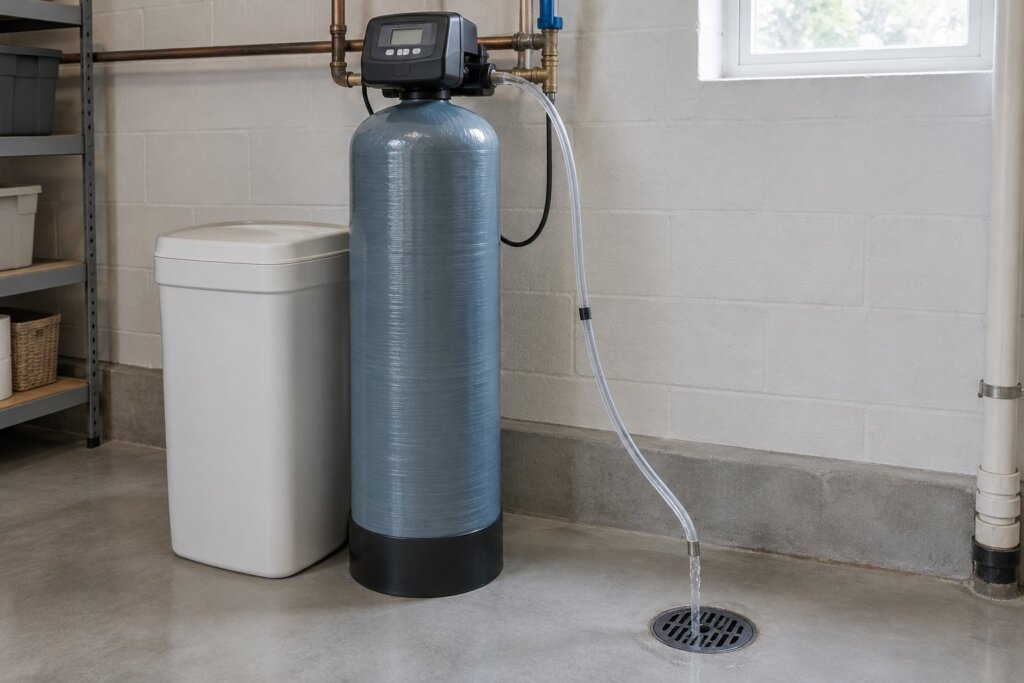
A water softener backwash is the step where water runs backward, bottom to top, through the resin tank to lift out trapped sediment and loosen the resin bed before the brine goes in. On the A.O. Smith softeners we checked it lasts 8 to 10 minutes and sends 18 to 60 gallons down the drain, and it happens at the start of every regeneration. You usually hear it at night, because both makers’ manuals set regeneration for 2:00 a.m. by default.
Below is what the backwash does, the real minutes and gallons from one maker’s spec table, how to run one by hand, and the signs that water running to the drain is a fault rather than a normal cycle.
What does a backwash do on a water softener?
Two jobs, both explained in the Hellenbrand owner’s manual. First, it cleans: “This reversing of the normal flow of water serves to remove sediment which may have accumulated during the softening process due to the filtering action of the exchange media.” The resin catches small particles while it softens, and the backwash flushes them out.
Second, it prepares the resin for the brine. “Backwashing also loosens and fluffs up the bed of exchange media to insure that during regeneration the brine solution will come into contact with all the media.” A packed bed lets brine take the easy path through, leaving some resin still full of hardness.
Where does backwash fit in the regeneration cycle?
It comes first. The water treatment trade magazine Water Conditioning & Purification calls backwash “the first cycle of the regeneration sequence” for a standard down-flow softener. The A.O. Smith softener manual lists the cycles in the order its display shows them:
- Fill: water goes into the brine tank.
- Softening: a 4 hour wait while the salt dissolves into brine, with soft water still going to the house.
- Backwash: reverse flow to the drain.
- Regenerant draw down: the brine is drawn through the resin, followed by a slow rinse.
- Rinse: a fast rinse that flushes leftover brine to the drain.
Some softeners fill the brine tank at the end of the cycle instead of the start. Hellenbrand’s units come set to prefill, which puts water in the brine tank 2 hours before the scheduled regeneration. The backwash still runs before the brine either way.
How long does a backwash cycle take on a water softener?
About 8 to 10 minutes on most home units. These are the cycle times A.O. Smith publishes for its own models:
| A.O. Smith model | Backwash | Backwash water | Whole regeneration | Backwash share of water |
|---|---|---|---|---|
| APR-1044 | 8 min | 18 gal | 72 min, 47 gal | 38% |
| APR-1054 | 8 min | 18 gal | 102 min, 58 gal | 31% |
| APR-1252 | 10 min | 32 gal | 104 min, 87 gal | 37% |
| APR-1354 | 10 min | 32 gal | 104 min, 88 gal | 36% |
| APRCAB-1035 | 8 min | 22 gal | 72 min, 60 gal | 37% |
| APRC-1054 | 8 min | 42 gal | 102 min, 89 gal | 47% |
| APRC-1354 | 8 min | 60 gal | 102 min, 139 gal | 43% |
The minutes and gallons are A.O. Smith’s; the last column is our math. Backwash is the shortest step but uses roughly a third to almost half of all the water in a regeneration. The 4 hour brine-making wait happens before regeneration and is not counted in the totals.
Water Conditioning & Purification gives a similar range for the industry: “a typical backwash cycle is 10 minutes but may be as much as 15 to 20 minutes,” with longer times for water that carries a lot of sediment. Its advice for setting the time is to “let the backwash cycle continue until the water to drain is clear.” For the length of the whole regeneration, see our guide on how often a water softener should regenerate.
How much water flows during backwash?
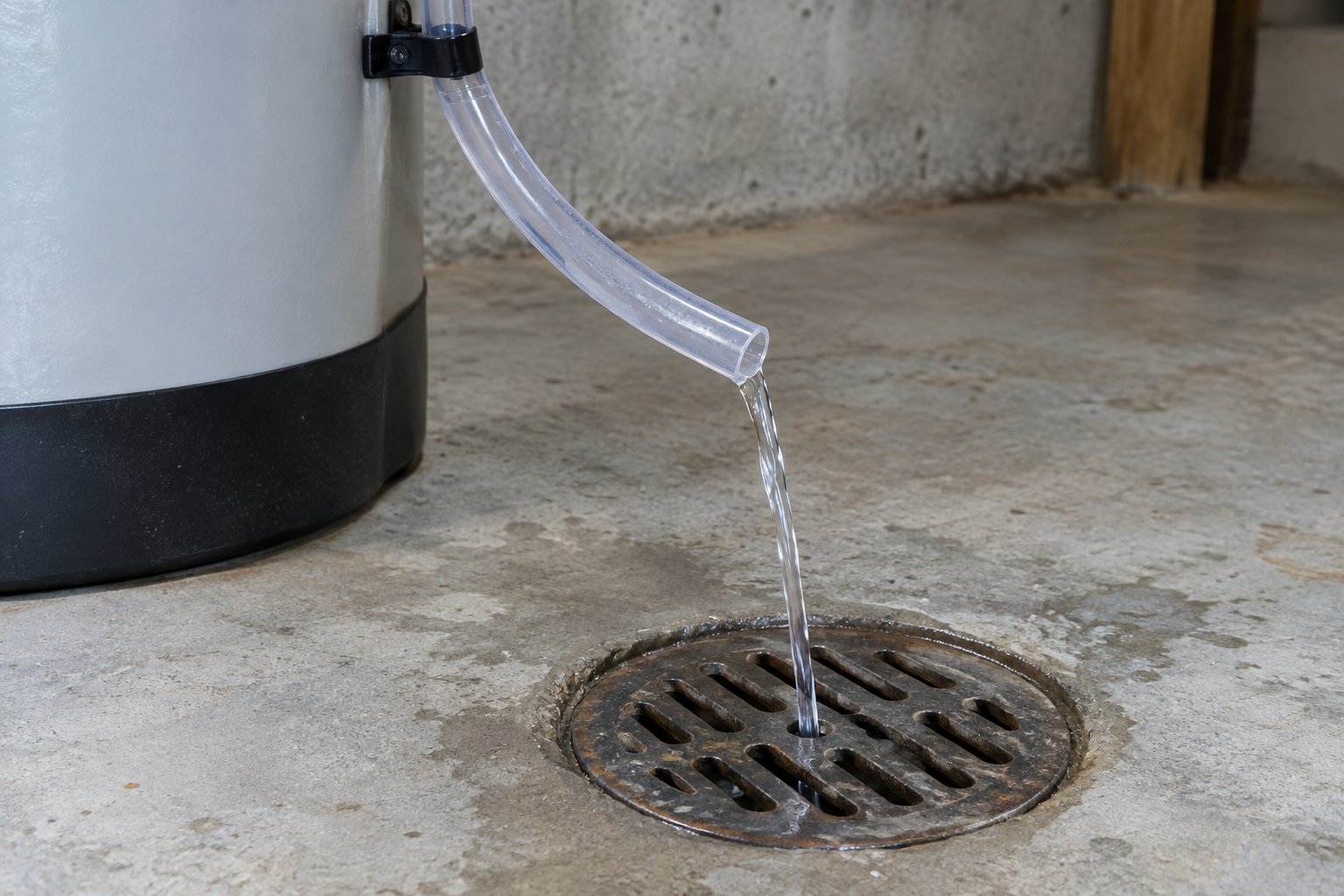
Dividing A.O. Smith’s backwash gallons by its minutes gives an average of about 2.3 gallons per minute on the smallest model and 7.5 gallons per minute on the APRC-1354. That flow is set by a backwash flow controller inside the valve, and it is the number your drain has to handle. A.O. Smith calls for a 3/4 inch drain line when the backwash rate is over 7 gallons per minute, so the largest model in its own table needs the bigger line. Our guide to the water softener drain line has the size and air gap rules.
How often should a water softener backwash?
Once per regeneration. In both manuals we read, backwash is a fixed step in every regeneration, so a softener backwashes exactly as often as it regenerates. Morton’s FAQ says a typical softener regenerates every 3 to 7 days, depending on household size and water use. A demand softener with a correct hardness setting will regenerate, and backwash, only when its capacity is used up.
You do not need to schedule extra backwashes on a working softener. If you think yours regenerates too often, the cause is usually a setting or a leak, which we cover in our regeneration frequency guide.
Why is my water softener doing a backwash?
In most cases, because it is regenerating on schedule. Check these in order:
- It is the regeneration time. Both manuals ship with 2:00 a.m. as the default. If your clock is wrong after a power cut, that “2:00 a.m.” can land in the middle of your day.
- Someone started a manual regeneration. On Hellenbrand units, holding REGEN for five seconds starts one at once, and the manual says “the request cannot be cancelled. You must cycle all the way through the cycles to make it stop.”
- Power came back mid-cycle. A.O. Smith’s troubleshooting chart says that after a power outage during regeneration, the control “will finish the remaining regeneration time” once power returns.
- It is stuck. If water runs to the drain for hours, see the next section.
A backwash sounds like fast running water in the pipes. Our guide to a water softener making loud noise explains which sounds are normal in each step.
When is water running to the drain a problem?
When it does not stop. A normal regeneration ends in under 2 hours on the units we checked. A.O. Smith lists these causes for “water running to drain”: a power outage during regeneration, a damaged seal and stack assembly, a piston assembly failure, or a drive cap assembly that is not tightened properly. The fixes are replacing the seal stack or piston and re-tightening the drive cap. Hellenbrand lists “continuous flow to drain” with the cause “piston position error” and tells owners to call a dealer.
A.O. Smith links a plugged backwash flow controller to a different symptom: too much water in the brine tank. If you see that, our guide to the water softener salt level covers how much water belongs there.
How do you manually backwash a water softener?
On most digital valves, you start a regeneration and step the valve to BACKWASH with the buttons. The two manuals describe it this way during start-up:
- Put the bypass valve in bypass. That cuts the softener off from the house plumbing, and the house gets untreated water while you work.
- Press the regeneration button to start a cycle, then press it again to step through FILL and SOFTENING until the display reads BACKWASH. Button names differ by valve; Hellenbrand and most A.O. Smith valves use REGEN.
- Let water into the tank slowly. A.O. Smith warns: “If water flows too rapidly, there will be a loss of media to the drain.”
- Keep it in backwash until the water at the drain runs clear, as Hellenbrand’s start-up steps say.
- Step on through BRINE and RINSE, then return the bypass to service.
Valves differ, so follow the manual for your model. If you only want a normal regeneration, the simpler path is to start one and let it run all the way through on its own.
What we would buy for this job
- CARBO 0 to 200 psi water pressure test gauge, 3/4 inch hose thread: backwash needs enough pressure to lift the resin bed, and A.O. Smith says incoming pressure must stay at 25 psi or more. Screw it onto a spigot to check yours.
As an Amazon Associate, Complete Water Guide earns from qualifying purchases. Prices change, so check the listing.
Do filters backwash the same way?
Many whole-house filters, such as iron and carbon backwashing filters, use the same reverse flow to clean their media, only with no brine step. A.O. Smith notes that its regenerant piston “is not used in backwash only applications.” The same drain and flow rules apply, since the backwash water still has to go somewhere. If you see water around the valve during any cycle, our guide to a water softener leaking walks through finding the source.
Frequently asked questions
What does a backwash do on a water softener?
It reverses the flow through the resin tank to flush out sediment the resin filtered from the water, and it loosens the resin bed so the brine reaches all of the resin during regeneration.
How often should a water softener backwash?
Once per regeneration. Backwash is a fixed step in every regeneration, and Morton says a typical softener regenerates every 3 to 7 days, depending on household size and water use.
How long does a backwash cycle take on a water softener?
About 8 to 10 minutes on A.O. Smith’s home models, using 18 to 60 gallons. Water Conditioning & Purification puts a typical backwash at 10 minutes, up to 15 to 20 minutes for water with heavy sediment.
Why is my water softener doing a backwash?
Usually because it is regenerating at its set time, which defaults to 2:00 a.m. It can also be a manual regeneration, a cycle resuming after a power cut, or a stuck valve if water runs to the drain for hours.
Can I stop a water softener in the middle of a backwash?
Not by cancelling it on Hellenbrand units: the manual says an immediate regeneration cannot be cancelled and must cycle all the way through. On many valves you can step forward through the cycles with the regeneration button.
Why is water still running to the drain after regeneration?
A.O. Smith lists a power outage during regeneration, a damaged seal and stack assembly, a failed piston assembly, or a loose drive cap. Hellenbrand lists a piston position error and says to call a dealer.
Sources
- A.O. Smith, Metered Water Softeners Installation Instructions and Owner’s Manual (APR, APRCAB, APRC models): cycle names and order, cycle times and usage table, start-up procedure and media loss warning, backwash-only note, 3/4 inch drain above 7 gpm, troubleshooting (water running to drain, plugged backwash flow controller).
- Hellenbrand, consumer installation and owner’s manual 800540: what backwashing does, prefill option, 2:00 a.m. default, immediate regeneration cannot be cancelled, start-up backwash until clear, continuous flow to drain.
- Water Conditioning & Purification, Gary Battenberg, “Cation exchange, part 3: Back to basics” (2016): backwash as the first cycle, 10 to 20 minutes, run until the drain water is clear.
- Morton Water Softeners FAQ: regeneration every 3 to 7 days, about 2 hours per regeneration.