How long does water softener resin last? Good-quality resin can work for more than 10 years, according to resin maker Purolite, but chlorine, iron and sediment in your water can cut that a lot. Purolite’s rule of thumb is that each 1 part per million of chlorine in the incoming water halves resin life, while 0.3 ppm causes little loss in cold water. So the same softener can need new resin far sooner on heavily chlorinated city water than on clean well water.
Below is what wears resin out, the signs it is failing, what replacement costs, and how to make it last.
How long does water softener resin last, and what shortens it?
Purolite says a premium softening resin can give “reliable operation for over ten years” in a well-designed system, then names the two things that cut that short: chlorine and iron. The owner’s manuals we read add a third, sediment.
| What wears resin out | What the source says | What to do |
|---|---|---|
| Chlorine in city water | Each 1 ppm halves resin life; 0.3 ppm causes little loss in cold water (Purolite) | Check your chlorine level; consider a carbon stage |
| Hot water | “The higher the water temperature, the faster the breakdown” (Purolite) | Keep the softener on the cold supply, ahead of the water heater |
| Iron | Builds up on the resin and speeds up chlorine damage (Purolite); can foul the bed (Hellenbrand) | Account for iron in the hardness setting or remove it first |
| Sand and sediment | Can plug the bed and “often requires rebedding” (Hellenbrand) | Fit a sediment filter ahead of the softener |
Purolite also says resin with higher crosslinking, meaning more DVB holding the beads together, has “greater resistance to oxidative attack.” That matters when you buy replacement resin.
How much chlorine is in your water?
Your water utility can tell you. EPA requires community water systems to publish an annual Consumer Confidence Report on water quality, and many list the chlorine or chloramine level. EPA’s legal maximum for chlorine in drinking water is 4 mg/L, so city water can range well above Purolite’s 0.3 ppm comfort level.
Two notes on reading it. Purolite’s figures are for free chlorine; many cities use chloramine instead, and we found no maker figure for resin life on chloramine. And private wells are often not chlorinated, so on well water iron and sediment are the bigger threats.
What are the signs water softener resin is bad?
Resin rarely fails overnight. These are the signs, roughly in the order you notice them:
- Hard water even though everything else checks out. The A.O. Smith troubleshooting chart lists “fouled media bed” as a cause of hard water, with the fix “replace media bed.” Rule out the easy causes first: salt, bypass, settings and power.
- Lower water pressure. Purolite says chlorine damage makes beads “physically weak and soft,” which causes “increased pressure-drop” through the bed. Hellenbrand says sediment can restrict flow through the resin bed.
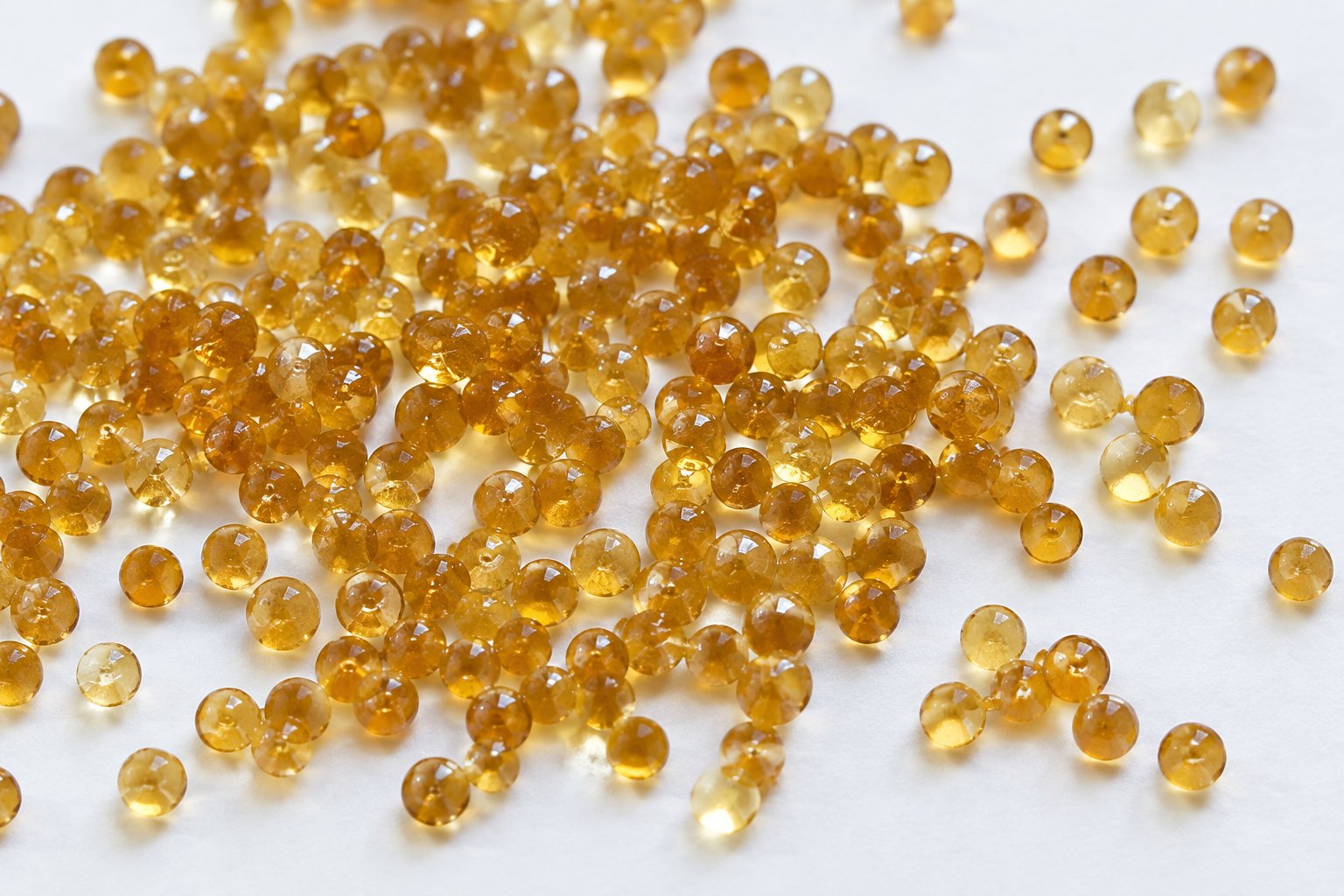
- Resin beads at the taps. Small amber beads in a faucet aerator or toilet tank mean resin is escaping or breaking. Our guide to a water softener not working covers that and other faults.
- Iron in the softened water. Hellenbrand lists “iron has fouled resin bed” as the cause, and also lists iron build-up in the resin as a cause of lost water pressure.
- Running out of soft water sooner. Purolite says iron build-up “reduces the resin’s capacity for calcium and magnesium,” so the softener gives less soft water per regeneration.
Before you blame the resin, work through the checks in our guide on how to reset a water softener. A wrong clock, no salt or an open bypass can look like dead resin.
Can you clean resin instead of replacing it?
Sometimes, but check your manual first, because the makers disagree:
- Hellenbrand suggests an iron-reducing resin cleaner for an iron-fouled bed, along with more salt, more frequent regeneration or rebedding.
- Morton recommends its own softener cleanser every four months, and using it extends the warranty on parts from one year to five.
- A.O. Smith warns that with some models it “does NOT recommend the use of any resin cleaners,” nor salt with cleaning additives.
Cleaning can remove iron fouling. It cannot repair beads that chlorine has already broken down; those need replacing.
What we would buy for this job
- Aldex C800x10 10% crosslinked water softener resin, 1 cu ft: the higher crosslinking Purolite says resists chlorine better. The listing says it is WQA tested to NSF 61. Check how much resin your tank holds before you order.
As an Amazon Associate, Complete Water Guide earns from qualifying purchases. Prices change, so check the listing.
How much does it cost to replace resin in a water softener?
For the resin itself, roughly $100 to $190 per cubic foot on Amazon when we checked in November 2026: about $100 for standard 7% crosslinked resin and $184 to $189 for 10% crosslinked resin. Home softeners hold about 1 to 1.5 cubic feet; the A.O. Smith spec table lists 1.0 and 1.5 cubic feet for its models. A dealer will add labor on top of the resin price.
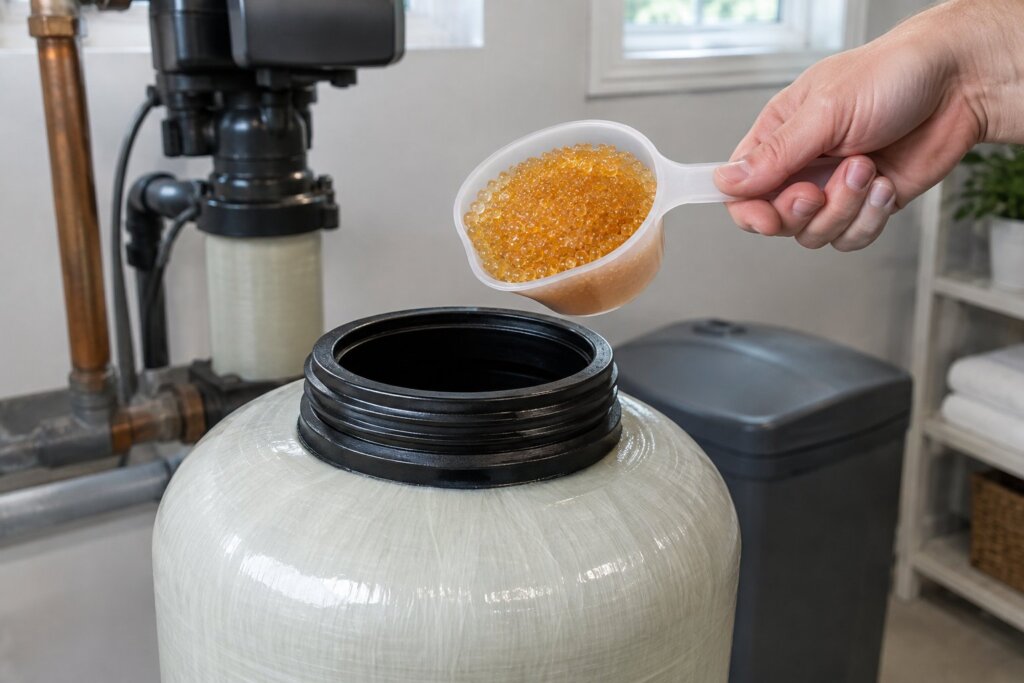
Rebedding means emptying the old resin, which also lets you check the riser tube and distributor, then pouring in the new resin. The tank has to be taken off the valve, so set aside an afternoon and follow your model’s manual.
Is it worth replacing resin in a water softener?
Usually yes, if the rest of the softener is sound. The tank is covered far longer than the rest: A.O. Smith warrants its fiberglass mineral tanks of 13 inches and smaller for 10 years, Morton warrants its mineral tank and salt tank for 10 years, while other parts get one year. If the valve is working and the tank does not leak, $100 to $300 of resin is a small fraction of a new softener; our guide on how much a water softener costs has full prices.
We would replace the whole unit instead if the control valve is failing too, if the softener is too small for your household, or if you want features like demand regeneration that an old timer unit lacks.
How do you make water softener resin last longer?
- Remove chlorine first on city water with high levels. A.O. Smith’s RC models put a carbon layer above the resin in a split tank, and say the carbon typically needs replacing every three to five years depending on chlorine level, water use and temperature.
- Filter sediment on well water. Hellenbrand recommends “the installation of an in-line filter system ahead of a water softener.”
- Deal with iron. Set the hardness higher for soluble iron as your manual says, or remove iron before the softener if there is a lot. Our guide to iron in well water covers the options.
- Let it backwash. The backwash step flushes out the sediment the resin traps; our guide to the water softener backwash explains it.
- Choose 10% crosslinked resin when you rebed on chlorinated water, given Purolite’s point about crosslinking and oxidation.
Frequently asked questions
How long does water softener resin last?
Premium resin can last more than 10 years in good conditions, according to resin maker Purolite. Each 1 ppm of chlorine in the water roughly halves that, and iron and sediment shorten it further.
How often should water softener resin be replaced?
Only when it shows signs of failing, such as hard water with everything else checked, lower pressure, beads at the taps or iron in the softened water. There is no fixed schedule in the manuals we read.
Does water softener resin go bad?
Yes, over time. Chlorine breaks the beads down and makes them soft, and iron and sediment coat or plug the bed, which reduces how much hardness it can remove.
How much does it cost to replace resin in a water softener?
About $100 to $190 per cubic foot for the resin when we checked Amazon in November 2026, and home softeners hold about 1 to 1.5 cubic feet. Dealer labor is extra.
Is it worth replacing resin in a water softener?
Usually, if the tank and control valve are sound. The tank carries a 10 year warranty from A.O. Smith and Morton, while other parts carry one year, so new resin is often far cheaper than a new softener.
What is 10% crosslinked resin?
Resin with more crosslinking holding the beads together. Purolite says higher crosslinking gives greater resistance to oxidation, which is why 10% resin is sold for chlorinated city water.
Sources
- Purolite, Main factors that affect softening resin performance and life: over ten years, chlorine halves life per 1 ppm, 0.3 ppm little reduction in cold water, temperature, crosslinking, iron fouling, signs of oxidation.
- A.O. Smith, Metered Water Softeners Installation Instructions and Owner’s Manual: fouled media bed, resin cleaner caution, RC carbon units, resin volume by model, warranty.
- Hellenbrand, consumer installation and owner’s manual 800540: sediment and rebedding, in-line filter recommendation, iron-fouled resin and resin cleaner.
- Morton, Water Softener Installation and Operation Manual (M20 to M34): cleanser and extended warranty, 10 year tank warranty.
- U.S. EPA: Consumer Confidence Reports; chlorine maximum residual disinfectant level of 4 mg/L.
- Amazon resin prices checked November 2, 2026.