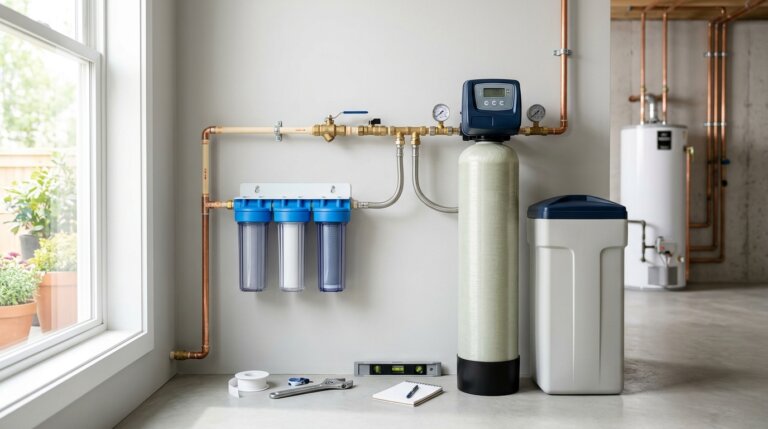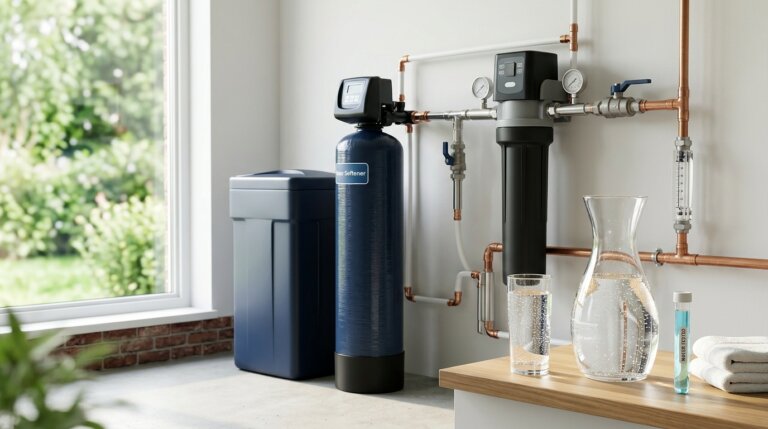
Water softener low water pressure has two very different causes: a small drop that every softener has by design, and a bigger drop from a clogged prefilter, a fouled or plugged resin bed, or a softener too small for your household’s flow. Morton’s own spec sheet shows its home softeners lose 11.3 to 14.7 psi when water runs through them at their full rated flow. More than that, or a drop that gets worse over months, means something is restricting the flow.
Below is a 5 minute bypass test that tells you whether the softener is the cause, the pressure limits from three makers’ manuals, and the fixes in the order we would try them.
Does a water softener reduce water pressure?
A little, yes. Water has to push through a tank packed with resin beads, and that costs some pressure. Morton publishes the figure for its M20 to M34 softeners:
| Morton model | Rated service flow | Pressure drop at that flow |
|---|---|---|
| M20 | 6.5 gpm | 11.3 psi |
| M27 | 6.5 gpm | 12.1 psi |
| M30 and MC30 | 7.0 gpm | 11.9 psi |
| M34 | 7.8 gpm | 14.7 psi |
Those drops apply at the rated flow, which is roughly several fixtures running at once. At a single faucet the flow is much lower, and so is the drop. If your house has 60 psi, a healthy softener should leave plenty of pressure for normal use. You notice it most when the shower and the washing machine run together.
How do I tell if my water softener is clogged?
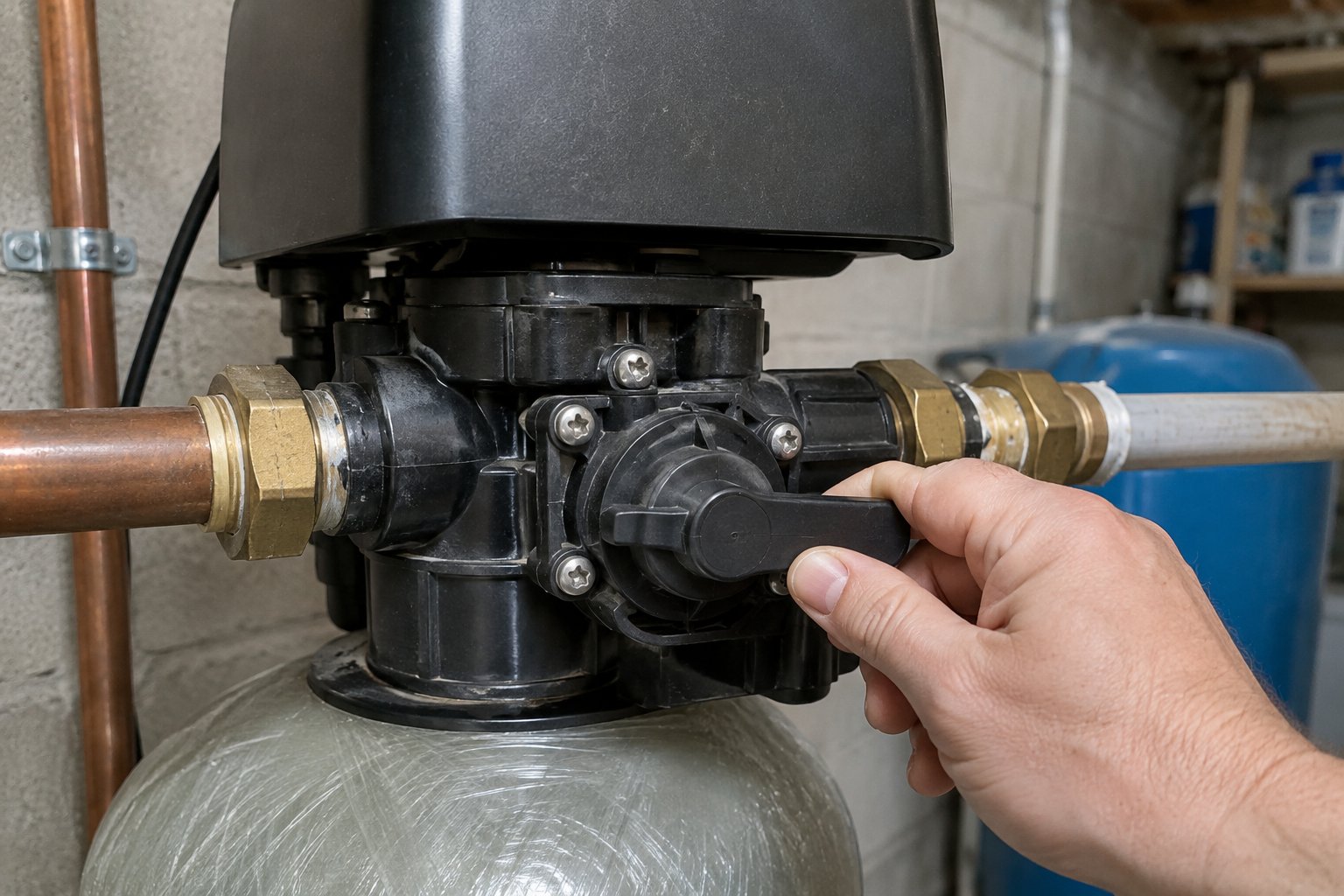
Use the bypass valve. In bypass, the A.O. Smith manual says, the system “is isolated from the water pressure in the plumbing system” and “untreated water is supplied to the building.” That makes it a clean test:
- Open a cold faucet or shower fully and note how strong the flow is. If you have a pressure gauge on a spigot after the softener, note the reading.
- Put the softener in bypass.
- Run the same faucet again.
If pressure clearly improves in bypass, the restriction is in the softener or a filter installed with it. If nothing changes, the softener is not your problem, and our guide to sudden low water pressure covers the other causes. Remember to put the bypass back to service afterward, or you will have hard water.
Why would my water softener cause low water pressure?
If the bypass test points at the softener, check these causes in order, from easiest to hardest:
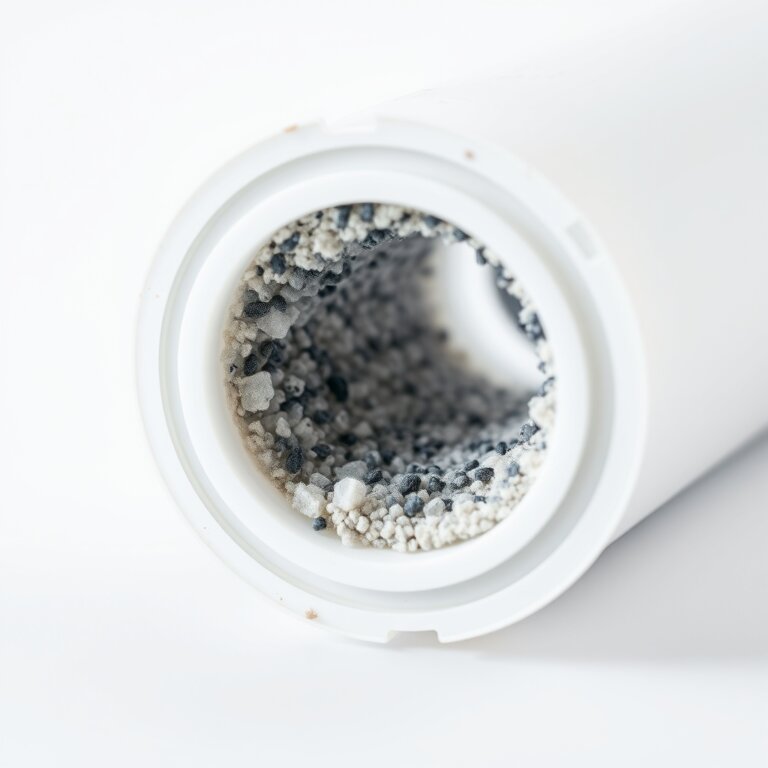
- A clogged prefilter. Hellenbrand recommends a sediment filter ahead of the softener, and the Hellenbrand manual‘s troubleshooting chart lists “prefilter failure” as a cause of loss of water pressure, with the fix “check prefilter if installed.” A cartridge packed with sediment is the first thing we would check, and the cheapest to fix.
- A bypass valve not fully in service. After maintenance, a single-stem bypass that is only part way in, or a three-valve bypass with one valve half closed, restricts flow. Morton tells owners to move the bypass slowly back to service after installation; make sure it went all the way.
- Iron fouling the resin. Hellenbrand also lists “iron build-up in resin, resin bed fouled” under loss of water pressure. Resin maker Purolite says iron builds up on the resin over time.
- Sediment plugging the resin bed. Hellenbrand warns that unfiltered sand and sediment “may plug up the water softener restricting the flow through the resin bed,” a problem that “often requires rebedding of the mineral tank.”
- Old resin breaking down. Purolite says chlorine damage makes beads soft, “causing increased pressure-drop.” Our guide on how long water softener resin lasts covers the signs and costs.
- A softener too small for your flow. If pressure was low from the day it was installed, the unit may be undersized. Morton’s spec notes that an efficiency-rated softener should not be “operated at a sustained maximum service flow rate greater than its listed rating.” Our water softener sizing guide explains how to match flow to household size.
What water pressure does a softener need?
Each maker sets its own range. These are the figures in their manuals:
| Maker | Pressure range | Other notes |
|---|---|---|
| A.O. Smith | 30 to 100 psi (site requirement) | At least 25 psi for regeneration; 40 to 60 psi recommended for an overhead drain |
| Hellenbrand | 25 to 120 psi | At least 25 psi required for regeneration |
| Morton (M20 to M34) | 20 to 125 psi | Needs at least 3 gpm of flow at the inlet |
Pressure that is too high is also a problem. Morton warns that if daytime pressure is over 80 psi, nighttime pressure may exceed its 125 psi maximum, and suggests a pressure reducing valve, while noting that adding one “may reduce the flow.”
What we would buy for this job
- CARBO 0 to 200 psi water pressure test gauge, 3/4 inch hose thread: screw it onto a spigot and compare the reading with the softener in service and in bypass. The red max pointer also catches nighttime spikes over the 80 psi Morton warns about.
As an Amazon Associate, Complete Water Guide earns from qualifying purchases. Prices change, so check the listing.
Can low water pressure stop a softener from working?
Yes. Below the minimum, the softener cannot regenerate properly. A.O. Smith lists low water pressure as a cause of a valve that “fails to draw in regenerant” and of leftover brine reaching your taps, and says pressure “must remain at minimum of 25 psi.” Hellenbrand lists low water pressure as a cause of salty water.
So low pressure can show up as salty water or hard water rather than a weak shower. Our guide to water softener water that tastes salty covers that symptom, and our guide to the water softener drain line explains how a drain run that is too high adds back pressure.
How do you fix water softener low water pressure?
- Run the bypass test to confirm the softener is the cause.
- Check that the bypass valve is fully in the service position.
- Replace the prefilter cartridge if you have one, and check its housing for a pressure drop.
- If you have iron, check your hardness setting includes the iron allowance from your manual; our guide to the water softener hardness setting has each maker’s rule. Hellenbrand suggests an iron-reducing resin cleaner for a fouled bed.
- If pressure is still low, the resin bed may be plugged or worn out. Rebedding or a dealer visit is next.
Why doesn’t my water feel soft even though the softener is running?
That is a different problem from low pressure, though both can come from the same fouled resin. The usual causes are no salt or a salt bridge, a bypass left open, a hardness setting that is too low, or a clock that is wrong after a power cut. Our guide on how to reset a water softener walks through those checks.
Frequently asked questions
Does a water softener reduce water pressure?
A little. Morton’s specs show its home softeners lose 11.3 to 14.7 psi at their full rated flow of 6.5 to 7.8 gallons per minute, and less at a single faucet. A bigger drop points to a restriction.
Why would my water softener cause low water pressure?
Usually a clogged prefilter, a bypass valve not fully in service, iron or sediment plugging the resin bed, worn resin, or a softener too small for the household’s flow.
How do I tell if my water softener is clogged?
Put it in bypass and run a faucet. If pressure improves in bypass, the restriction is in the softener or its prefilter. If not, look elsewhere in the plumbing.
Why is my water pressure low after installing a water softener?
Check that the bypass is fully in service first. If pressure has been low since day one, the softener may be undersized for your flow, or a prefilter installed with it may be restricting flow.
What psi does a water softener need?
It varies by maker: A.O. Smith lists 30 to 100 psi, Hellenbrand 25 to 120 psi and Morton 20 to 125 psi. A.O. Smith and Hellenbrand both say at least 25 psi is needed for regeneration.
Can low water pressure make softened water salty?
Yes. A.O. Smith and Hellenbrand both list low water pressure as a cause of salty water, because the valve cannot draw and rinse the brine properly.
Sources
- Morton, Water Softener Installation and Operation Manual, models M20, M27, M30, M34 and MC30: rated service flow, pressure drop at rated flow, 20 to 125 psi, 3 gpm minimum inlet flow, 80 psi daytime warning and pressure reducing valve, bypass return to service.
- A.O. Smith, Metered Water Softeners Installation Instructions and Owner’s Manual: site requirement 30 to 100 psi, 25 psi minimum, 40 to 60 psi for overhead drains, bypass position, troubleshooting for low water pressure.
- Hellenbrand, consumer installation and owner’s manual 800540: 25 to 120 psi, loss of water pressure causes (iron build-up in resin, prefilter failure), sediment plugging and rebedding, salty water from low pressure.
- Purolite, factors that affect softening resin performance and life: iron build-up, oxidized beads and increased pressure drop.