

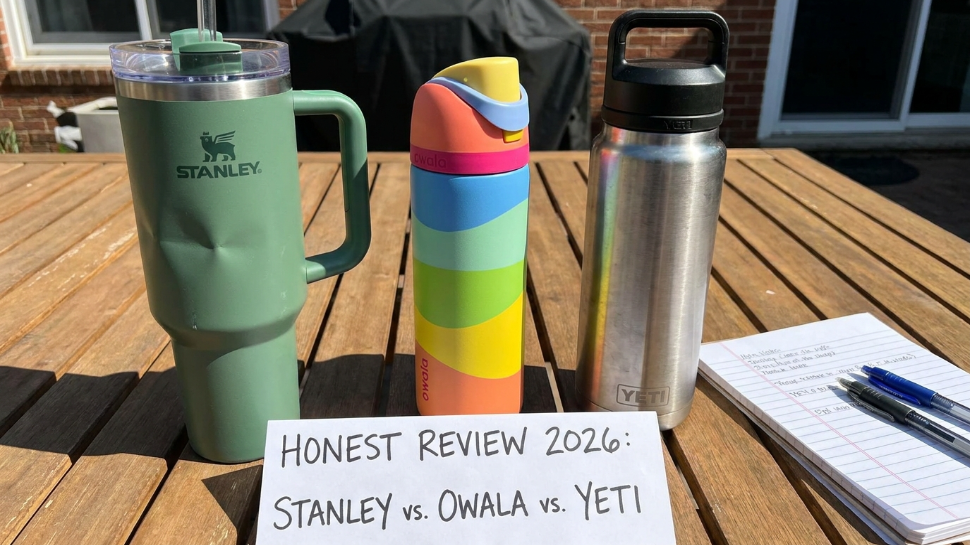
⚡ Top 3 Quick Picks — jump to all 4 bottles & prices ↓
Owala FreeSip 24oz
America’s #1 seller. 2-in-1 spout, lifetime warranty, best value.
Check Price
YETI Rambler 26oz
Best hot retention & leak resistance. Nearly indestructible.
Check Price
Stanley Quencher 30oz
Fits cupholders, side handle, 30+ colors, big capacity.
Check Price
The Big Four At a Glance
A note on the name: Hydro Flask is the brand’s own spelling, but it is very commonly written as one word, Hydroflask. Both refer to the same bottles, and this comparison uses the official two-word form throughout. If you have already narrowed it down to those two, we compare them head to head in Owala vs Hydro Flask.
Before going deep on each brand, here’s the head-to-head summary. All four use double-wall vacuum insulation, all four are sold in the same major retailers, and all four are stainless steel. The differences come down to lid design, warranty, leak resistance, and which trade-offs each brand prioritizes.
| Brand | Best For | Cold Retention | Hot Retention | Leak Resistance | Warranty | Approx Price |
|---|---|---|---|---|---|---|
| Owala FreeSip | Everyday users, drivers | Excellent (24+ hr) | Not recommended | Good (when locked) | Lifetime | $25-35 |
| YETI Rambler | Hot drinks, durability | Excellent (24+ hr) | Excellent (8+ hr) | Best in category | 5 years | $40-50 |
| Stanley Quencher | Capacity, style | Average | Below average | Poor (leaks when tipped) | Lifetime | $35-45 |
| Hydro Flask | Classic design, hikers | Reliable | Good | Varies by lid | Lifetime | $40-50 |
Owala FreeSip — The New #1
Best for: Daily commuters, drivers, anyone who wants flexibility between sipping and chugging
Standout feature: 2-in-1 spout with hidden straw and chug opening
Not for: Hot beverages, anyone wanting cupholder compatibility
Owala became America’s top-selling stainless steel water bottle in 2023 — overtaking Stanley despite a fraction of the marketing budget. The reason is in the lid. Press the button, the cap flips open, and you can either sip through the hidden straw or tilt back and chug through a separate opening. Lock it down with a satisfying click and the lid stays sealed.
The design solves two real problems. First, you can drink while driving without lifting the bottle to your face. Second, you can either take small sips at your desk or fast-chug after a workout, depending on what you need in the moment. Most bottles force you to choose one or the other.
The trade-offs:
- Not designed for hot drinks — pressure buildup can damage the bottle
- The spring-loaded lid can accidentally open if something presses the button in a bag
- Doesn’t fit standard cup holders (too wide)
- Optional silicone bottle boot ($7.99 extra) helps grip but adds cost
What you get right: Lifetime warranty, BPA-free materials, 24-hour cold retention, the highest customer satisfaction score among the four brands in independent testing, and the lowest price of the premium tier.
YETI Rambler — The Indestructible One
Best for: Hot drinks, outdoor use, people who’re rough on gear
Standout feature: Bombproof construction and best-in-class hot retention
Not for: Style-conscious daily users who want maximum lid features
YETI built its reputation on coolers that survive grizzly bears. The Rambler bottle line carries that same engineering DNA — virtually indestructible 18/8 stainless steel construction, thick walls, and a no-nonsense aesthetic. It’s the bottle you buy when you’ve broken too many cheaper ones.
In independent testing, YETI Rambler delivers the best leak resistance among the four — retains more than half its water when laid on its side, where Stanley loses most of its water within 30 seconds. It also dominates hot retention, keeping tea or coffee at hot temperature for 8+ hours where Stanley underperforms despite marketing for both.
The trade-offs:
- 5-year warranty (vs lifetime from Owala, Stanley, Hydro Flask)
- Heavier than Owala — noticeable in a bag or backpack
- No handle on most models — awkward to carry one-handed
- Less interesting visual design — premium understated, not trendy
- Most expensive at the entry size point
What you get right: Dishwasher-safe (one of the few in the category), exceptional durability, best hot retention, professional aesthetic that doesn’t go out of style.
Stanley Quencher H2.0 Flowstate — The Famous One
Best for: Cupholder users, large-capacity drinkers, people who love the style
Standout feature: 30+ color options and viral cultural cachet
Not for: Travel, leak-sensitive situations, anyone who needs hot retention
Stanley is the dominant name by sales volume, though its growth has slowed considerably as Owala has eaten into the market. The 30oz Quencher H2.0 Flowstate Tumbler is the model that launched a thousand TikToks — tapered bottom that fits car cupholders, side handle for one-handed carrying, integrated straw, and an enormous range of color drops and limited editions.
Stanley’s strength is style and capacity. The 30oz size genuinely holds enough water that most people only need to refill once a day. The handle is genuinely useful for carrying. The colors are genuinely beautiful. The bottle survived a car fire with ice still inside, in a now-legendary social media moment that did more for the brand than any ad campaign.
The trade-offs (and they’re real):
- Independent tests show below-average hot retention despite marketing as hot/cold capable
- Average cold retention — not better than cheaper alternatives
- Poor leak resistance — loses most of its water within 30 seconds when tipped on its side
- Larger and bulkier than competitors — barely fits some cupholders
- Premium pricing without premium performance in independent testing
What you get right: Lifetime warranty, fits cup holders, large capacity, side handle, and undeniable cultural moment. The trade-off is that you’re paying somewhat for the brand and the colors rather than measurably superior performance.
Hydro Flask Standard Mouth — The Classic
Best for: Existing Hydro Flask fans, hikers, simple design lovers
Standout feature: Broadest size range and proven reliability
Not for: Anyone who wants a built-in straw or modern lid design
Hydro Flask deserves credit for essentially starting the modern stainless steel water bottle category. Its 2018-2019 VSCO girl era turned insulated bottles into a fashion accessory, and the product itself — straightforward double-wall vacuum insulation, simple cap, powder-coated colors — became the template the rest of the industry copied.
What’s changed since then is competition. Hydro Flask’s market share has dipped meaningfully as Stanley and Owala captured the trend cycle and offered more lid innovation. The bottle itself isn’t worse than it was at its peak — it’s just no longer leading the category.
Why it still works:
- Broadest size range — from 12oz to 64oz, plus kids line
- Many cap options (straw, flex, sport, wide mouth)
- Lifetime warranty
- Solid reliable insulation
- Proven durability — many users still have 5+ year old bottles in use
The trade-offs:
- No built-in straw on standard mouth models — requires separate straw cap purchase
- Some users find cleaning the wide mouth + standard cap combination harder than Owala’s modular lid
- Visual identity hasn’t kept pace with Stanley/Owala color-drop strategy
- Standard mouth opening can spill when walking and drinking simultaneously
The honest take: Hydro Flask is a perfectly capable bottle that’s been outpaced on lid innovation. If you already own one and it works, there’s no functional reason to replace it. If you’re buying new in 2026, Owala or YETI offer better feature sets at similar prices.
Only deciding between two of them? The most common matchup by far is Owala against Hydro Flask, and it comes down to one question: whether you need hot drinks and a cup holder, or a straw and chug spout in one lid. We settle that pairing in detail in Owala vs Hydro Flask: which is better.
Head-to-Head: The Actual Tests
Marketing claims and independent test results often diverge. Here’s how the four brands actually perform across the metrics that matter, based on aggregated third-party testing data:
Insulation Tests
Cold retention (room temperature environment):
- Owala FreeSip: 33°F → 55.4°F over 24 hours ✅
- YETI Rambler: 32°F → 54.3°F over 24 hours ✅
- Hydro Flask: Reliable but slightly behind ✅
- Stanley Quencher: Average — not better than budget alternatives ⚠️
Hot retention (8 hours):
- YETI Rambler: Stays hot ✅ (best in test)
- Hydro Flask: Stays warm ✅
- Stanley Quencher: Below average ⚠️
- Owala FreeSip: Not designed for hot ❌
Leak Resistance Test (bottle tipped on side)
- YETI Rambler: Retains 50%+ of water ✅
- Owala FreeSip: Holds when locked, can flick water if button hit ⚠️
- Hydro Flask: Depends on cap — flex cap good, sport cap weaker
- Stanley Quencher: Loses most water within 30 seconds ❌
Cup Holder Compatibility
- Stanley Quencher: Yes (designed for it) ✅
- Hydro Flask: Slim line fits, standard mouth may not
- YETI Rambler: Most models fit
- Owala FreeSip: Generally too wide ❌
Ease of Cleaning
- YETI Rambler: Dishwasher-safe (best) ✅
- Owala FreeSip: Modular lid disassembles easily ✅
- Stanley Quencher: Lid dishwasher-safe top rack, body hand wash
- Hydro Flask: Wide mouth allows brush access, modular lids vary
For detailed cleaning protocols specific to each brand, see our complete stainless steel water bottle cleaning guide.
The Stanley Lead Controversy — Resolved, Finally
In January 2024, social media exploded with claims that Stanley cups contain lead. Home lead-testing kits showed positive results on Stanley bases. A consumer class-action lawsuit followed in February 2024. Multiple media cycles played out. Many users threw away their cups in fear.
Here’s what’s actually true:
Yes, Stanley uses lead in manufacturing. Specifically, a small lead pellet is used in the vacuum-sealing component at the base of the cup. This is actually an industry-standard manufacturing technique, used by multiple bottle brands historically. Stanley confirmed this in a January 2024 statement to TODAY.com.
No, the lead does not contact your drink or your hands in normal use. The lead pellet is fully encased in stainless steel under the base cap. Both the FDA-cited and EPA-cited testing confirmed that lead cannot migrate to the cup’s interior or exterior under normal use conditions. Independent expert Jack Caravanos (NYU School of Public Health) said on the TODAY show: “There really is practically zero risk of you ingesting any of the lead that’s in this cup.”
The home test kits people used are unreliable. The Consumer Product Safety Commission specifically noted that home lead-testing kits are designed for detecting lead on painted surfaces and produce unreliable readings on metal products. The CPSC has not recalled Stanley cups.
The lawsuit was dismissed in April 2026. A federal court in Washington ruled that “the presence of lead, alone, cannot be material to a reasonable consumer without a plausible safety risk.” Judge Lin’s order noted that consumer surveys showing buyers prefer “non-lead” products don’t establish legal materiality without actual harm. The case was dismissed without finding for the plaintiffs.
The one real risk: If the base cap of your Stanley physically falls off, the lead pellet could be exposed. Stanley honors a lifetime warranty replacement in this scenario. The risk is more relevant for children who might damage bottles than for adults using bottles normally.
Material Safety — BPA, Lead, Microplastics
Beyond the Stanley-specific lead question, here’s how the four brands compare on material safety across the categories that matter:
| Safety Factor | Owala | YETI | Stanley | Hydro Flask |
|---|---|---|---|---|
| BPA-free body | ✅ Yes | ✅ Yes | ✅ Yes | ✅ Yes |
| BPA-free lid components | ✅ Yes | ✅ Yes | ✅ Yes | ✅ Yes |
| Lead in manufacturing | No reported use | No reported use | Yes — sealed in base pellet | No reported use |
| Phthalate-free | ✅ Yes | ✅ Yes | ✅ Yes | ✅ Yes |
| Food-grade interior | 18/8 stainless | 18/8 stainless | Recycled stainless | Pro-grade stainless |
| Microplastic risk | Low (stainless body) | Low (stainless body) | Low (stainless body) | Low (stainless body) |
All four brands meet modern food-contact safety standards. The Stanley lead issue is real but contained — for non-Stanley bottles, there’s no significant material safety concern at this point. For PFAS in your actual water supply (a much bigger contamination issue than anything in the bottle itself), see our PFAS water filter guide.
Which Bottle Should You Actually Buy?
The “best” bottle depends entirely on your daily habits and priorities. Use this decision tree to narrow it down:
Pick: Owala FreeSip. The 2-in-1 spout lets you drink without removing it from your hand. Spring-loaded lid is easy to operate while keeping eyes on the road. Cold retention handles even a 2-hour commute.
Pick: YETI Rambler. Best hot retention in independent testing (8+ hours). Built for thermal use. Stanley underperforms here despite marketing — don’t fall for the convenience claim if hot drinks are your priority.
Pick: YETI Rambler or Hydro Flask. Both prioritize durability over lid innovation. YETI is virtually bombproof; Hydro Flask is lighter but still tough.
Pick: Owala FreeSip. Easy one-handed sipping while typing or in meetings. Lid stays closed when not in use. Doesn’t take up much desk space.
Pick: Owala FreeSip or Hydro Flask Kids line. Owala’s straw stays covered when closed — better hygiene than open-straw Stanley. Hydro Flask Kids offers age-appropriate sizing.
Pick: YETI Rambler. Best leak resistance — survives being tossed in a duffel bag. Easy to chug between sets.
Pick: Stanley Quencher. 30+ colors, limited edition drops, collaboration releases. If aesthetic matters most, Stanley still wins on visual variety.
Pick: Owala FreeSip. Cheapest of the four at $25-35 with lifetime warranty. Best price-to-performance ratio.
Pricing & Where to Buy
All four brands are widely available at major US retailers — Target, Walmart, Amazon, REI, Dick’s Sporting Goods, and the brands’ own websites. Approximate 2026 pricing:
| Brand & Size | Standard Price | Limited Editions | Best Deals |
|---|---|---|---|
| Owala FreeSip 24oz | $25-35 | $35-45 | Amazon, Owala holiday sales |
| Stanley Quencher 30oz | $35-45 | $45-80+ | Target weekly ad, Stanley sale events |
| Hydro Flask Standard 32oz | $40-50 | $45-55 | REI member events, REI Anniversary sale |
| YETI Rambler 26oz | $40-50 | $45-55 | Limited discounting; outdoor retailer sales |
Buy Each Bottle on Amazon
As an Amazon Associate we earn from qualifying purchases. If you buy through the links below, we may earn a small commission at no extra cost to you — it never affects our rankings.
Owala FreeSip 24oz
America’s #1 seller. 2-in-1 straw + chug spout, lifetime warranty, best price of the premium tier. The everyday winner for most people.
YETI Rambler 26oz
Best hot retention and best leak resistance in testing. Virtually indestructible, dishwasher-safe. The one to buy if you’re rough on gear.
Stanley Quencher H2.0 30oz
The viral one. Fits cupholders, side handle, 30+ colors, large capacity. Best if style and cupholder fit matter most to you.
Hydro Flask 32oz Wide Mouth
The original insulated bottle. Broadest size range, proven durability, leakproof Flex Cap, lifetime warranty. A reliable classic.
![Is Alkaline Water Good for You? [Benefits, Risks & Science]](https://completewaterguide.com/wp-content/uploads/2025/09/10-768x416.webp)
![Is Sparkling Water Good for You? [Benefits, Risks & Facts]](https://completewaterguide.com/wp-content/uploads/2025/09/6-768x416.webp)