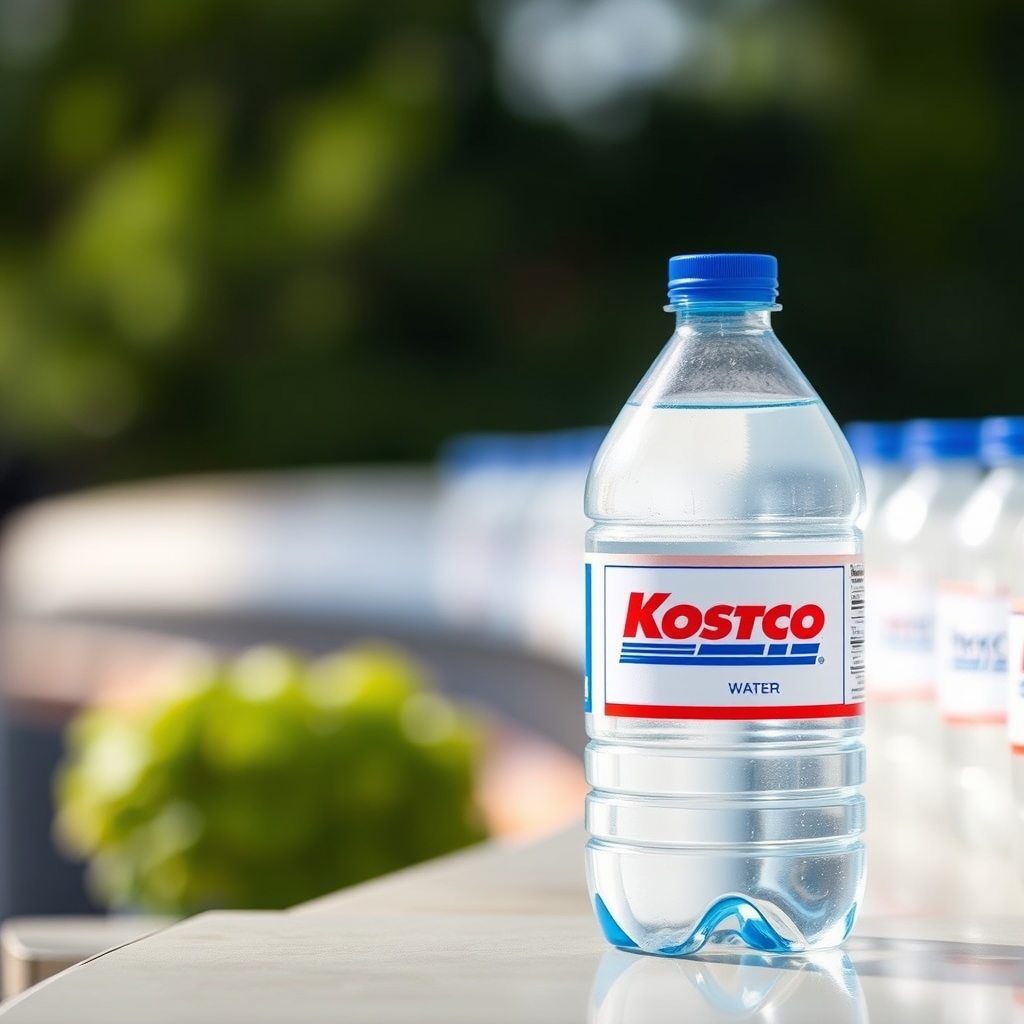
Quick Answer: Almost certainly trace amounts, but there is a catch: Kirkland Signature is a Costco store brand, not a single water. Its Purified Water is reverse-osmosis-treated municipal water — the same process that keeps Aquafina and Dasani near 0.4-0.5 ppt — so it should test similarly low. Its Premium Spring Water comes from natural springs with no RO step, which is the category that sometimes tests higher. Kirkland has not published independent PFAS results for either line, so specific numbers are not verifiable — but the purification method tells you which line is the safer bet.
The Key Distinction: Two Different Kirkland Waters
Most “does Kirkland water have PFAS” searches miss the single most important fact: Kirkland Signature bottles at least two distinct products, and they are made completely differently. Confusing them is the main reason there is so much conflicting information online.
| Kirkland Line | Source | Treatment | Likely PFAS risk |
|---|---|---|---|
| Purified Water | Municipal | Reverse osmosis | Low — RO removes PFAS |
| Premium Spring Water | Natural springs | Minimal (filtration only) | Higher — no RO step |
If your bottle says “Purified Water”, it went through reverse osmosis and belongs in the same low-PFAS group as Aquafina and Dasani. If it says “Premium Spring Water,” it is a natural spring product with no membrane step — the same category as Poland Spring, which tested at 1.66 ppt. For full brand context, see our Kirkland Signature water review.
What We Know — And What We Don’t
Here is the honest state of the evidence in 2026:
- No published independent PFAS test exists for either Kirkland line. The widely cited Consumer Reports analysis of 47 bottled waters did not include Kirkland Signature. That absence is why we cannot give you a hard number the way we can for Aquafina (0.5) or Poland Spring (1.66).
- Costco does publish water quality reports for its bottled water on request and in-warehouse, stating compliance with FDA and IBWA standards — but these do not typically break out total PFAS in parts per trillion.
- Kirkland Purified is co-packed by major bottlers using standard RO purification. Because RO removes 94-99% of PFAS regardless of the source municipality, the purified line is very likely in the same sub-1 ppt range as other RO brands.
So the honest answer is: the purified line is almost certainly low, the spring line is a question mark, and neither has a verified public number. Anyone claiming a precise Kirkland PFAS figure is extrapolating, not citing a test.
Why the Purification Method Is Your Best Guide
When a specific test does not exist, the treatment process is the most reliable predictor — and the pattern across every tested brand is consistent.
Reverse osmosis forces water through a membrane with pores around 0.0001 microns, physically smaller than PFAS molecules. Every RO-treated brand that has been tested — Essentia (0.2), Dasani (~0.4), Aquafina (~0.5) — came in under the 1 ppt scientist-recommended threshold. There is no strong reason Kirkland Purified, using the same process, would behave differently.
Spring water, by contrast, is typically only filtered for sediment and disinfected — no step that removes PFAS. That is why Poland Spring tested at 1.66 ppt and why several carbonated spring waters test higher still. Kirkland Premium Spring shares this vulnerability, though without a test we cannot say where in the range it falls.
How Kirkland Fits the Broader Rankings
| Brand | Total PFAS (ppt) | Type |
|---|---|---|
| Essentia | 0.2 | Purified (RO) |
| Dasani | ~0.4 | Purified (RO) |
| Aquafina | ~0.5 | Purified (RO) |
| Kirkland Purified | No published data (likely <1) | Purified (RO) |
| Kirkland Spring | No published data | Spring |
| Poland Spring | 1.66 | Spring |
Full rankings: Best Bottled Water Without PFAS and our complete bottled water rankings.
Which Kirkland Water Should You Buy?
If PFAS is your deciding factor, the choice within the Kirkland range is straightforward:
- Choose Kirkland Purified. The reverse osmosis process is the single most reliable PFAS-removal step in bottled water. Absent a specific test, this is the safer bet by a clear margin.
- Be cautious with Kirkland Spring. Not because it is known to be high — it is untested — but because the spring-water category as a whole is where the higher results have shown up. Untested plus higher-risk-category is a reason for caution, not alarm.
- Check the label every time. Costco has sold both lines, and packaging changes. The words “Purified” versus “Spring” on the front are the fastest read on likely PFAS risk.
Is 0.4-0.5 ppt (the Likely Range) Safe?
For the purified line, the likely range sits well under every current benchmark. The EPA legal limit is 4 ppt for individual regulated compounds, the industry voluntary standard is 5 ppt total, and even the strict scientist-recommended 1 ppt threshold would not be breached by a typical RO product. PFAS accumulate across food packaging, cookware, dust and tap water, so at sub-1 ppt, Kirkland Purified would be one of the smallest contributors to your total exposure.
The caveat remains that this is inference from process, not a lab result. If you want certainty rather than a well-founded estimate, the only route is home filtration with a verifiable output.
Want a Verified Number? Filter at Home
A certified NSF 53/58 filter gives you a testable result rather than an inferred one — and takes tap water below what most bottled brands measure at, for pennies per gallon. As an Amazon Associate we earn from qualifying purchases.
Clearly Filtered Pitcher
Tested against 365+ contaminants including PFOA and PFOS. A verifiable way to go below bottled-water PFAS levels at home.
For under-sink and RO options, see the best certified PFAS filters.
Frequently Asked Questions
Does Kirkland water have PFAS?
Neither Kirkland line has a published independent PFAS test. However, Kirkland Purified uses reverse osmosis, which removes 94-99% of PFAS, so it very likely tests under 1 ppt like other RO brands. Kirkland Premium Spring, with no RO step, belongs to the spring-water category where higher results have appeared.
Is Kirkland water just tap water?
Kirkland Purified starts as municipal water and is then treated with reverse osmosis and filtration, so it is purified rather than raw tap water. Kirkland Premium Spring comes from natural springs. They are two different products under the same brand.
Which Kirkland water is best for avoiding PFAS?
Kirkland Purified Water is the safer choice, because reverse osmosis is the most effective PFAS-removal step used in bottled water. The spring line lacks that step and is untested, making purified the lower-risk option.
Is Kirkland water safe to drink?
Yes. Both lines meet FDA and IBWA bottled water standards. The PFAS question is about optimising an already-safe product, not about a safety failure. For most people either line is fine; the purified line simply has a lower likely PFAS level.
Why is there no PFAS test for Kirkland?
Store brands are less frequently included in independent testing than national brands. The prominent Consumer Reports study tested 47 waters but did not include Kirkland Signature, so no widely cited number exists — only inference from its purification method.
Which bottled water has the lowest PFAS?
Among tested brands, Icelandic Glacial reported non-detect and Essentia measured 0.2 ppt. See the full PFAS-free bottled water rankings.
The Bottom Line
Kirkland Signature water almost certainly contains trace PFAS like nearly all bottled water, but the honest answer depends on which line you buy — and neither has a verified public number. Kirkland Purified, made with reverse osmosis, is very likely in the same sub-1 ppt range as Aquafina and Dasani and is the safer choice. Kirkland Premium Spring, drawn from natural springs with no RO step, sits in the higher-risk spring-water category, though it remains untested.
The practical rule is simple: read the front label, choose “Purified” over “Spring” if PFAS is your concern, and remember that no bottled brand gives you a number you can personally verify. For that, home filtration with a certified NSF 53/58 system is the only route to a result you can check yourself.
References
- Consumer Reports — Bottled Water PFAS Testing (47 products)
- EPA — PFAS National Primary Drinking Water Regulation (2024)
- FDA — PFAS in Food & Bottled Water
- International Bottled Water Association — Standards & PFAS Position
- Environmental Working Group — PFAS Contamination Map
Affiliate disclosure: as an Amazon Associate we earn from qualifying purchases. It never affects our rankings or the numbers we report.